
The role of sex hormones in neurological and functional recovery following spinal cord injury in females: a systematic review of the literature
IF 2.2
4区 医学
Q3 CLINICAL NEUROLOGY
引用次数: 0
Abstract
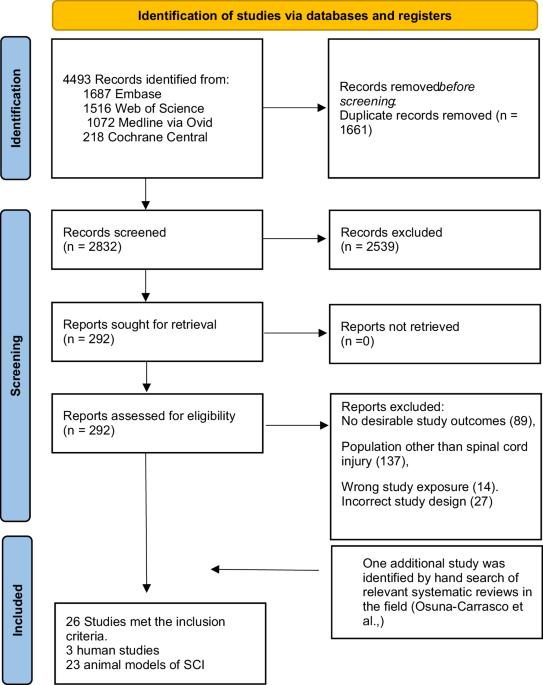
Systematic review. To synthesize human and animal evidence on the potential neuroprotective effects of sex hormones in women with spinal cord injury (SCI) and in female animal models, with the aim of comparing findings across experimental and clinical studies and identifying gaps in clinical research. EMBASE, Medline, Cochrane CENTRAL, and Web of Science were searched from inception to August 22, 2025, without language restrictions. Two reviewers independently performed study screening, data extraction, and risk of bias assessment. Of 2832 screened records, 26 studies were included (23 preclinical and 3 clinical). Human evidence was scarce and primarily addressed functional recovery after acute SCI, as well as cardiovascular risk factors and bone outcomes in small cohorts of pre- and postmenopausal women with chronic SCI. Preclinical studies consistently demonstrated broad neuroprotective effects of estradiol across multiple outcomes. Inhibition of estrogen synthesis with letrozole was associated with impaired motor recovery, while the presence of intact ovaries was linked to improved sensory outcomes, supporting a protective role of endogenous estrogens. Evidence for progesterone and dehydroepiandrosterone (DHEA) was mixed, although DHEA showed promising effects in two of three studies, including improved motor and sensory recovery and tissue preservation. This review highlights the therapeutic potential of sex hormones in SCI recovery while also revealing substantial gaps in human research. Future studies should investigate endogenous hormone profiles and hormone-based interventions during the acute and subacute phases of SCI to guide therapeutic development and bridge the gap between animal models and clinical practice.
性激素在女性脊髓损伤后神经和功能恢复中的作用:文献系统综述。
研究设计:系统评价。目的:综合性激素对脊髓损伤(SCI)女性和雌性动物模型的潜在神经保护作用的人类和动物证据,比较实验和临床研究结果,找出临床研究的空白。方法:检索EMBASE、Medline、Cochrane CENTRAL和Web of Science自成立至2025年8月22日,无语言限制。两名审稿人独立进行研究筛选、数据提取和偏倚风险评估。结果:在2832份筛选记录中,纳入26项研究(23项临床前研究,3项临床研究)。人类的证据很少,主要针对急性脊髓损伤后的功能恢复,以及绝经前和绝经后慢性脊髓损伤妇女的心血管危险因素和骨骼结局。临床前研究一致证明雌二醇在多种结果中具有广泛的神经保护作用。来曲唑抑制雌激素合成与运动恢复受损有关,而完整卵巢的存在与改善感觉结果有关,支持内源性雌激素的保护作用。黄体酮和脱氢表雄酮(DHEA)的证据好坏参半,尽管DHEA在三项研究中的两项显示出有希望的效果,包括改善运动和感觉恢复以及组织保存。结论:这篇综述强调了性激素在脊髓损伤恢复中的治疗潜力,同时也揭示了人类研究的实质性空白。未来的研究应该研究脊髓损伤急性和亚急性期的内源性激素特征和基于激素的干预措施,以指导治疗发展,弥合动物模型和临床实践之间的差距。
本文章由计算机程序翻译,如有差异,请以英文原文为准。
求助全文
约1分钟内获得全文
求助全文
来源期刊
Spinal cord
医学-临床神经学
CiteScore
4.50
自引率
9.10%
发文量
142
审稿时长
2 months
期刊介绍:
Spinal Cord is a specialised, international journal that has been publishing spinal cord related manuscripts since 1963. It appears monthly, online and in print, and accepts contributions on spinal cord anatomy, physiology, management of injury and disease, and the quality of life and life circumstances of people with a spinal cord injury. Spinal Cord is multi-disciplinary and publishes contributions across the entire spectrum of research ranging from basic science to applied clinical research. It focuses on high quality original research, systematic reviews and narrative reviews.
Spinal Cord''s sister journal Spinal Cord Series and Cases: Clinical Management in Spinal Cord Disorders publishes high quality case reports, small case series, pilot and retrospective studies perspectives, Pulse survey articles, Point-couterpoint articles, correspondences and book reviews. It specialises in material that addresses all aspects of life for persons with spinal cord injuries or disorders. For more information, please see the aims and scope of Spinal Cord Series and Cases.
 求助内容:
求助内容: 应助结果提醒方式:

 京公网安备 11010802042870号


