Can Yang, Bingyuan Dai, Minxuan Wang, Hui Xu, Hongbing Zheng, Cheng Ma, Licheng Ling, Jitong Wang
{"title":"Engineering highly-exposed nickel nanoparticles within a nitrogen-doped carbon matrix for efficient CO2 electroreduction to CO","authors":"Can Yang, Bingyuan Dai, Minxuan Wang, Hui Xu, Hongbing Zheng, Cheng Ma, Licheng Ling, Jitong Wang","doi":"10.1007/s11705-026-2668-0","DOIUrl":null,"url":null,"abstract":"<div><p>Ni single-atom catalysts have been widely explored for CO<sub>2</sub> reduction, however, their practical application is often hampered by complex synthesis and instability at high current densities. In this context, well-dispersed nickel nanoparticles present a compelling alternative, offering both facile fabrication and robust performance. Herein, a hierarchical catalyst comprising nickel nanoparticles encapsulated within a nitrogen-doped carbon shell on a hollow-rod carbon substrate (denoted as Ni<sub>NP</sub>-BCN@C) was designed. The hollow-rod architecture maximizes the exposure of nickel nanoparticles as active sites, while the nitrogen-doped carbon shell effectively modulates the electronic environment of the metallic Ni, suppressing the competing hydrogen evolution reaction and promoting CO<sub>2</sub> activation. The catalyst exhibits exceptional CO<sub>2</sub>-to-CO conversion, with a Faradaic efficiency exceeding 90% at −0.83 V <i>vs.</i> RHE in an H-cell and remarkable stability over 32 h. When evaluated in a flow-cell configuration, it achieves a CO Faradaic efficiency > 98% at a current density of 300 mA·cm<sup>−2</sup>, corresponding to a high turnover frequency of ∼93,579 h<sup>−1</sup>. <i>In situ</i> Fourier transform infrared spectroscopy revealed intensified bands for key intermediates (*COOH and COO<sup>−</sup>), confirming enhanced CO<sub>2</sub> adsorption and activation. This work showcases a scalable and efficient catalyst design, highlighting the synergy between structural engineering and electronic modulation for advanced CO<sub>2</sub> electroreduction.</p><div><figure><div><div><picture><source><img></source></picture></div></div></figure></div></div>","PeriodicalId":571,"journal":{"name":"Frontiers of Chemical Science and Engineering","volume":"20 7","pages":""},"PeriodicalIF":4.2000,"publicationDate":"2026-04-02","publicationTypes":"Journal Article","fieldsOfStudy":null,"isOpenAccess":false,"openAccessPdf":"","citationCount":"0","resultStr":null,"platform":"Semanticscholar","paperid":null,"PeriodicalName":"Frontiers of Chemical Science and Engineering","FirstCategoryId":"5","ListUrlMain":"https://link.springer.com/article/10.1007/s11705-026-2668-0","RegionNum":3,"RegionCategory":"工程技术","ArticlePicture":[],"TitleCN":null,"AbstractTextCN":null,"PMCID":null,"EPubDate":"","PubModel":"","JCR":"Q2","JCRName":"ENGINEERING, CHEMICAL","Score":null,"Total":0}
引用次数: 0
Abstract
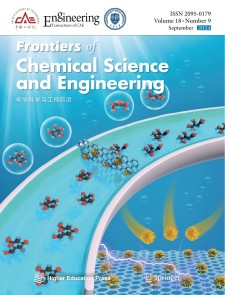
Ni single-atom catalysts have been widely explored for CO2 reduction, however, their practical application is often hampered by complex synthesis and instability at high current densities. In this context, well-dispersed nickel nanoparticles present a compelling alternative, offering both facile fabrication and robust performance. Herein, a hierarchical catalyst comprising nickel nanoparticles encapsulated within a nitrogen-doped carbon shell on a hollow-rod carbon substrate (denoted as NiNP-BCN@C) was designed. The hollow-rod architecture maximizes the exposure of nickel nanoparticles as active sites, while the nitrogen-doped carbon shell effectively modulates the electronic environment of the metallic Ni, suppressing the competing hydrogen evolution reaction and promoting CO2 activation. The catalyst exhibits exceptional CO2-to-CO conversion, with a Faradaic efficiency exceeding 90% at −0.83 V vs. RHE in an H-cell and remarkable stability over 32 h. When evaluated in a flow-cell configuration, it achieves a CO Faradaic efficiency > 98% at a current density of 300 mA·cm−2, corresponding to a high turnover frequency of ∼93,579 h−1. In situ Fourier transform infrared spectroscopy revealed intensified bands for key intermediates (*COOH and COO−), confirming enhanced CO2 adsorption and activation. This work showcases a scalable and efficient catalyst design, highlighting the synergy between structural engineering and electronic modulation for advanced CO2 electroreduction.
期刊介绍:
Frontiers of Chemical Science and Engineering presents the latest developments in chemical science and engineering, emphasizing emerging and multidisciplinary fields and international trends in research and development. The journal promotes communication and exchange between scientists all over the world. The contents include original reviews, research papers and short communications. Coverage includes catalysis and reaction engineering, clean energy, functional material, nanotechnology and nanoscience, biomaterials and biotechnology, particle technology and multiphase processing, separation science and technology, sustainable technologies and green processing.

 求助内容:
 应助结果提醒方式:


 京公网安备 11010802042870号


