
Emerging roles of mesoporous silica nanoparticles in personalized medicine: revolutionizing therapy and diagnosis — a comprehensive review

IF 7.9 Q1 ENGINEERING, MULTIDISCIPLINARY
Adel Mahmoudi Gharehbaba , Fatemeh Soltanmohammadi , Morteza Eskandani , Khosro Adibkia
{"title":"Emerging roles of mesoporous silica nanoparticles in personalized medicine: revolutionizing therapy and diagnosis — a comprehensive review","authors":"Adel Mahmoudi Gharehbaba ,&nbsp;Fatemeh Soltanmohammadi ,&nbsp;Morteza Eskandani ,&nbsp;Khosro Adibkia","doi":"10.1016/j.rineng.2026.110396","DOIUrl":null,"url":null,"abstract":"<div><div>Personalized medicine represents a novel strategy in modern healthcare, emphasizing the customization of treatments to align with the unique genetic, molecular, and clinical profiles of individual patients. This review explores the intersection of personalized medicine and nanotechnology, with a particular focus on mesoporous silica nanoparticles (MSNs) as versatile platforms for precision applications. Owing to their high surface area, tunable pore architecture, and flexible surface functionalization, MSNs offer distinct advantages over conventional nanocarriers, enabling high drug-loading capacity, controlled release, and multifunctional integration. Recent advances highlight the use of MSNs in personalized cancer therapy, including targeted drug delivery, gene and gene-silencing co-delivery, and combination treatment strategies, as well as in diagnostics, biosensing, imaging, and theranostic systems. The integration of MSNs with molecular targeting ligands and imaging modalities further enables real-time monitoring of therapeutic responses and adaptive treatment optimization. In addition to summarizing emerging and transformative MSN-based applications, this review also discusses key challenges for clinical translation, including biosafety, scalable manufacturing, and regulatory considerations. Overall, MSNs are presented as a promising and evolving nanoplatform with the potential to revolutionize personalized diagnosis and therapy.</div></div>","PeriodicalId":36919,"journal":{"name":"Results in Engineering","volume":"30 ","pages":"Article 110396"},"PeriodicalIF":7.9000,"publicationDate":"2026-04-04","publicationTypes":"Journal Article","fieldsOfStudy":null,"isOpenAccess":false,"openAccessPdf":"","citationCount":"0","resultStr":null,"platform":"Semanticscholar","paperid":null,"PeriodicalName":"Results in Engineering","FirstCategoryId":"1085","ListUrlMain":"https://www.sciencedirect.com/science/article/pii/S2590123026014301","RegionNum":0,"RegionCategory":null,"ArticlePicture":[],"TitleCN":null,"AbstractTextCN":null,"PMCID":null,"EPubDate":"","PubModel":"","JCR":"Q1","JCRName":"ENGINEERING, MULTIDISCIPLINARY","Score":null,"Total":0}
引用次数: 0

Abstract

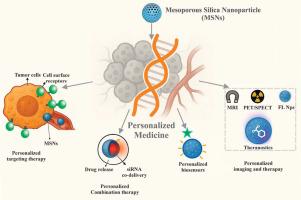
Personalized medicine represents a novel strategy in modern healthcare, emphasizing the customization of treatments to align with the unique genetic, molecular, and clinical profiles of individual patients. This review explores the intersection of personalized medicine and nanotechnology, with a particular focus on mesoporous silica nanoparticles (MSNs) as versatile platforms for precision applications. Owing to their high surface area, tunable pore architecture, and flexible surface functionalization, MSNs offer distinct advantages over conventional nanocarriers, enabling high drug-loading capacity, controlled release, and multifunctional integration. Recent advances highlight the use of MSNs in personalized cancer therapy, including targeted drug delivery, gene and gene-silencing co-delivery, and combination treatment strategies, as well as in diagnostics, biosensing, imaging, and theranostic systems. The integration of MSNs with molecular targeting ligands and imaging modalities further enables real-time monitoring of therapeutic responses and adaptive treatment optimization. In addition to summarizing emerging and transformative MSN-based applications, this review also discusses key challenges for clinical translation, including biosafety, scalable manufacturing, and regulatory considerations. Overall, MSNs are presented as a promising and evolving nanoplatform with the potential to revolutionize personalized diagnosis and therapy.
Abstract Image

介孔二氧化硅纳米颗粒在个性化医疗中的新兴作用:革命性的治疗和诊断-全面回顾
个性化医疗代表了现代医疗保健中的一种新策略,强调根据个体患者独特的遗传、分子和临床特征定制治疗。这篇综述探讨了个性化医疗和纳米技术的交叉,特别关注介孔二氧化硅纳米颗粒(MSNs)作为精密应用的通用平台。由于其高表面积、可调节的孔隙结构和灵活的表面功能化,msn比传统的纳米载体具有明显的优势,能够实现高载药能力、控释和多功能集成。最近的进展突出了msn在个性化癌症治疗中的应用,包括靶向药物递送、基因和基因沉默共同递送、联合治疗策略,以及诊断、生物传感、成像和治疗系统。msn与分子靶向配体和成像模式的整合进一步实现了治疗反应的实时监测和自适应治疗优化。除了总结新兴的和变革性的基于msn的应用之外,本综述还讨论了临床翻译的关键挑战,包括生物安全、可扩展制造和监管考虑。总的来说,msn被认为是一个有前途的和不断发展的纳米平台,具有彻底改变个性化诊断和治疗的潜力。
本文章由计算机程序翻译,如有差异,请以英文原文为准。
求助全文
约1分钟内获得全文 求助全文
来源期刊
Results in Engineering
Results in Engineering Engineering-Engineering (all)
CiteScore
5.80
自引率
34.00%
发文量
441
审稿时长
47 days

×
引用
GB/T 7714-2015
复制
MLA
复制
APA
复制
导出至
BibTeX EndNote RefMan NoteFirst NoteExpress
×
提示
您的信息不完整,为了账户安全,请先补充。
现在去补充
×
提示
您因"违规操作"
具体请查看互助需知
我知道了
×
提示
确定
请完成安全验证×
copy
已复制链接
快去分享给好友吧!
我知道了
右上角分享
点击右上角分享
0
联系我们:info@booksci.cn Book学术提供免费学术资源搜索服务,方便国内外学者检索中英文文献。致力于提供最便捷和优质的服务体验。 Copyright © 2023 布克学术 All rights reserved.
京ICP备2023020795号-1
ghs 京公网安备 11010802042870号
Book学术文献互助
Book学术文献互助群
群 号:604180095
Book学术官方微信
小红书


