
Consideration for HPV vaccination recommendations in patients with vulvar dysplasia and malignancy following resection: A retrospective study investigating rural-urban vaccination practices in patients served by an academic medical center in the heartland
IF 1.5
Q3 OBSTETRICS & GYNECOLOGY
Gynecologic Oncology Reports
Pub Date : 2026-04-01
Epub Date: 2026-03-27
DOI:10.1016/j.gore.2026.102067
引用次数: 0
Abstract
Objectives
The American College of Obstetricians and Gynecologists (ACOG) recommends the HPV vaccine for unvaccinated or incompletely vaccinated individuals as an adjuvant treatment for cervical intraepithelial neoplasia (CIN) 2 + . Due to no such recommendation for adjuvant HPV vaccination for patients with vulvar intraepithelial neoplasia (VIN) 2 + after resection, and due to the large catchment area of our institution comprising rural and urban patient populations, which are disproportionately affected by HPV-associated cancers, we examined HPV vaccination uptake in patients with VIN2 + and vulvar malignancy and assessed relationships between social vulnerability and rurality.
Methods
We performed a retrospective analysis of patients treated between 2018 and 2023 at a single Midwestern academic medical center. The study analyzed clinical and demographic data along with the associated social vulnerability index (SVI) and Rural-Urban Commuting Area (RUCA) codes.
Results
Two hundred three unique patients met inclusion criteria. Of these, 36.5% (n = 74) lived in non-urban areas and 63.5% (n = 129) lived in urban areas. In the population of patients younger than 45 years of age who were not vaccinated for HPV prior to their VIN2 + diagnosis and treatment (n = 31), only 19.4% (n = 6) received at least one dose of the HPV vaccine in the adjuvant setting. Social vulnerability in housing and transportation was greatest in those living in rural areas.
Conclusions
Extending the ACOG 2023 practice advisory recommendation for adjuvant HPV vaccination after excisional procedures for CIN2 + to encompass patients treated for VIN2 + may help reduce the burden of HPV-associated cancers.
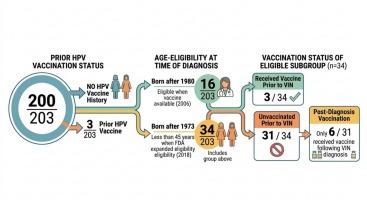
考虑外阴发育不良和恶性肿瘤切除术后患者的HPV疫苗接种建议:一项回顾性研究调查农村-城市疫苗接种实践在心脏地带的学术医疗中心服务的患者
目的美国妇产科医师学会(ACOG)推荐未接种或未完全接种HPV疫苗的个体接种HPV疫苗,作为宫颈上皮内瘤变(CIN) 2 +的辅助治疗。由于对于外阴上皮内瘤变(VIN) 2 +切除后患者没有这样的辅助HPV疫苗接种建议,并且由于我们机构的大集水区包括农村和城市患者人群,这些人群受到HPV相关癌症的不成比例的影响,我们检查了VIN2 +和外阴恶性肿瘤患者的HPV疫苗接种情况,并评估了社会脆弱性与农村之间的关系。方法对2018年至2023年在中西部某学术医疗中心接受治疗的患者进行回顾性分析。该研究分析了临床和人口统计数据以及相关的社会脆弱性指数(SVI)和城乡通勤区(RUCA)代码。结果203例患者符合纳入标准。其中,36.5% (n = 74)居住在非城市地区,63.5% (n = 129)居住在城市地区。在年龄小于45岁且在诊断和治疗前未接种HPV疫苗的患者人群中(n = 31),只有19.4% (n = 6)在佐剂设置中接受了至少一剂HPV疫苗。居住在农村地区的人在住房和交通方面的社会脆弱性最大。结论扩展ACOG 2023实践咨询建议,在CIN2 +切除手术后进行辅助HPV疫苗接种,以涵盖接受VIN2 +治疗的患者,可能有助于减轻HPV相关癌症的负担。
本文章由计算机程序翻译,如有差异,请以英文原文为准。
求助全文
约1分钟内获得全文
求助全文
来源期刊

Gynecologic Oncology Reports
OBSTETRICS & GYNECOLOGY-
CiteScore
2.00
自引率
0.00%
发文量
183
审稿时长
41 days
期刊介绍:
Gynecologic Oncology Reports is an online-only, open access journal devoted to the rapid publication of narrative review articles, survey articles, case reports, case series, letters to the editor regarding previously published manuscripts and other short communications in the field of gynecologic oncology. The journal will consider papers that concern tumors of the female reproductive tract, with originality, quality, and clarity the chief criteria of acceptance.
 求助内容:
求助内容: 应助结果提醒方式:

 京公网安备 11010802042870号


