
Conversion of cow dung into high-performance biochar for efficient adsorptive removal of methyl red from aqueous solutions: Kinetic, isotherm, and mechanistic insights
IF 1.3
4区 化学
Q4 CHEMISTRY, ANALYTICAL
Chinese Journal of Analytical Chemistry
Pub Date : 2026-04-01
Epub Date: 2026-02-26
DOI:10.1016/j.cjac.2026.100718
引用次数: 0
Abstract
This study aimed to evaluate the effectiveness of biochar derived from cow dung in removing methyl red (MR) from aqueous solutions. The prepared biochar was alkaline in nature with a carbon content of 58.34 % and a specific surface area of 455.5 m2 g−1. Adsorption behavior of MR onto cow dung derived biochar was examined under varying experimental conditions, including contact time, adsorbent dosage, initial pH, and initial dye concentration. The results demonstrated that an equilibration time of 40 min, an adsorbent dose of 0.5 g, and an initial pH of 3 constituted the optimal conditions for MR removal. Increasing the initial dye concentrations from 25 mg L−1 to 200 mg L−1 led to a decrease in removal efficiency. Equilibrium data were best described by the Freundlich isotherm model (r2 = 0.958), indicating heterogeneous surface characteristics and multilayer adsorption. The pseudo-second-order kinetic model provided the best fit across all tested concentrations (r2 > 0.986), suggesting that chemisorption governs the adsorption process. The adsorption intensity (1/n = 0.18) and the dimensionless constant parameter (RL = 0) further confirmed the favorability of the adsorption. Additionally, the D–R isotherm-derived free energy value (E = 60 kJ mol−1) supports the predominance of chemical adsorption mechanisms. Overall, the cow-dung-based biochar proved to be a cost-effective and efficient adsorbent for MR dye removal. Its performance indicates strong potential for application in the treatment of textile dye-contaminated wastewater in industrial settings.
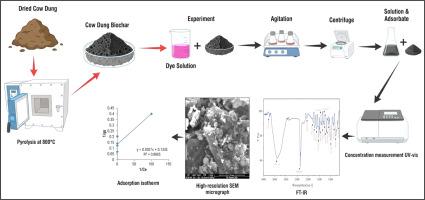
牛粪转化为高效吸附去除水溶液中甲基红的高性能生物炭:动力学,等温线和机理见解
本研究旨在评价牛粪生物炭去除水溶液中甲基红(MR)的效果。制备的生物炭为碱性,碳含量为58.34%,比表面积为455.5 m2 g−1。在不同的实验条件下,包括接触时间、吸附剂用量、初始pH和初始染料浓度,研究了MR在牛粪生物炭上的吸附行为。结果表明,平衡时间为40 min,吸附剂剂量为0.5 g,初始pH为3是MR去除的最佳条件。当染料初始浓度从25 mg L−1增加到200 mg L−1时,去除率降低。Freundlich等温线模型(r2 = 0.958)最能描述平衡数据,表明其表面具有非均匀性和多层吸附特性。拟二级动力学模型在所有测试浓度下的拟合效果最好(r2 > 0.986),表明化学吸附控制了吸附过程。吸附强度(1/n = 0.18)和无量纲常数参数(RL = 0)进一步证实了吸附的有利性。此外,D-R等温线推导的自由能值(E = 60 kJ mol−1)支持化学吸附机制的优势。总的来说,牛粪基生物炭被证明是一种经济有效的MR染料去除吸附剂。它的性能表明在工业环境中处理纺织染料污染废水具有很大的应用潜力。
本文章由计算机程序翻译,如有差异,请以英文原文为准。
求助全文
约1分钟内获得全文
求助全文
来源期刊
CiteScore
3.60
自引率
25.00%
发文量
17223
审稿时长
35 days
期刊介绍:
Chinese Journal of Analytical Chemistry(CJAC) is an academic journal of analytical chemistry established in 1972 and sponsored by the Chinese Chemical Society and Changchun Institute of Applied Chemistry, Chinese Academy of Sciences. Its objectives are to report the original scientific research achievements and review the recent development of analytical chemistry in all areas. The journal sets up 5 columns including Research Papers, Research Notes, Experimental Technique and Instrument, Review and Progress and Summary Accounts. The journal published monthly in Chinese language. A detailed abstract, keywords and the titles of figures and tables are provided in English, except column of Summary Accounts. Prof. Wang Erkang, an outstanding analytical chemist, academician of Chinese Academy of Sciences & Third World Academy of Sciences, holds the post of the Editor-in-chief.
 求助内容:
求助内容: 应助结果提醒方式:

 京公网安备 11010802042870号


