
Microbiological research progress on greenhouse gas emissions in lakes of the Tibetan Plateau
Watershed Ecology and the Environment
Pub Date : 2026-01-01
Epub Date: 2026-03-30
DOI:10.1016/j.wsee.2026.03.001
引用次数: 0
Abstract
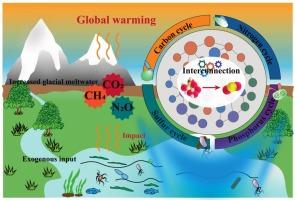
In recent years, under the influence of climate warming, lakes have rapidly expanded, becoming a hotspot environment for studying the biogeochemical cycles of elements such as carbon, nitrogen and sulfur. Microorganisms tightly couple the carbon, nitrogen, phosphorus and sulfur cycles, jointly regulating the source-sink patterns of greenhouse gases like CO2, CH4 and N2O. However, how these processes interact and network in the complex natural environment, and how they jointly regulate the overall mechanism of greenhouse gas emissions, remain the forefront and key challenges of research. This review highlights the substantial spatiotemporal heterogeneity of lake greenhouse gas emissions, revealing profound influences from lake type, ice cover duration and seasonal pulse emissions on flux dynamics. At the molecular level, it elucidates the core driving role of microorganisms, including photosynthetic and chemotrophic autotrophic carbon fixation, heterotrophic decomposition of organic matter, methanogenesis/methanotrophy, and denitrification coupled with nitrogen-sulfur cycling, emphasizing the indicative significance of key functional genes. The review dissected how the availability of biogenic elements (carbon, nitrogen, phosphorus, sulfur) and their coupling relationships shape carbon cycling pathways by regulating microbial communities and activity. It assessed how climate change reconfigures lake carbon source-sink functions by altering physicochemical conditions and material inputs. Findings indicate that carbon cycling in Tibetan Plateau lakes constitutes a dynamically balanced process mediated by microorganisms and regulated by multi-element coupling. Thermophilic lakes serve as critical hotspots for activating ancient permafrost carbon and releasing substantial CH4. Climate change may enhance primary production by extending growing seasons, yet simultaneously intensifies organic matter decomposition and greenhouse gas production through warming, increased external carbon inputs, and salinity changes. This dual effect risks transforming the system into a net carbon source, creating a positive feedback loop that exacerbates warming. We must develop integrated biogeochemical models that incorporate microbial mechanisms and multi-factor coupling. Based on these models, differentiated management strategies should be implemented to suppress emission hotspots, thereby providing critical scientific support and management solutions for regional green development and global carbon neutrality.
青藏高原湖泊温室气体排放微生物学研究进展
近年来,在气候变暖的影响下,湖泊规模迅速扩大,成为研究碳、氮、硫等元素生物地球化学循环的热点环境。微生物紧密耦合碳、氮、磷和硫循环,共同调节CO2、CH4和N2O等温室气体的源汇模式。然而,这些过程如何在复杂的自然环境中相互作用和相互作用,以及它们如何共同调节温室气体排放的整体机制,仍然是研究的前沿和关键挑战。湖泊温室气体排放具有明显的时空异质性,揭示了湖泊类型、冰盖持续时间和季节性脉冲排放对通量动态的深刻影响。在分子水平上,阐明了微生物的核心驱动作用,包括光合和化养自养固碳、有机质异养分解、产甲烷/产甲烷以及氮硫循环耦合的反硝化作用,强调了关键功能基因的指示意义。这篇综述剖析了生物源元素(碳、氮、磷、硫)的有效性及其耦合关系如何通过调节微生物群落和活动来塑造碳循环途径。它评估了气候变化如何通过改变物理化学条件和物质输入来重新配置湖泊碳源-汇功能。结果表明,青藏高原湖泊碳循环是一个由微生物介导、多元素耦合调控的动态平衡过程。嗜热湖泊是激活古冻土碳和释放大量CH4的关键热点。气候变化可能通过延长生长季节来提高初级生产,但同时通过变暖、外部碳输入增加和盐度变化加剧有机质分解和温室气体产生。这种双重效应有可能将气候系统转变为净碳源,形成一个加剧变暖的正反馈循环。我们必须建立集成微生物机制和多因素耦合的生物地球化学模型。在此基础上,实施差别化管理策略,抑制排放热点,为区域绿色发展和全球碳中和提供关键的科学支撑和管理方案。
本文章由计算机程序翻译,如有差异,请以英文原文为准。
求助全文
约1分钟内获得全文
求助全文

 求助内容:
求助内容: 应助结果提醒方式:

 京公网安备 11010802042870号


