
Synthesis of 2-aryl substituted benzimidazoles as bifunctional agents combining antiparasitic activity with radical-scavenging properties against Trichinella infection
IF 4
Q2 BIOTECHNOLOGY & APPLIED MICROBIOLOGY
Current Research in Biotechnology
Pub Date : 2026-01-01
Epub Date: 2026-04-02
DOI:10.1016/j.crbiot.2026.100383
引用次数: 0
Abstract
Purpose
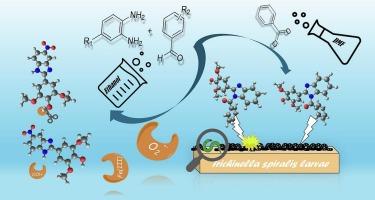
The aim of this research was to synthesize a series of 2-arylbenzimidazoles and evaluate their anti-Trichinella activity and free radical scavenging potential.
Methods
Three complementary synthetic approaches were applied, and structures were confirmed by spectroscopic methods and DFT calculations. Biological evaluation included an in vitro anti-Trichinella spiralis (T. spiralis) assay, in vitro tubulin polymerization study, antioxidant assays (superoxide anion radical scavenging, ferric reducing capacity and suppression of AAPH-induced oxidative damage of lecithin and deoxyribose), and cytotoxicity testing in BJ human fibroblasts using the MTT assay. In silico methods were used to predict lipophilicity and other physicochemical parameters for evaluating the expected bioavailability and drug-likeness.
Results
The compounds exhibited pronounced in vitro larvicidal activity against T. spiralis muscle larvae. At 100 μg/mL after 48 h, 4aA and its 5(6)-nitro analogue 4cA showed high efficacy (81.5% and 80.2%, respectively), while compound 5 demonstrated the strongest effect (95.7%). In tubulin polymerization assays, 4aA slightly reduced the polymerization rate compared to control, whereas 4cA and 5 significantly enhanced it. Antioxidant activity, including radical scavenging and ferric-reducing capacity, correlated with the observed anthelmintic effects. The presence of a 4-hydroxy-3,5-dimethoxyphenyl moiety contributed to both biological activities. The deoxyribose model showed the strongest consistency in the observed activities, with compound 5 displaying superior capacity to prevent oxidative degradation.
Conclusion
Compound 5 stands out as a promising lead for further investigation against T. spiralis.
2-芳基取代苯并咪唑的合成,结合抗寄生虫和清除旋毛虫感染自由基的特性
目的合成一系列2-芳基苯并咪唑,并评价其抗旋毛虫活性和自由基清除能力。方法采用三种互补的合成方法,通过光谱方法和DFT计算确定结构。生物学评价包括体外抗旋毛虫(T. spiralis)实验、体外微管蛋白聚合实验、抗氧化实验(清除超氧阴离子自由基、铁还原能力和抑制aaph诱导的卵磷脂和脱氧核糖氧化损伤),以及MTT法对BJ人成纤维细胞的细胞毒性实验。采用计算机方法预测亲脂性和其他物理化学参数,以评估预期的生物利用度和药物相似性。结果化合物对螺旋体幼虫有明显的体外杀虫活性。在100 μg/mL作用48 h时,4aA及其5(6)-硝基类似物4cA的药效最高(分别为81.5%和80.2%),其中化合物5的药效最强(95.7%)。在微管蛋白聚合实验中,与对照组相比,4aA略微降低了聚合速率,而4cA和5显著提高了聚合速率。抗氧化活性,包括自由基清除和铁还原能力,与观察到的驱虫作用相关。4-羟基-3,5-二甲氧基苯基部分的存在有助于这两种生物活性。脱氧核糖模型在观察到的活性中表现出最强的一致性,化合物5表现出更强的抗氧化降解能力。结论化合物5对螺旋螺旋体的进一步研究具有重要意义。
本文章由计算机程序翻译,如有差异,请以英文原文为准。
求助全文
约1分钟内获得全文
求助全文
来源期刊

Current Research in Biotechnology
Biochemistry, Genetics and Molecular Biology-Biotechnology
CiteScore
6.70
自引率
3.60%
发文量
50
审稿时长
38 days
期刊介绍:
Current Research in Biotechnology (CRBIOT) is a new primary research, gold open access journal from Elsevier. CRBIOT publishes original papers, reviews, and short communications (including viewpoints and perspectives) resulting from research in biotechnology and biotech-associated disciplines.
Current Research in Biotechnology is a peer-reviewed gold open access (OA) journal and upon acceptance all articles are permanently and freely available. It is a companion to the highly regarded review journal Current Opinion in Biotechnology (2018 CiteScore 8.450) and is part of the Current Opinion and Research (CO+RE) suite of journals. All CO+RE journals leverage the Current Opinion legacy-of editorial excellence, high-impact, and global reach-to ensure they are a widely read resource that is integral to scientists' workflow.
 求助内容:
求助内容: 应助结果提醒方式:

 京公网安备 11010802042870号


