
Application of glutamate: Up-regulation of GLUTAMATE RECEPTOR-LIKE genes enhances biosynthesis of the aroma 2-acetyl-1-pyrroline in rice under arsenic-induced stress
IF 5.7
2区 生物学
Q1 PLANT SCIENCES
Plant Physiology and Biochemistry
Pub Date : 2026-04-01
Epub Date: 2026-04-06
DOI:10.1016/j.plaphy.2026.111280
引用次数: 0
Abstract
GLUTAMATE RECEPTOR-LIKE (GLR) channels respond to heavy metals, whose genes are potentially activated by glutamate (Glu) solution. Glu contributes to the 2-acetyl-1-pyrroline (2AP) formation and provides arsenic (As) stress tolerance in fragrant rice, but the regulatory mechanism remains elusive. A three-factor randomized block experiment of glutamic acid (Glu) and 6,7-dinitroquinoxaline-2,3-dione (DNQX, GLRs antagonist) under non-As and As stress for non-fragrant and fragrant rice was conducted. Comprehensive enzymatic, metabolite, and transcriptomic profiling, and genetic experiments revealed that exogenous Glu treatment up-regulated GLRs and improved 2AP content by 17.2% under As stress. Ornithine and glutamine in 2AP biosynthesis increased by 0.4-8.3-fold, while the activities of glutamine synthetase and proline dehydrogenase increased by 10.4% and 10.7%, respectively. In addition, GSH1 and G6PD2 in glutathione metabolism were up-regulated to balance the reduced/oxidized glutathione that inhibited transport of As from roots to shoots by 17.6%. Multivariate analysis revealed that the activities of glutathione S-transferase, glutamine synthetase activity, the transcription levels of DAO4, and GSH1 contributed to 2AP biosynthesis under As stress. Furthermore, transcriptomic analysis indicated that differential expression genes were enriched in α-linolenic acid, nitrogen, and glutathione metabolism with qRT-PCR validations. Collectively, Glu applications provided dual functions in improving the rice aroma quality and As tolerance.
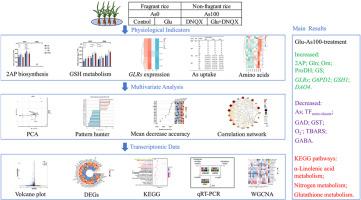
谷氨酸的应用:在砷胁迫下,谷氨酸受体样基因的上调促进了水稻香气2-乙酰基-1-吡咯啉的生物合成。
谷氨酸受体样(GLR)通道响应重金属,其基因可能被谷氨酸(Glu)溶液激活。谷氨酸参与芳香水稻2-乙酰基-1-吡咯啉(2AP)的形成并提供砷(As)抗性,但其调控机制尚不清楚。以非香稻和香稻为材料,进行了谷氨酸(Glu)和6,7-二硝基喹啉-2,3-二酮(DNQX, GLRs拮抗剂)在非砷和砷胁迫下的三因素随机区组试验。综合酶学、代谢物、转录组学分析和遗传实验显示,外源Glu处理上调了As胁迫下的GLRs,使2AP含量提高了17.2%。鸟氨酸和谷氨酰胺在2AP生物合成中的活性提高了0.4 ~ 8.3倍,谷氨酰胺合成酶和脯氨酸脱氢酶的活性分别提高了10.4%和10.7%。此外,谷胱甘肽代谢中的GSH1和G6PD2上调,以平衡抑制As从根到芽转运的还原性/氧化性谷胱甘肽,上调比例为17.6%。多因素分析表明,As胁迫下谷胱甘肽s转移酶活性、谷氨酰胺合成酶活性、DAO4和GSH1的转录水平对2AP的生物合成有影响。此外,转录组学分析表明,差异表达基因在α-亚麻酸、氮和谷胱甘肽代谢中富集,并经qRT-PCR验证。综上所述,Glu在提高水稻香气品质和抗砷性方面具有双重作用。
本文章由计算机程序翻译,如有差异,请以英文原文为准。
求助全文
约1分钟内获得全文
求助全文
来源期刊
CiteScore
11.10
自引率
3.10%
发文量
410
审稿时长
33 days
期刊介绍:
Plant Physiology and Biochemistry publishes original theoretical, experimental and technical contributions in the various fields of plant physiology (biochemistry, physiology, structure, genetics, plant-microbe interactions, etc.) at diverse levels of integration (molecular, subcellular, cellular, organ, whole plant, environmental). Opinions expressed in the journal are the sole responsibility of the authors and publication does not imply the editors'' agreement.
Manuscripts describing molecular-genetic and/or gene expression data that are not integrated with biochemical analysis and/or actual measurements of plant physiological processes are not suitable for PPB. Also "Omics" studies (transcriptomics, proteomics, metabolomics, etc.) reporting descriptive analysis without an element of functional validation assays, will not be considered. Similarly, applied agronomic or phytochemical studies that generate no new, fundamental insights in plant physiological and/or biochemical processes are not suitable for publication in PPB.
Plant Physiology and Biochemistry publishes several types of articles: Reviews, Papers and Short Papers. Articles for Reviews are either invited by the editor or proposed by the authors for the editor''s prior agreement. Reviews should not exceed 40 typewritten pages and Short Papers no more than approximately 8 typewritten pages. The fundamental character of Plant Physiology and Biochemistry remains that of a journal for original results.
 求助内容:
求助内容: 应助结果提醒方式:

 京公网安备 11010802042870号


