
Guar gum macromolecule-based nanoformulation of syringic acid for enhanced diabetic wound healing: Box–Behnken optimization and in vitro evaluation
IF 8.5
1区 化学
Q1 BIOCHEMISTRY & MOLECULAR BIOLOGY
International Journal of Biological Macromolecules
Pub Date : 2026-05-01
Epub Date: 2026-04-07
DOI:10.1016/j.ijbiomac.2026.151867
引用次数: 0
Abstract
Diabetic wound healing is impaired by persistent oxidative stress, reduced angiogenesis, and delayed tissue regeneration. In this study, a guar gum–based nanoformulation of syringic acid (NF) was developed and optimized using a Box–Behnken design to improve physicochemical characteristics and in vitro biological performance. The optimized NF exhibited a mean particle size of ~26 nm, low polydispersity (PDI) (~0.1), a negative zeta potential (−27.6 mV), high encapsulation efficiency (~83%), and spherical morphology. Thermal and spectroscopic analyses confirmed successful drug incorporation and enhanced stability. In vitro release studies indicated a diffusion-controlled, sustained-release profile. Compared with free syringic acid, NF demonstrated enhanced antioxidant activity, improved α-glucosidase and α-amylase inhibition, and improved cytocompatibility in L929 fibroblasts and HaCaT keratinocytes. Under hyperglycaemic conditions, NF significantly reduced lipid peroxidation and restored the activities of endogenous antioxidant enzymes, i.e., superoxide dismutase (SOD), catalase (CAT), and glutathione S-transferase (GST). The formulation also promoted keratinocyte migration (81.6% wound closure) and enhanced endothelial tube formation, accompanied by increased VEGF expression (71.61% VEGF-positive cells). Overall, nanoencapsulation improved the functional activity of syringic acid under diabetic-like conditions. These findings provide an in vitro foundation for future mechanistic and in vivo investigations in wound-related models.
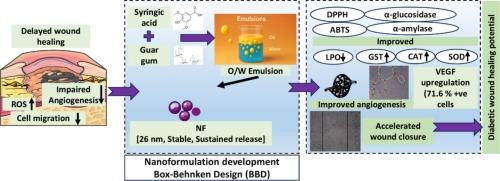
瓜尔胶基丁香酸纳米配方促进糖尿病伤口愈合:Box-Behnken优化及体外评价。
糖尿病伤口愈合受到持续氧化应激、血管生成减少和组织再生延迟的损害。本研究采用Box-Behnken设计优化瓜尔胶基丁香酸纳米配方,以改善其理化特性和体外生物学性能。优化后的纳米颗粒平均粒径为~26 nm, PDI低(~0.1),zeta电位为负(-27.6 mV),包封效率高(~83%),呈球形。热分析和光谱分析证实成功的药物掺入和增强的稳定性。体外释放研究表明其具有扩散控制、缓释的特点。与游离丁香酸相比,NF增强了L929成纤维细胞和HaCaT角质形成细胞的抗氧化活性,改善了α-葡萄糖苷酶和α-淀粉酶的抑制作用,并改善了细胞相容性。在高血糖条件下,NF显著降低脂质过氧化,恢复内源性抗氧化酶,即超氧化物歧化酶(SOD)、过氧化氢酶(CAT)和谷胱甘肽s -转移酶(GST)的活性。该制剂还促进角化细胞迁移(81.6%伤口愈合),增强内皮管形成,并伴有VEGF表达增加(71.61% VEGF阳性细胞)。总的来说,纳米胶囊化提高了丁香酸在糖尿病样条件下的功能活性。这些发现为未来伤口相关模型的机制和体内研究提供了体外基础。
本文章由计算机程序翻译,如有差异,请以英文原文为准。
求助全文
约1分钟内获得全文
求助全文
来源期刊
CiteScore
13.70
自引率
9.80%
发文量
2728
审稿时长
64 days
期刊介绍:
The International Journal of Biological Macromolecules is a well-established international journal dedicated to research on the chemical and biological aspects of natural macromolecules. Focusing on proteins, macromolecular carbohydrates, glycoproteins, proteoglycans, lignins, biological poly-acids, and nucleic acids, the journal presents the latest findings in molecular structure, properties, biological activities, interactions, modifications, and functional properties. Papers must offer new and novel insights, encompassing related model systems, structural conformational studies, theoretical developments, and analytical techniques. Each paper is required to primarily focus on at least one named biological macromolecule, reflected in the title, abstract, and text.
 求助内容:
求助内容: 应助结果提醒方式:

 京公网安备 11010802042870号


