L. Böckstiegel, K. Oehlke, R. Rüsch, B. Egert, C. H. Weinert
{"title":"Effect of feeding substrate, larval weight and drying procedures on the volatile profile of yellow mealworm larvae (T. molitor L.)","authors":"L. Böckstiegel, K. Oehlke, R. Rüsch, B. Egert, C. H. Weinert","doi":"10.1007/s00217-026-05039-2","DOIUrl":null,"url":null,"abstract":"<div>\n \n <p>Larvae of the yellow meal beetle, <i>Tenebrio molitor</i> L., have been authorized as novel food in the European Union in 2021. The aroma, determined by volatile compounds, strongly influences consumer acceptance of insects. We therefore investigated the impact of rearing substrate, harvest weight and oven drying procedure on the volatile profile of <i>T. molitor</i> larvae. The larvae were reared on five different substrates, harvested at two different weights and subjected to two oven drying procedures with and without previous blanching. Using a dual column approach, we detected > 300 volatiles via headspace-solid phase microextraction-gas chromatography-mass spectrometry (HS-SPME-GC-MS), included 269 volatiles in the data analysis and annotated 151 thereof. Color, moisture content, primary lipid oxidation products and carbonyl proteins were additionally determined. The drying procedure strongly impacted the volatile profile and modulated the influence of the factors feed and larval weight. Nitrogen- and sulfur-containing analytes were prominent in the samples exposed to a higher temperature while the volatile profile of the blanched larvae was richer in, e.g., hydrocarbons and aldehydes. Feed related differences between the groups were more pronounced in the smaller larvae. Furthermore, feed and weight affected 65 qualitative markers and the contribution to the volatile profile of 90 analytes. Possible reasons for the observed changes are discussed also considering the physico-chemical parameters.</p>\n </div>","PeriodicalId":549,"journal":{"name":"European Food Research and Technology","volume":"252 5","pages":""},"PeriodicalIF":3.2000,"publicationDate":"2026-04-10","publicationTypes":"Journal Article","fieldsOfStudy":null,"isOpenAccess":false,"openAccessPdf":"https://link.springer.com/content/pdf/10.1007/s00217-026-05039-2.pdf","citationCount":"0","resultStr":null,"platform":"Semanticscholar","paperid":null,"PeriodicalName":"European Food Research and Technology","FirstCategoryId":"97","ListUrlMain":"https://link.springer.com/article/10.1007/s00217-026-05039-2","RegionNum":3,"RegionCategory":"农林科学","ArticlePicture":[],"TitleCN":null,"AbstractTextCN":null,"PMCID":null,"EPubDate":"","PubModel":"","JCR":"Q2","JCRName":"FOOD SCIENCE & TECHNOLOGY","Score":null,"Total":0}
引用次数: 0
Abstract
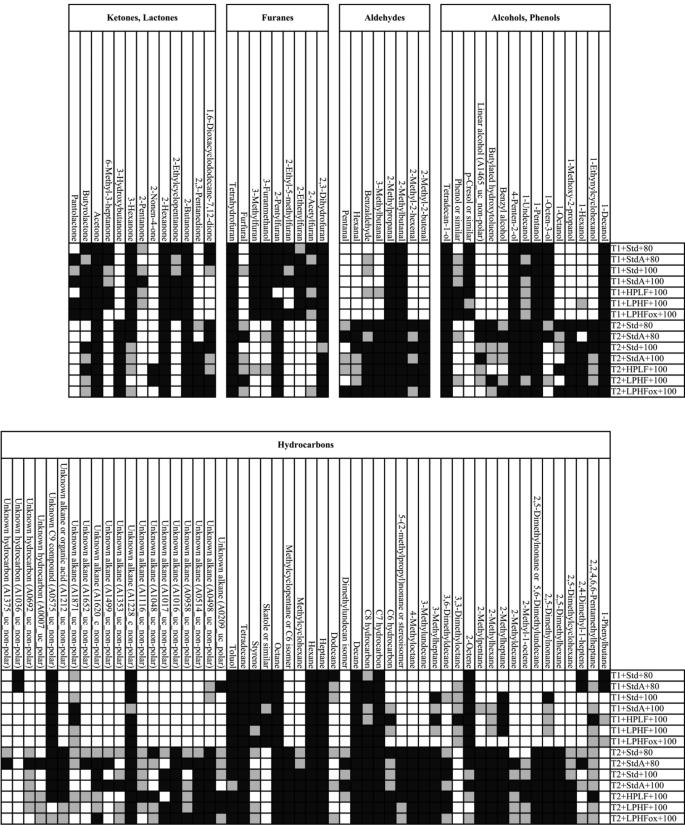
Larvae of the yellow meal beetle, Tenebrio molitor L., have been authorized as novel food in the European Union in 2021. The aroma, determined by volatile compounds, strongly influences consumer acceptance of insects. We therefore investigated the impact of rearing substrate, harvest weight and oven drying procedure on the volatile profile of T. molitor larvae. The larvae were reared on five different substrates, harvested at two different weights and subjected to two oven drying procedures with and without previous blanching. Using a dual column approach, we detected > 300 volatiles via headspace-solid phase microextraction-gas chromatography-mass spectrometry (HS-SPME-GC-MS), included 269 volatiles in the data analysis and annotated 151 thereof. Color, moisture content, primary lipid oxidation products and carbonyl proteins were additionally determined. The drying procedure strongly impacted the volatile profile and modulated the influence of the factors feed and larval weight. Nitrogen- and sulfur-containing analytes were prominent in the samples exposed to a higher temperature while the volatile profile of the blanched larvae was richer in, e.g., hydrocarbons and aldehydes. Feed related differences between the groups were more pronounced in the smaller larvae. Furthermore, feed and weight affected 65 qualitative markers and the contribution to the volatile profile of 90 analytes. Possible reasons for the observed changes are discussed also considering the physico-chemical parameters.
期刊介绍:
The journal European Food Research and Technology publishes state-of-the-art research papers and review articles on fundamental and applied food research. The journal''s mission is the fast publication of high quality papers on front-line research, newest techniques and on developing trends in the following sections:
-chemistry and biochemistry-
technology and molecular biotechnology-
nutritional chemistry and toxicology-
analytical and sensory methodologies-
food physics.
Out of the scope of the journal are:
- contributions which are not of international interest or do not have a substantial impact on food sciences,
- submissions which comprise merely data collections, based on the use of routine analytical or bacteriological methods,
- contributions reporting biological or functional effects without profound chemical and/or physical structure characterization of the compound(s) under research.

 求助内容:
求助内容: 应助结果提醒方式:

 京公网安备 11010802042870号


