Guilherme J. Antunes e Sousa, Susana P. Silva, Fábio A. O. Fernandes, Ricardo J. Alves de Sousa
{"title":"Cork-Based Composite Materials for Multifunctional Engineering Applications: Processing, Performance and Research Challenges","authors":"Guilherme J. Antunes e Sousa, Susana P. Silva, Fábio A. O. Fernandes, Ricardo J. Alves de Sousa","doi":"10.1007/s10443-026-10468-z","DOIUrl":null,"url":null,"abstract":"<div>\n \n <p>Cork-based composite materials have emerged as multifunctional, lightweight, and environmentally friendly alternatives to conventional polymer foams in engineering applications requiring energy absorption, thermal insulation, and damage tolerance. This review provides a critical synthesis of advances in cork composites reported between 2015 and 2025, including additive manufacturing approaches, bio-based polymer systems, and impact-resistant structural configurations. Following PRISMA guidelines, 54 peer-reviewed articles were selected from Scopus and Web of Science and analysed using a process-structure-property framework. Cork integration reliably reduces density, provides thermal insulation, and improves damping in fused deposition modelling, stereolithography, and extrusion-based cementitious printing, however, at high cork loadings, printability and interfacial strength suffer. Hybridisation with biodegradable polymers, natural fibres, aerogels, and bio-resins increases acoustic, fire, and moisture-buffering performance in bio-based composite systems, but at the expense of stiffness, durability, and resistance to environmental ageing. Impact-oriented studies indicate that cork-based cores can outperform certain synthetic foams (e.g. EPS or PVC) under low-velocity and repeated impact, particularly in terms of energy absorption and recovery behaviour. Advanced hybrid concepts incorporating shear-thickening fluids and architected layers have been shown to extend performance limits. Despite these advances, major challenges remain, such as a lack of industrial-scale demonstrations, poor understanding of long-term durability under ultraviolet radiation, humidity, and thermal cycling, and a lack of standardised life-cycle assessment frameworks. This review identifies key research priorities necessary to propel cork composites from laboratory-scale development to reliable, high-performance engineering solutions, positioning cork not only as a sustainable substitute but also as an enabler for next-generation multifunctional composite systems in mobility, construction, aerospace, and energy applications.</p>\n </div>","PeriodicalId":468,"journal":{"name":"Applied Composite Materials","volume":"33 3","pages":""},"PeriodicalIF":2.9000,"publicationDate":"2026-04-11","publicationTypes":"Journal Article","fieldsOfStudy":null,"isOpenAccess":false,"openAccessPdf":"https://link.springer.com/content/pdf/10.1007/s10443-026-10468-z.pdf","citationCount":"0","resultStr":null,"platform":"Semanticscholar","paperid":null,"PeriodicalName":"Applied Composite Materials","FirstCategoryId":"88","ListUrlMain":"https://link.springer.com/article/10.1007/s10443-026-10468-z","RegionNum":4,"RegionCategory":"材料科学","ArticlePicture":[],"TitleCN":null,"AbstractTextCN":null,"PMCID":null,"EPubDate":"","PubModel":"","JCR":"Q3","JCRName":"MATERIALS SCIENCE, COMPOSITES","Score":null,"Total":0}
引用次数: 0
Abstract
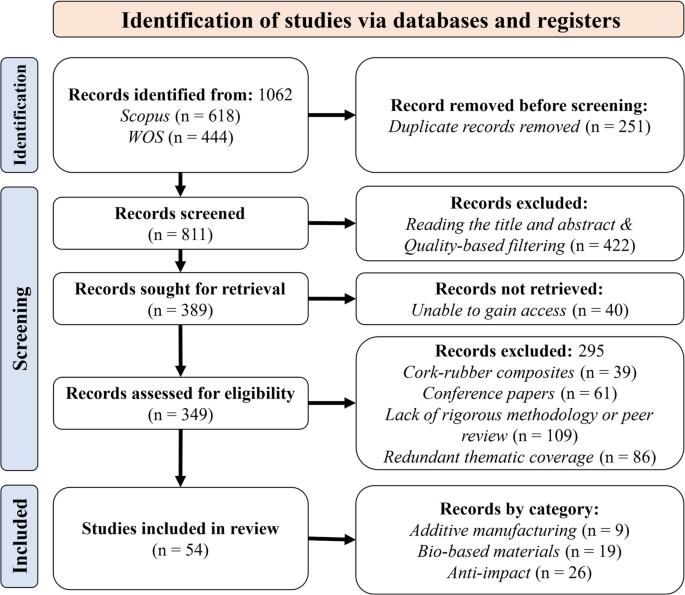
Cork-based composite materials have emerged as multifunctional, lightweight, and environmentally friendly alternatives to conventional polymer foams in engineering applications requiring energy absorption, thermal insulation, and damage tolerance. This review provides a critical synthesis of advances in cork composites reported between 2015 and 2025, including additive manufacturing approaches, bio-based polymer systems, and impact-resistant structural configurations. Following PRISMA guidelines, 54 peer-reviewed articles were selected from Scopus and Web of Science and analysed using a process-structure-property framework. Cork integration reliably reduces density, provides thermal insulation, and improves damping in fused deposition modelling, stereolithography, and extrusion-based cementitious printing, however, at high cork loadings, printability and interfacial strength suffer. Hybridisation with biodegradable polymers, natural fibres, aerogels, and bio-resins increases acoustic, fire, and moisture-buffering performance in bio-based composite systems, but at the expense of stiffness, durability, and resistance to environmental ageing. Impact-oriented studies indicate that cork-based cores can outperform certain synthetic foams (e.g. EPS or PVC) under low-velocity and repeated impact, particularly in terms of energy absorption and recovery behaviour. Advanced hybrid concepts incorporating shear-thickening fluids and architected layers have been shown to extend performance limits. Despite these advances, major challenges remain, such as a lack of industrial-scale demonstrations, poor understanding of long-term durability under ultraviolet radiation, humidity, and thermal cycling, and a lack of standardised life-cycle assessment frameworks. This review identifies key research priorities necessary to propel cork composites from laboratory-scale development to reliable, high-performance engineering solutions, positioning cork not only as a sustainable substitute but also as an enabler for next-generation multifunctional composite systems in mobility, construction, aerospace, and energy applications.
软木基复合材料作为一种多功能、轻质、环保的材料,在需要吸能、隔热和损伤容忍度的工程应用中取代了传统的聚合物泡沫。本文综述了2015年至2025年间软木复合材料合成的重要进展,包括增材制造方法、生物基聚合物体系和抗冲击结构配置。按照PRISMA的指导方针,从Scopus和Web of Science中选择了54篇同行评议的文章,并使用过程-结构-属性框架进行了分析。软木集成可靠地降低了密度,提供了隔热,并改善了熔融沉积建模,立体光刻和基于挤出的胶凝打印的阻尼,然而,在高软木负载下,印刷性和界面强度受到影响。生物可降解聚合物、天然纤维、气凝胶和生物树脂的混合可以提高生物基复合材料系统的声学、防火和防潮性能,但代价是刚度、耐用性和抗环境老化性。以冲击为导向的研究表明,软木基岩心在低速和反复冲击下的性能优于某些合成泡沫(如EPS或PVC),特别是在能量吸收和恢复行为方面。结合剪切增稠流体和结构层的先进混合概念已被证明可以扩展性能极限。尽管取得了这些进展,但主要的挑战仍然存在,例如缺乏工业规模的演示,对紫外线辐射、湿度和热循环下的长期耐久性了解不足,以及缺乏标准化的生命周期评估框架。这篇综述确定了将软木复合材料从实验室规模发展到可靠、高性能的工程解决方案所必需的关键研究重点,将软木材料定位为可持续的替代品,同时也是下一代多功能复合材料系统在移动、建筑、航空航天和能源应用中的推动者。
期刊介绍:
Applied Composite Materials is an international journal dedicated to the publication of original full-length papers, review articles and short communications of the highest quality that advance the development and application of engineering composite materials. Its articles identify problems that limit the performance and reliability of the composite material and composite part; and propose solutions that lead to innovation in design and the successful exploitation and commercialization of composite materials across the widest spectrum of engineering uses. The main focus is on the quantitative descriptions of material systems and processing routes.
Coverage includes management of time-dependent changes in microscopic and macroscopic structure and its exploitation from the material''s conception through to its eventual obsolescence.

 求助内容:
求助内容: 应助结果提醒方式:

 京公网安备 11010802042870号


