Minwoo Park, Younha Kim, Youjung Jang, Hyejung Hu, Satoru Chatani, Shuxiao Wang, Zbigniew Klimont, Jung-Hun Woo
{"title":"An Integrated Framework for MOSAIC-AQNEA Emission Inventory Development in Northeast Asia","authors":"Minwoo Park, Younha Kim, Youjung Jang, Hyejung Hu, Satoru Chatani, Shuxiao Wang, Zbigniew Klimont, Jung-Hun Woo","doi":"10.1007/s13143-026-00434-x","DOIUrl":null,"url":null,"abstract":"<div>\n \n <p>Air pollutant emissions in Northeast Asia play a critical role in regional air quality and transboundary pollution. This study presents the development of the MOSAIC-AQNEA emission inventory framework, integrating country-specific emission inventories for six countries: China, South Korea, Japan, North Korea, Mongolia, and the Asian part of Russia. A mosaic approach was applied to combine nationally developed inventories under a unified sectoral classification scheme. The inventory includes major seven pollutants (SO<sub>2</sub>, NOₓ, PM<sub>10</sub>, PM<sub>2.5,</sub> NH<sub>3</sub>, NMVOCs and CO) for the base year 2019. While PM<sub>10</sub> and PM<sub>2.5</sub> are explicitly distinguished in the emission inventory and model processing, they are occasionally referred to collectively as PM in the text for brevity. To support air quality modeling, the compiled inventories were processed using the SMOKE-Asia system to generate model-ready inputs. The resulting gridded emissions provide a consistent, high-resolution dataset representing regional emission characteristics. Analysis by sector, pollutant, and intensity metrics (Emissions per GDP and per Population) revealed distinct structural differences among countries, reflecting variations in energy systems, industrial activities, and socioeconomic conditions. This study provides a comprehensively integrated, model-ready emission inventory framework that consistently integrates national inventories across Northeast Asia under a unified processing structure. The framework ensures cross-country comparability through systematic sector mapping, bottom-up emission based downscaling, and consistent chemical speciation. The resulting dataset offers a transparent and directly usable emission input for regional air quality modeling and policy-relevant assessments.</p>\n </div>","PeriodicalId":8556,"journal":{"name":"Asia-Pacific Journal of Atmospheric Sciences","volume":"62 2","pages":""},"PeriodicalIF":2.3000,"publicationDate":"2026-04-10","publicationTypes":"Journal Article","fieldsOfStudy":null,"isOpenAccess":false,"openAccessPdf":"https://link.springer.com/content/pdf/10.1007/s13143-026-00434-x.pdf","citationCount":"0","resultStr":null,"platform":"Semanticscholar","paperid":null,"PeriodicalName":"Asia-Pacific Journal of Atmospheric Sciences","FirstCategoryId":"89","ListUrlMain":"https://link.springer.com/article/10.1007/s13143-026-00434-x","RegionNum":4,"RegionCategory":"地球科学","ArticlePicture":[],"TitleCN":null,"AbstractTextCN":null,"PMCID":null,"EPubDate":"","PubModel":"","JCR":"Q3","JCRName":"METEOROLOGY & ATMOSPHERIC SCIENCES","Score":null,"Total":0}
引用次数: 0
Abstract
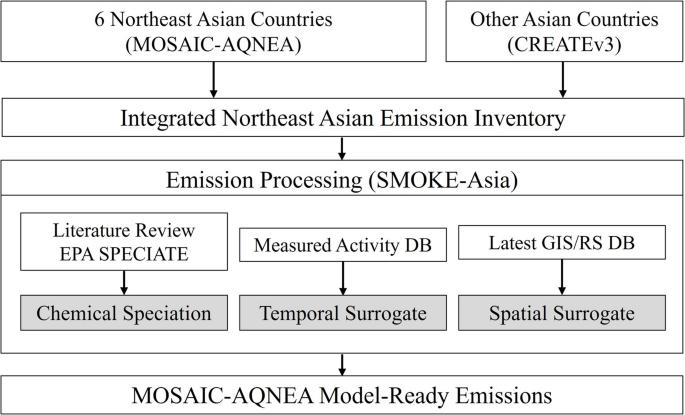
Air pollutant emissions in Northeast Asia play a critical role in regional air quality and transboundary pollution. This study presents the development of the MOSAIC-AQNEA emission inventory framework, integrating country-specific emission inventories for six countries: China, South Korea, Japan, North Korea, Mongolia, and the Asian part of Russia. A mosaic approach was applied to combine nationally developed inventories under a unified sectoral classification scheme. The inventory includes major seven pollutants (SO2, NOₓ, PM10, PM2.5, NH3, NMVOCs and CO) for the base year 2019. While PM10 and PM2.5 are explicitly distinguished in the emission inventory and model processing, they are occasionally referred to collectively as PM in the text for brevity. To support air quality modeling, the compiled inventories were processed using the SMOKE-Asia system to generate model-ready inputs. The resulting gridded emissions provide a consistent, high-resolution dataset representing regional emission characteristics. Analysis by sector, pollutant, and intensity metrics (Emissions per GDP and per Population) revealed distinct structural differences among countries, reflecting variations in energy systems, industrial activities, and socioeconomic conditions. This study provides a comprehensively integrated, model-ready emission inventory framework that consistently integrates national inventories across Northeast Asia under a unified processing structure. The framework ensures cross-country comparability through systematic sector mapping, bottom-up emission based downscaling, and consistent chemical speciation. The resulting dataset offers a transparent and directly usable emission input for regional air quality modeling and policy-relevant assessments.
期刊介绍:
The Asia-Pacific Journal of Atmospheric Sciences (APJAS) is an international journal of the Korean Meteorological Society (KMS), published fully in English. It has started from 2008 by succeeding the KMS'' former journal, the Journal of the Korean Meteorological Society (JKMS), which published a total of 47 volumes as of 2011, in its time-honored tradition since 1965. Since 2008, the APJAS is included in the journal list of Thomson Reuters’ SCIE (Science Citation Index Expanded) and also in SCOPUS, the Elsevier Bibliographic Database, indicating the increased awareness and quality of the journal.

 求助内容:
求助内容: 应助结果提醒方式:

 京公网安备 11010802042870号


