A. Shteinfer-Kuzmine, A. Karunanithi Nivedita, M. Santhanam, S. Trishna, R. W. Swerdlow, J. Pan, V. Shoshan-Barmatz
{"title":"Targeting VDAC1 to protect against mitochondria-linked cell death pathways: apoptosis, pyroptosis, ferroptosis, and associated diseases","authors":"A. Shteinfer-Kuzmine, A. Karunanithi Nivedita, M. Santhanam, S. Trishna, R. W. Swerdlow, J. Pan, V. Shoshan-Barmatz","doi":"10.1007/s10495-025-02217-7","DOIUrl":null,"url":null,"abstract":"<div><p>The pathways of programmed cell death (PCD), including apoptosis, pyroptosis, and ferroptosis, are interconnected. They can be activated simultaneously within tissues or cell lines and are often associated with various diseases. Thus, identifying a common player and inhibitor targeting several PCD types is essential. Here, we show that overexpression and oligomerization of the mitochondrial gatekeeper voltage-dependent anion channel 1 (VDAC1) is involved in apoptosis, pyroptosis, and ferroptosis, and specific VDAC1 oligomerization inhibitors, VBIT-4 and VBIT-12, prevented multiple forms of PCD triggered by various stimuli. In addition, they mitigated mitochondrial dysfunction, reduced reactive oxygen species production and intracellular Ca<sup>2</sup>⁺ levels, preserved mitochondrial-associated hexokinase, and inhibited assembly/activation of the NLRP3 inflammasome. In Alzheimer’s disease and inflammatory bowel disease mouse models, VBIT-4 and VBIT-12, respectively, protected against apoptosis, pyroptosis, ferroptosis, and disease-associated pathologies. Thus, we show that VDAC1 oligomerization represents a prime target for VBIT-4 and VBIT-12 that can simultaneously inhibit various PCD forms and diseases associated with enhanced PCD and/or inflammation.</p></div>","PeriodicalId":8062,"journal":{"name":"Apoptosis","volume":"31 4","pages":""},"PeriodicalIF":8.1000,"publicationDate":"2026-04-11","publicationTypes":"Journal Article","fieldsOfStudy":null,"isOpenAccess":false,"openAccessPdf":"https://link.springer.com/content/pdf/10.1007/s10495-025-02217-7.pdf","citationCount":"0","resultStr":null,"platform":"Semanticscholar","paperid":null,"PeriodicalName":"Apoptosis","FirstCategoryId":"99","ListUrlMain":"https://link.springer.com/article/10.1007/s10495-025-02217-7","RegionNum":2,"RegionCategory":"生物学","ArticlePicture":[],"TitleCN":null,"AbstractTextCN":null,"PMCID":null,"EPubDate":"","PubModel":"","JCR":"Q1","JCRName":"BIOCHEMISTRY & MOLECULAR BIOLOGY","Score":null,"Total":0}
引用次数: 0
Abstract
The pathways of programmed cell death (PCD), including apoptosis, pyroptosis, and ferroptosis, are interconnected. They can be activated simultaneously within tissues or cell lines and are often associated with various diseases. Thus, identifying a common player and inhibitor targeting several PCD types is essential. Here, we show that overexpression and oligomerization of the mitochondrial gatekeeper voltage-dependent anion channel 1 (VDAC1) is involved in apoptosis, pyroptosis, and ferroptosis, and specific VDAC1 oligomerization inhibitors, VBIT-4 and VBIT-12, prevented multiple forms of PCD triggered by various stimuli. In addition, they mitigated mitochondrial dysfunction, reduced reactive oxygen species production and intracellular Ca2⁺ levels, preserved mitochondrial-associated hexokinase, and inhibited assembly/activation of the NLRP3 inflammasome. In Alzheimer’s disease and inflammatory bowel disease mouse models, VBIT-4 and VBIT-12, respectively, protected against apoptosis, pyroptosis, ferroptosis, and disease-associated pathologies. Thus, we show that VDAC1 oligomerization represents a prime target for VBIT-4 and VBIT-12 that can simultaneously inhibit various PCD forms and diseases associated with enhanced PCD and/or inflammation.
期刊介绍:
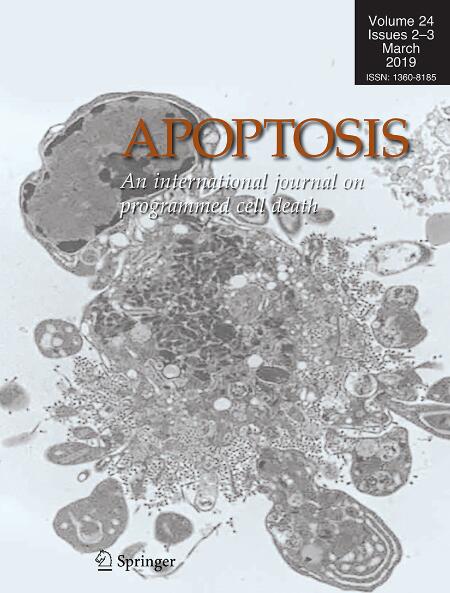
Apoptosis, a monthly international peer-reviewed journal, focuses on the rapid publication of innovative investigations into programmed cell death. The journal aims to stimulate research on the mechanisms and role of apoptosis in various human diseases, such as cancer, autoimmune disease, viral infection, AIDS, cardiovascular disease, neurodegenerative disorders, osteoporosis, and aging. The Editor-In-Chief acknowledges the importance of advancing clinical therapies for apoptosis-related diseases. Apoptosis considers Original Articles, Reviews, Short Communications, Letters to the Editor, and Book Reviews for publication.

 求助内容:
求助内容: 应助结果提醒方式:

 京公网安备 11010802042870号


