{"title":"Hfq Positively Regulated the Proliferation Ability of Escherichia coli K-12 Under Simulated Microgravity Condition","authors":"Xinxin Li, Ya Li, Huaxian Li, Quanxian Guo, Wentian Zhang, Manzhi Gao, Sumin Li, Hanxiao Zhang, Weiwei Yan, Yong Liu, Peijun Han, Wenlan Wang","doi":"10.1007/s12217-026-10249-0","DOIUrl":null,"url":null,"abstract":"<div>\n \n <p>Simulated microgravity enhances <i>Escherichia coli</i> (<i>E. coli</i>) proliferation ability, but the underlying mechanisms remain unclear. In this study, we cultured <i>E. coli</i> in a three-dimensional rotational environment for 14 days to establish simulated microgravity strains (SMG). Compared to normal gravity strains (NG), SMG exhibited enhanced growth rate, and motility. Hfq plays a crucial role in proliferation ability in terms of growth rate and motility in <i>E. coli</i>. And it is worth noting that, compared with the NG, the expression of <i>hfq</i> in <i>E. coli</i> was upregulated in SMG. The expression of genes including <i>minD</i>, <i>minE</i>, <i>flhC</i> and <i>flhD</i> upregulated in SMG. To investigate the effect of <i>hfq</i> on <i>E. coli</i> proliferation ability, we knocked out <i>hfq</i> in <i>E. coli</i> to establish a Δ<i>hfq E. coli</i> strain and cultured it under simulated microgravity conditions for 14 days (Δ<i>hfq</i> SMG). The Δ<i>hfq</i> SMG exhibited reduced growth rate and motility compared to SMG. Meanwhile, the expression levels of <i>minD</i>, <i>minE</i>, <i>flhC</i> and <i>flhD</i> were downregulated. Replenishing <i>hfq</i> to Δ<i>hfq</i> SMG could restore growth rate and motility, and re-activate the downregulated genes. In conclusion, it is demonstrated that <i>hfq</i> played a significant role in the proliferation ability of <i>E. coli</i> under simulated microgravity condition and this effect might be closely related to the proliferation ability -related genes of <i>E. coli</i>. This study may provide a new idea for preventing and controlling opportunistic pathogenic bacterial infections during aerospace missions.</p>\n </div>","PeriodicalId":707,"journal":{"name":"Microgravity Science and Technology","volume":"38 2","pages":""},"PeriodicalIF":1.5000,"publicationDate":"2026-04-06","publicationTypes":"Journal Article","fieldsOfStudy":null,"isOpenAccess":false,"openAccessPdf":"","citationCount":"0","resultStr":null,"platform":"Semanticscholar","paperid":null,"PeriodicalName":"Microgravity Science and Technology","FirstCategoryId":"5","ListUrlMain":"https://link.springer.com/article/10.1007/s12217-026-10249-0","RegionNum":4,"RegionCategory":"工程技术","ArticlePicture":[],"TitleCN":null,"AbstractTextCN":null,"PMCID":null,"EPubDate":"","PubModel":"","JCR":"Q2","JCRName":"ENGINEERING, AEROSPACE","Score":null,"Total":0}
引用次数: 0
Abstract
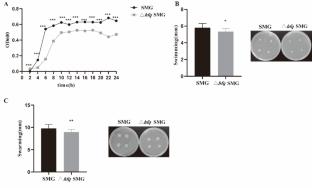
Simulated microgravity enhances Escherichia coli (E. coli) proliferation ability, but the underlying mechanisms remain unclear. In this study, we cultured E. coli in a three-dimensional rotational environment for 14 days to establish simulated microgravity strains (SMG). Compared to normal gravity strains (NG), SMG exhibited enhanced growth rate, and motility. Hfq plays a crucial role in proliferation ability in terms of growth rate and motility in E. coli. And it is worth noting that, compared with the NG, the expression of hfq in E. coli was upregulated in SMG. The expression of genes including minD, minE, flhC and flhD upregulated in SMG. To investigate the effect of hfq on E. coli proliferation ability, we knocked out hfq in E. coli to establish a Δhfq E. coli strain and cultured it under simulated microgravity conditions for 14 days (Δhfq SMG). The Δhfq SMG exhibited reduced growth rate and motility compared to SMG. Meanwhile, the expression levels of minD, minE, flhC and flhD were downregulated. Replenishing hfq to Δhfq SMG could restore growth rate and motility, and re-activate the downregulated genes. In conclusion, it is demonstrated that hfq played a significant role in the proliferation ability of E. coli under simulated microgravity condition and this effect might be closely related to the proliferation ability -related genes of E. coli. This study may provide a new idea for preventing and controlling opportunistic pathogenic bacterial infections during aerospace missions.
期刊介绍:
Microgravity Science and Technology – An International Journal for Microgravity and Space Exploration Related Research is a is a peer-reviewed scientific journal concerned with all topics, experimental as well as theoretical, related to research carried out under conditions of altered gravity.
Microgravity Science and Technology publishes papers dealing with studies performed on and prepared for platforms that provide real microgravity conditions (such as drop towers, parabolic flights, sounding rockets, reentry capsules and orbiting platforms), and on ground-based facilities aiming to simulate microgravity conditions on earth (such as levitrons, clinostats, random positioning machines, bed rest facilities, and micro-scale or neutral buoyancy facilities) or providing artificial gravity conditions (such as centrifuges).
Data from preparatory tests, hardware and instrumentation developments, lessons learnt as well as theoretical gravity-related considerations are welcome. Included science disciplines with gravity-related topics are:
− materials science
− fluid mechanics
− process engineering
− physics
− chemistry
− heat and mass transfer
− gravitational biology
− radiation biology
− exobiology and astrobiology
− human physiology

 求助内容:
求助内容: 应助结果提醒方式:

 京公网安备 11010802042870号


