Carolina Marion de Godoy, Moa Andersson, Merima Hasani, Hans Theliander
{"title":"Uniformity of delignification during kraft pulping of hardwood chips: impact of wood structure and the importance of impregnation","authors":"Carolina Marion de Godoy, Moa Andersson, Merima Hasani, Hans Theliander","doi":"10.1007/s00226-026-01769-4","DOIUrl":null,"url":null,"abstract":"<div><p>This study examines the homogeneity of lignin and xylan removal in model sapwood chips of alder (<i>Alnus glutinosa</i>), birch (<i>Betula pubescens</i>), beech (<i>Fagus sylvatica</i>), and aspen (<i>Populus tremula</i>) during batch kraft pulping. The first experiments focused on investigating the effect of hardwood morphology on the evolution of pulping. By comparing the gradients of lignin and xylan inside the chips at different stages of delignification, it was established that the process is more uniform in hardwoods of lower density (high porosity), like aspen. Hence, characteristics such as large and frequent vessels, thin fiber walls, and large lumens may help to achieve pulps with more homogeneous composition and to avoid shives. The influence of other morphological features was not clear. The results also suggested that the impact of morphology was mostly connected to the impregnation step, as the porosity of the sapwood dictated the initial concentration of hydroxide ions within the chips. Thus, a second set of experiments was conducted to evaluate the possibility to overcome this impact by utilizing liquors with high alkali content during pulping. Among the evaluated conditions, the use of liquor containing 2 mol HO<sup>−</sup>/kg during impregnation followed by cooking with 0.55 mol HO<sup>−</sup>/kg was shown to be a reasonable approach to increase the uniformity of delignification.</p></div>","PeriodicalId":810,"journal":{"name":"Wood Science and Technology","volume":"60 3","pages":""},"PeriodicalIF":3.0000,"publicationDate":"2026-04-06","publicationTypes":"Journal Article","fieldsOfStudy":null,"isOpenAccess":false,"openAccessPdf":"https://link.springer.com/content/pdf/10.1007/s00226-026-01769-4.pdf","citationCount":"0","resultStr":null,"platform":"Semanticscholar","paperid":null,"PeriodicalName":"Wood Science and Technology","FirstCategoryId":"88","ListUrlMain":"https://link.springer.com/article/10.1007/s00226-026-01769-4","RegionNum":2,"RegionCategory":"农林科学","ArticlePicture":[],"TitleCN":null,"AbstractTextCN":null,"PMCID":null,"EPubDate":"","PubModel":"","JCR":"Q1","JCRName":"FORESTRY","Score":null,"Total":0}
引用次数: 0
Abstract
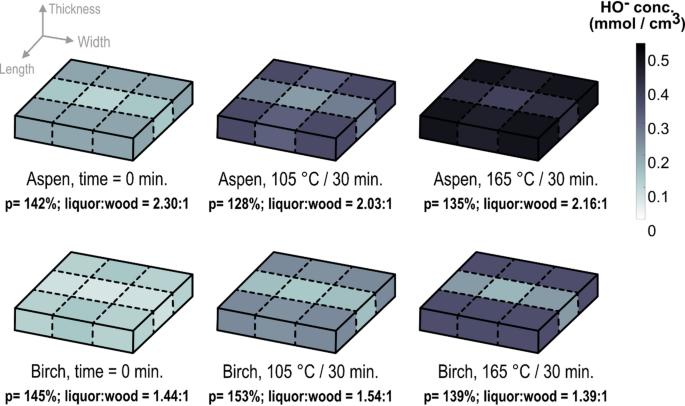
This study examines the homogeneity of lignin and xylan removal in model sapwood chips of alder (Alnus glutinosa), birch (Betula pubescens), beech (Fagus sylvatica), and aspen (Populus tremula) during batch kraft pulping. The first experiments focused on investigating the effect of hardwood morphology on the evolution of pulping. By comparing the gradients of lignin and xylan inside the chips at different stages of delignification, it was established that the process is more uniform in hardwoods of lower density (high porosity), like aspen. Hence, characteristics such as large and frequent vessels, thin fiber walls, and large lumens may help to achieve pulps with more homogeneous composition and to avoid shives. The influence of other morphological features was not clear. The results also suggested that the impact of morphology was mostly connected to the impregnation step, as the porosity of the sapwood dictated the initial concentration of hydroxide ions within the chips. Thus, a second set of experiments was conducted to evaluate the possibility to overcome this impact by utilizing liquors with high alkali content during pulping. Among the evaluated conditions, the use of liquor containing 2 mol HO−/kg during impregnation followed by cooking with 0.55 mol HO−/kg was shown to be a reasonable approach to increase the uniformity of delignification.
期刊介绍:
Wood Science and Technology publishes original scientific research results and review papers covering the entire field of wood material science, wood components and wood based products. Subjects are wood biology and wood quality, wood physics and physical technologies, wood chemistry and chemical technologies. Latest advances in areas such as cell wall and wood formation; structural and chemical composition of wood and wood composites and their property relations; physical, mechanical and chemical characterization and relevant methodological developments, and microbiological degradation of wood and wood based products are reported. Topics related to wood technology include machining, gluing, and finishing, composite technology, wood modification, wood mechanics, creep and rheology, and the conversion of wood into pulp and biorefinery products.

 求助内容:
求助内容: 应助结果提醒方式:

 京公网安备 11010802042870号


