{"title":"Why Antimicrobial Resistance Does Not Perpetually Expand in an Antibiotics-Free Environment: Insight from Quorum Sensing","authors":"Lin Zhu, , , Mengdi Gao, , , Jingpeng Li, , , Xuezhu Han, , , Jiaming Yi, , and , Meizhen Wang*, ","doi":"10.1021/acs.est.5c16848","DOIUrl":null,"url":null,"abstract":"<p >The persistence of antimicrobial resistance (AMR) in environmental reservoirs, even in the absence of direct antibiotic selection pressure, represents a critical challenge for global health. However, the mechanisms that prevent the unlimited expansion of environmental AMR remain poorly understood. In this study, we explore how quorum sensing (QS) plays a central role in constraining AMR under antibiotic-free conditions. Through long-term evolution experiments with antibiotic-resistant <i>Pseudomonas aeruginosa</i> strains (<i>P</i><sub>AMP</sub> and <i>P</i><sub>CIP</sub>), we observed the spontaneous emergence and accumulation of <i>las</i>R-deficient mutants (Δ<i>las</i>R), which act as social cheaters. These mutants exhibited a 2.44- to 4.88-fold reduction in minimum inhibitory concentration and impaired biofilm formation, leading to a 70–87.5% decrease in biofilm-protected survival against antibiotics. Moreover, the Δ<i>las</i>R frequency was strongly correlated with the decline in population-level resistance. Importantly, disruption of QS-mediated policing via reactive oxygen species scavengers accelerated the loss of resistance, confirming the role of <i>las</i>R in maintaining AMR. Furthermore, Δ<i>las</i>R possessed a growth advantage only in the absence of antibiotics, thus illustrating an evolutionary trade-off that naturally selects against resistance traits when selection pressure is removed. These findings provide a mechanistic explanation for the reversibility of environmental AMR and may aid the development of strategies targeting QS policing to mitigate antibiotic resistance.</p>","PeriodicalId":36,"journal":{"name":"环境科学与技术","volume":"60 15","pages":"11653–11664"},"PeriodicalIF":12.2000,"publicationDate":"2026-04-21","publicationTypes":"Journal Article","fieldsOfStudy":null,"isOpenAccess":false,"openAccessPdf":"","citationCount":"0","resultStr":null,"platform":"Semanticscholar","paperid":null,"PeriodicalName":"环境科学与技术","FirstCategoryId":"1","ListUrlMain":"https://pubs.acs.org/doi/10.1021/acs.est.5c16848","RegionNum":1,"RegionCategory":"环境科学与生态学","ArticlePicture":[],"TitleCN":null,"AbstractTextCN":null,"PMCID":null,"EPubDate":"2026/4/10 0:00:00","PubModel":"Epub","JCR":"Q1","JCRName":"ENGINEERING, ENVIRONMENTAL","Score":null,"Total":0}
引用次数: 0
Abstract
The persistence of antimicrobial resistance (AMR) in environmental reservoirs, even in the absence of direct antibiotic selection pressure, represents a critical challenge for global health. However, the mechanisms that prevent the unlimited expansion of environmental AMR remain poorly understood. In this study, we explore how quorum sensing (QS) plays a central role in constraining AMR under antibiotic-free conditions. Through long-term evolution experiments with antibiotic-resistant Pseudomonas aeruginosa strains (PAMP and PCIP), we observed the spontaneous emergence and accumulation of lasR-deficient mutants (ΔlasR), which act as social cheaters. These mutants exhibited a 2.44- to 4.88-fold reduction in minimum inhibitory concentration and impaired biofilm formation, leading to a 70–87.5% decrease in biofilm-protected survival against antibiotics. Moreover, the ΔlasR frequency was strongly correlated with the decline in population-level resistance. Importantly, disruption of QS-mediated policing via reactive oxygen species scavengers accelerated the loss of resistance, confirming the role of lasR in maintaining AMR. Furthermore, ΔlasR possessed a growth advantage only in the absence of antibiotics, thus illustrating an evolutionary trade-off that naturally selects against resistance traits when selection pressure is removed. These findings provide a mechanistic explanation for the reversibility of environmental AMR and may aid the development of strategies targeting QS policing to mitigate antibiotic resistance.
期刊介绍:
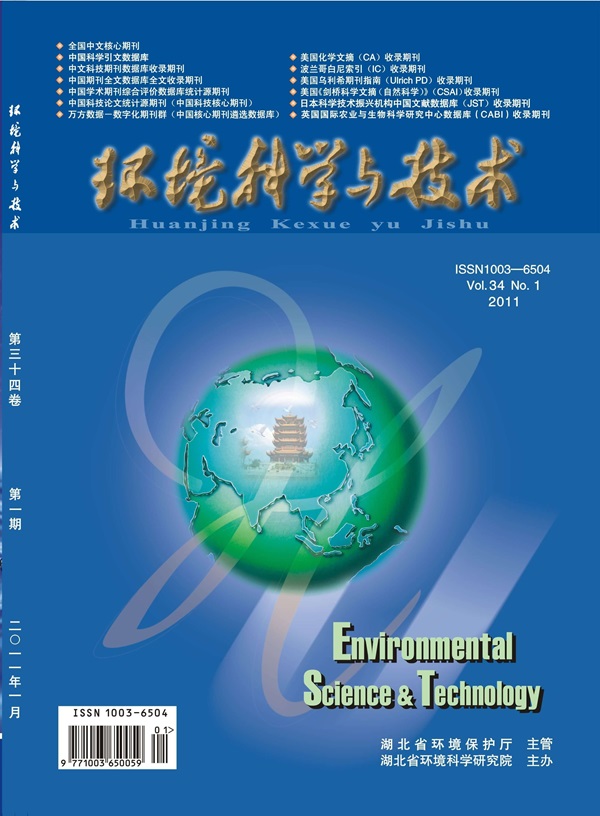
Environmental Science & Technology (ES&T) is a co-sponsored academic and technical magazine by the Hubei Provincial Environmental Protection Bureau and the Hubei Provincial Academy of Environmental Sciences.
Environmental Science & Technology (ES&T) holds the status of Chinese core journals, scientific papers source journals of China, Chinese Science Citation Database source journals, and Chinese Academic Journal Comprehensive Evaluation Database source journals. This publication focuses on the academic field of environmental protection, featuring articles related to environmental protection and technical advancements.


 求助内容:
 应助结果提醒方式:


 京公网安备 11010802042870号


