HR-LC/MS/MS and GC–MS-based phytochemical analysis of Nephrolepis exaltata (L.) Schott and its antioxidant and anti-Alzheimer’s activities: in vitro and in vivo studies
Heba A. Mohamed, Sherifa F. Moustafa, Passent M. Abdel-Baki, Abeer A. A. Salama, Wael M. Aboulthana, Nadia M. Sokkar
{"title":"HR-LC/MS/MS and GC–MS-based phytochemical analysis of Nephrolepis exaltata (L.) Schott and its antioxidant and anti-Alzheimer’s activities: in vitro and in vivo studies","authors":"Heba A. Mohamed, Sherifa F. Moustafa, Passent M. Abdel-Baki, Abeer A. A. Salama, Wael M. Aboulthana, Nadia M. Sokkar","doi":"10.1186/s43094-026-00957-0","DOIUrl":null,"url":null,"abstract":"<div><h3>Background</h3><p><i>Nephrolepis exaltata</i> (L.) Schott is an ornamental non-flowering plant that is found in tropical and subtropical regions. Some <i>Nephrolepis</i> species have been traditionally used to improve memory. For the first time, this study aims to provide comparative metabolomic profiling of <i>N. exaltata</i> (L.) Schott leaves’(NEL) and underground parts’(NEU) hydro-ethanolic extracts and to investigate their saponifiable and unsaponifiable fractions, antioxidant and anti-Alzheimer's activities using in vitro and in vivo models.</p><h3>Results</h3><p>A total of 61 metabolites were tentatively identified, including phenolic acids, flavonoids, terpenoids, lipids, fatty acids and carotenoids using high-resolution tandem mass spectrometry coupled with high-performance liquid chromatography (HR-LC–MS/MS) in positive and negative ionization modes. Additionally, gas chromatography coupled with mass spectrometry (GC–MS) revealed the presence of fatty acids, sesquiterpenoids, diterpenoids, triterpenoids, and sterols. NEL exhibited the highest total phenolic content (281.35 ± 0.32 mg gallic acid/100 g), total antioxidant capacity (267.32 ± 0.47 mg gallic acid/g), iron reducing power (253.34 ± 0.42 μg/mL), 1,1-Diphenyl-2-picryl-hydrazyl (DPPH) (IC<sub>50</sub> 7.10 ± 0.01 µg/mL) and 2,2′-azinobis-(3-ethylbenzothiazoline-6-sulfonic acid) (ABTS) (68.99 ± 0.08%) radical-scavenging activities followed by NEU. The leaves butanol fraction demonstrated the highest in vitro acetylcholinesterase (AChE) inhibitory activity (61.20 ± 0.03%). In lipopolysaccharide (LPS)-induced Alzheimer disease in mice model, NEU significantly improved cognitive function, reduced AChE, Toll-like receptor 4 (TLR4), Nuclear factor kappa β (NF-κβ), Tumor necrosis factor alpha (TNF-α), and Angiotensin type 1 receptor (AT1R1) levels, and upregulated Cannabinoid receptor 1 (CB1) as compared to the LPS group followed by the NEL. In the mice treated with NEU, the cerebral cortex, hippocampus subiculum, fascia dentata, hilus, and striatum exhibited normal histological structures. NEL-treated mice showed no histopathological changes in the cerebral cortex and hippocampus subiculum. However, the fascia dentata and hilus exhibited minimal nuclear pyknosis and neuronal degeneration. Moreover, the striatum showed diffuse gliosis between the intact neurons.</p><h3>Conclusion</h3><p>The study reports for the first time 2 important investigations and findings: first, the metabolomic profile in NEL and NEU hydro-ethanolic extracts using HR-LC/MS/MS and GC–MS, and second, the pharmacological evidence of <i>N. exaltata</i> (L.) ability to protect against AD in a mice model.</p></div>","PeriodicalId":577,"journal":{"name":"Future Journal of Pharmaceutical Sciences","volume":"12 1","pages":""},"PeriodicalIF":3.0000,"publicationDate":"2026-03-30","publicationTypes":"Journal Article","fieldsOfStudy":null,"isOpenAccess":false,"openAccessPdf":"https://link.springer.com/content/pdf/10.1186/s43094-026-00957-0.pdf","citationCount":"0","resultStr":null,"platform":"Semanticscholar","paperid":null,"PeriodicalName":"Future Journal of Pharmaceutical Sciences","FirstCategoryId":"1085","ListUrlMain":"https://link.springer.com/article/10.1186/s43094-026-00957-0","RegionNum":0,"RegionCategory":null,"ArticlePicture":[],"TitleCN":null,"AbstractTextCN":null,"PMCID":null,"EPubDate":"","PubModel":"","JCR":"Q2","JCRName":"PHARMACOLOGY & PHARMACY","Score":null,"Total":0}
引用次数: 0
Abstract
Background
Nephrolepis exaltata (L.) Schott is an ornamental non-flowering plant that is found in tropical and subtropical regions. Some Nephrolepis species have been traditionally used to improve memory. For the first time, this study aims to provide comparative metabolomic profiling of N. exaltata (L.) Schott leaves’(NEL) and underground parts’(NEU) hydro-ethanolic extracts and to investigate their saponifiable and unsaponifiable fractions, antioxidant and anti-Alzheimer's activities using in vitro and in vivo models.
Results
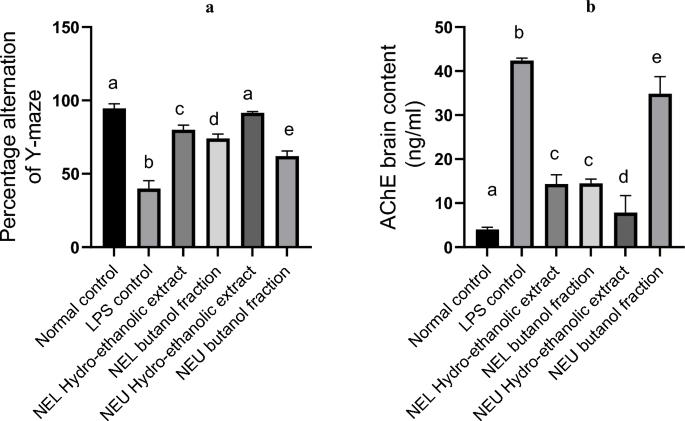
A total of 61 metabolites were tentatively identified, including phenolic acids, flavonoids, terpenoids, lipids, fatty acids and carotenoids using high-resolution tandem mass spectrometry coupled with high-performance liquid chromatography (HR-LC–MS/MS) in positive and negative ionization modes. Additionally, gas chromatography coupled with mass spectrometry (GC–MS) revealed the presence of fatty acids, sesquiterpenoids, diterpenoids, triterpenoids, and sterols. NEL exhibited the highest total phenolic content (281.35 ± 0.32 mg gallic acid/100 g), total antioxidant capacity (267.32 ± 0.47 mg gallic acid/g), iron reducing power (253.34 ± 0.42 μg/mL), 1,1-Diphenyl-2-picryl-hydrazyl (DPPH) (IC50 7.10 ± 0.01 µg/mL) and 2,2′-azinobis-(3-ethylbenzothiazoline-6-sulfonic acid) (ABTS) (68.99 ± 0.08%) radical-scavenging activities followed by NEU. The leaves butanol fraction demonstrated the highest in vitro acetylcholinesterase (AChE) inhibitory activity (61.20 ± 0.03%). In lipopolysaccharide (LPS)-induced Alzheimer disease in mice model, NEU significantly improved cognitive function, reduced AChE, Toll-like receptor 4 (TLR4), Nuclear factor kappa β (NF-κβ), Tumor necrosis factor alpha (TNF-α), and Angiotensin type 1 receptor (AT1R1) levels, and upregulated Cannabinoid receptor 1 (CB1) as compared to the LPS group followed by the NEL. In the mice treated with NEU, the cerebral cortex, hippocampus subiculum, fascia dentata, hilus, and striatum exhibited normal histological structures. NEL-treated mice showed no histopathological changes in the cerebral cortex and hippocampus subiculum. However, the fascia dentata and hilus exhibited minimal nuclear pyknosis and neuronal degeneration. Moreover, the striatum showed diffuse gliosis between the intact neurons.
Conclusion
The study reports for the first time 2 important investigations and findings: first, the metabolomic profile in NEL and NEU hydro-ethanolic extracts using HR-LC/MS/MS and GC–MS, and second, the pharmacological evidence of N. exaltata (L.) ability to protect against AD in a mice model.
期刊介绍:
Future Journal of Pharmaceutical Sciences (FJPS) is the official journal of the Future University in Egypt. It is a peer-reviewed, open access journal which publishes original research articles, review articles and case studies on all aspects of pharmaceutical sciences and technologies, pharmacy practice and related clinical aspects, and pharmacy education. The journal publishes articles covering developments in drug absorption and metabolism, pharmacokinetics and dynamics, drug delivery systems, drug targeting and nano-technology. It also covers development of new systems, methods and techniques in pharmacy education and practice. The scope of the journal also extends to cover advancements in toxicology, cell and molecular biology, biomedical research, clinical and pharmaceutical microbiology, pharmaceutical biotechnology, medicinal chemistry, phytochemistry and nutraceuticals.

 求助内容:
求助内容: 应助结果提醒方式:

 京公网安备 11010802042870号


