{"title":"A simple ninhydrin–hydrazone probe for highly selective and sensitive colorimetric detection of Cu2+ ions","authors":"Vanie V, Kavitha R","doi":"10.1007/s11243-026-00730-5","DOIUrl":null,"url":null,"abstract":"<div><p>Copper ions (Cu<sup>2+</sup>) are essential in numerous biological and environmental processes, yet their excess can lead to severe toxicity. Hence, developing selective and sensitive colorimetric sensors for Cu<sup>2+</sup> detection remains a critical research pursuit. In this study, a newly synthesized Nin–PyHz-based chemosensor, 2-(2-(pyridin-2-yl)hydrazono)-1H-indene-1,3(2 H)-dione (<b>L</b>), was explored for its selective Cu<sup>2+</sup> recognition ability. The sensor exhibited a distinct optical response exclusively toward Cu<sup>2+</sup> ions, while other metal ions and anions caused negligible interference. The free ligand showed an absorption band at 382 nm, which shifted to 434 nm upon Cu<sup>2+</sup> binding, accompanied by a perceptible color change, indicating complex formation. This bathochromic shift arises from modulation of the intramolecular charge transfer (ICT) process upon coordination with Cu<sup>2+</sup> ions. The binding constant, derived from the Benesi–Hildebrand relation, was found to be 1.83 × 10<sup>5</sup> M⁻<sup>1</sup>, and the limit of detection (LOD) was determined as 0.69 µM. Job’s plot confirmed a 1:1 stoichiometric interaction between <b>L</b> and Cu<sup>2+</sup> ions. The sensor exhibited optimal performance in the pH range of 6.0–8.0, highlighting its excellent selectivity and applicability for Cu<sup>2+</sup> detection in real or complex samples.</p></div>","PeriodicalId":803,"journal":{"name":"Transition Metal Chemistry","volume":"51 3","pages":""},"PeriodicalIF":2.8000,"publicationDate":"2026-03-31","publicationTypes":"Journal Article","fieldsOfStudy":null,"isOpenAccess":false,"openAccessPdf":"","citationCount":"0","resultStr":null,"platform":"Semanticscholar","paperid":null,"PeriodicalName":"Transition Metal Chemistry","FirstCategoryId":"92","ListUrlMain":"https://link.springer.com/article/10.1007/s11243-026-00730-5","RegionNum":4,"RegionCategory":"化学","ArticlePicture":[],"TitleCN":null,"AbstractTextCN":null,"PMCID":null,"EPubDate":"","PubModel":"","JCR":"Q3","JCRName":"CHEMISTRY, INORGANIC & NUCLEAR","Score":null,"Total":0}
引用次数: 0
Abstract
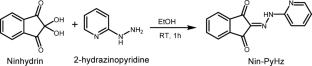
Copper ions (Cu2+) are essential in numerous biological and environmental processes, yet their excess can lead to severe toxicity. Hence, developing selective and sensitive colorimetric sensors for Cu2+ detection remains a critical research pursuit. In this study, a newly synthesized Nin–PyHz-based chemosensor, 2-(2-(pyridin-2-yl)hydrazono)-1H-indene-1,3(2 H)-dione (L), was explored for its selective Cu2+ recognition ability. The sensor exhibited a distinct optical response exclusively toward Cu2+ ions, while other metal ions and anions caused negligible interference. The free ligand showed an absorption band at 382 nm, which shifted to 434 nm upon Cu2+ binding, accompanied by a perceptible color change, indicating complex formation. This bathochromic shift arises from modulation of the intramolecular charge transfer (ICT) process upon coordination with Cu2+ ions. The binding constant, derived from the Benesi–Hildebrand relation, was found to be 1.83 × 10⁵ M⁻1, and the limit of detection (LOD) was determined as 0.69 µM. Job’s plot confirmed a 1:1 stoichiometric interaction between L and Cu2+ ions. The sensor exhibited optimal performance in the pH range of 6.0–8.0, highlighting its excellent selectivity and applicability for Cu2+ detection in real or complex samples.
期刊介绍:
Transition Metal Chemistry is an international journal designed to deal with all aspects of the subject embodied in the title: the preparation of transition metal-based molecular compounds of all kinds (including complexes of the Group 12 elements), their structural, physical, kinetic, catalytic and biological properties, their use in chemical synthesis as well as their application in the widest context, their role in naturally occurring systems etc.
Manuscripts submitted to the journal should be of broad appeal to the readership and for this reason, papers which are confined to more specialised studies such as the measurement of solution phase equilibria or thermal decomposition studies, or papers which include extensive material on f-block elements, or papers dealing with non-molecular materials, will not normally be considered for publication. Work describing new ligands or coordination geometries must provide sufficient evidence for the confident assignment of structural formulae; this will usually take the form of one or more X-ray crystal structures.

 求助内容:
求助内容: 应助结果提醒方式:

 京公网安备 11010802042870号


