{"title":"Recycling of Coal Preparation Plant Production Waste to Obtain Fuel Briquettes","authors":"K. Yu. Ushakov, E. A. Eremeev, E. Yu. Temnikova","doi":"10.1134/S004060152570079X","DOIUrl":null,"url":null,"abstract":"<p>The article considers a pressing problem of recycling coal sludge (cake), which is one of the main production waste kinds generated in the course of coal preparation. According to assessments, the annual amount of cake generated in Russia makes around 300–650 thousand t. The study considers the prospects for making fuel briquettes from cake without the addition of binding substances, but with the use of wood sawdust as a component absorbing moisture from the surface of cake particles. Such component is necessary because in molding a briquette in the mold, the water phase separates from the cake. The technical characteristics of wet coal cake produced at the Severnaya Coal Preparation Plant (CPP) operated by the Northern Kuzbass Coal Company were determined: the cake moisture content is 44.71%, yield of volatiles is 14.3%, ash content is 47.35%, and higher heating value is 17.67 MJ/kg. With due regard to the experimental and theoretical study results, briquettes from cake are made without additional thermal drying, which have a mechanical drop strength of not lower than 95% and meet the transportation requirements. Formulations for briquetting are selected, and the relationship between the cake moisture content and the required amount of moisture absorbing component is shown. In the case of using cake with the initial moisture content that has not been subjected to pre-drying, it is recommended to use the composition with the cake to sawdust ratio equal to 95/5 wt %. With such composition, the briquettes have the minimal content of sawdust, due to which they feature an increased ash content of 42–45% and a moderate yield of volatiles of 17.3–18.5%. It is shown that mold preheating to 80–100°С helps make briquettes less prone to deformation when subjected to a mechanical impact. The obtained fuel briquettes can be used in the power industry and in public utilities as fuel for boiler facilities and household furnaces.</p>","PeriodicalId":799,"journal":{"name":"Thermal Engineering","volume":"73 2","pages":"91 - 97"},"PeriodicalIF":1.0000,"publicationDate":"2026-04-03","publicationTypes":"Journal Article","fieldsOfStudy":null,"isOpenAccess":false,"openAccessPdf":"","citationCount":"0","resultStr":null,"platform":"Semanticscholar","paperid":null,"PeriodicalName":"Thermal Engineering","FirstCategoryId":"1085","ListUrlMain":"https://link.springer.com/article/10.1134/S004060152570079X","RegionNum":0,"RegionCategory":null,"ArticlePicture":[],"TitleCN":null,"AbstractTextCN":null,"PMCID":null,"EPubDate":"","PubModel":"","JCR":"Q4","JCRName":"ENERGY & FUELS","Score":null,"Total":0}
引用次数: 0
Abstract
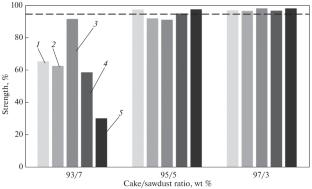
The article considers a pressing problem of recycling coal sludge (cake), which is one of the main production waste kinds generated in the course of coal preparation. According to assessments, the annual amount of cake generated in Russia makes around 300–650 thousand t. The study considers the prospects for making fuel briquettes from cake without the addition of binding substances, but with the use of wood sawdust as a component absorbing moisture from the surface of cake particles. Such component is necessary because in molding a briquette in the mold, the water phase separates from the cake. The technical characteristics of wet coal cake produced at the Severnaya Coal Preparation Plant (CPP) operated by the Northern Kuzbass Coal Company were determined: the cake moisture content is 44.71%, yield of volatiles is 14.3%, ash content is 47.35%, and higher heating value is 17.67 MJ/kg. With due regard to the experimental and theoretical study results, briquettes from cake are made without additional thermal drying, which have a mechanical drop strength of not lower than 95% and meet the transportation requirements. Formulations for briquetting are selected, and the relationship between the cake moisture content and the required amount of moisture absorbing component is shown. In the case of using cake with the initial moisture content that has not been subjected to pre-drying, it is recommended to use the composition with the cake to sawdust ratio equal to 95/5 wt %. With such composition, the briquettes have the minimal content of sawdust, due to which they feature an increased ash content of 42–45% and a moderate yield of volatiles of 17.3–18.5%. It is shown that mold preheating to 80–100°С helps make briquettes less prone to deformation when subjected to a mechanical impact. The obtained fuel briquettes can be used in the power industry and in public utilities as fuel for boiler facilities and household furnaces.

 求助内容:
求助内容: 应助结果提醒方式:

 京公网安备 11010802042870号


