Mohd Shahidan Shaari, Amri Sulong, Abdul Hayy Haziq Mohamad
{"title":"Effects of marginal CO₂ emissions on life Expectancy: A linear and nonlinear panel analysis of Asean","authors":"Mohd Shahidan Shaari, Amri Sulong, Abdul Hayy Haziq Mohamad","doi":"10.1007/s11869-026-01970-1","DOIUrl":null,"url":null,"abstract":"<div>\n \n <p>This study investigates the asymmetric effects of marginal carbon dioxide (CO₂) emissions, defined as CO₂ emissions per unit of energy use, on life expectancy in ASEAN countries from 1990 to 2023. Unlike most existing studies that focus on total CO₂ emissions, this paper introduces a novel and policy-relevant indicator that more accurately reflects energy efficiency: marginal CO₂ emissions. Using both linear and nonlinear panel Autoregressive Distributed Lag (ARDL and NARDL) models, the findings reveal that rising marginal CO₂ emissions have a significant negative impact on life expectancy. In contrast, reductions in marginal emissions are associated with improvements in public health, confirming the presence of asymmetric effects. Interestingly, health expenditure and economic expansion exhibit unexpected negative long-term associations with life expectancy, whereas inflation shows contrasting short- and long-term effects. The nonlinear model demonstrates superior explanatory power compared to the linear approach, particularly in capturing these asymmetric dynamics. ASEAN countries are selected due to their rapid economic growth, high environmental vulnerability, and wide heterogeneity in energy efficiency and health systems, making them a critical and timely context for this analysis. Therefore, policymakers should prioritise enhancing energy efficiency and reducing emissions intensity to improve population health outcomes across the region.</p>\n </div>","PeriodicalId":49109,"journal":{"name":"Air Quality Atmosphere and Health","volume":"19 4","pages":""},"PeriodicalIF":2.9000,"publicationDate":"2026-04-01","publicationTypes":"Journal Article","fieldsOfStudy":null,"isOpenAccess":false,"openAccessPdf":"","citationCount":"0","resultStr":null,"platform":"Semanticscholar","paperid":null,"PeriodicalName":"Air Quality Atmosphere and Health","FirstCategoryId":"93","ListUrlMain":"https://link.springer.com/article/10.1007/s11869-026-01970-1","RegionNum":4,"RegionCategory":"环境科学与生态学","ArticlePicture":[],"TitleCN":null,"AbstractTextCN":null,"PMCID":null,"EPubDate":"","PubModel":"","JCR":"Q3","JCRName":"ENVIRONMENTAL SCIENCES","Score":null,"Total":0}
引用次数: 0
Abstract
This study investigates the asymmetric effects of marginal carbon dioxide (CO₂) emissions, defined as CO₂ emissions per unit of energy use, on life expectancy in ASEAN countries from 1990 to 2023. Unlike most existing studies that focus on total CO₂ emissions, this paper introduces a novel and policy-relevant indicator that more accurately reflects energy efficiency: marginal CO₂ emissions. Using both linear and nonlinear panel Autoregressive Distributed Lag (ARDL and NARDL) models, the findings reveal that rising marginal CO₂ emissions have a significant negative impact on life expectancy. In contrast, reductions in marginal emissions are associated with improvements in public health, confirming the presence of asymmetric effects. Interestingly, health expenditure and economic expansion exhibit unexpected negative long-term associations with life expectancy, whereas inflation shows contrasting short- and long-term effects. The nonlinear model demonstrates superior explanatory power compared to the linear approach, particularly in capturing these asymmetric dynamics. ASEAN countries are selected due to their rapid economic growth, high environmental vulnerability, and wide heterogeneity in energy efficiency and health systems, making them a critical and timely context for this analysis. Therefore, policymakers should prioritise enhancing energy efficiency and reducing emissions intensity to improve population health outcomes across the region.
期刊介绍:
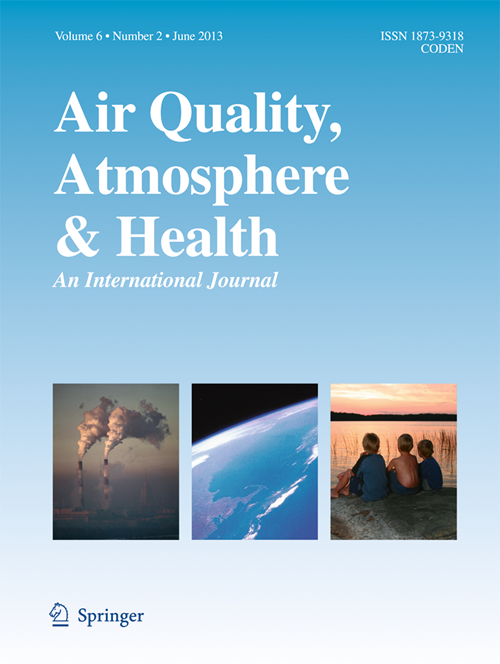
Air Quality, Atmosphere, and Health is a multidisciplinary journal which, by its very name, illustrates the broad range of work it publishes and which focuses on atmospheric consequences of human activities and their implications for human and ecological health.
It offers research papers, critical literature reviews and commentaries, as well as special issues devoted to topical subjects or themes.
International in scope, the journal presents papers that inform and stimulate a global readership, as the topic addressed are global in their import. Consequently, we do not encourage submission of papers involving local data that relate to local problems. Unless they demonstrate wide applicability, these are better submitted to national or regional journals.
Air Quality, Atmosphere & Health addresses such topics as acid precipitation; airborne particulate matter; air quality monitoring and management; exposure assessment; risk assessment; indoor air quality; atmospheric chemistry; atmospheric modeling and prediction; air pollution climatology; climate change and air quality; air pollution measurement; atmospheric impact assessment; forest-fire emissions; atmospheric science; greenhouse gases; health and ecological effects; clean air technology; regional and global change and satellite measurements.
This journal benefits a diverse audience of researchers, public health officials and policy makers addressing problems that call for solutions based in evidence from atmospheric and exposure assessment scientists, epidemiologists, and risk assessors. Publication in the journal affords the opportunity to reach beyond defined disciplinary niches to this broader readership.

 求助内容:
求助内容: 应助结果提醒方式:

 京公网安备 11010802042870号


