O. V. Zakharova, E. N. Vasilchenko, T. P. Fedulova, N. N. Cherkasova, G. V. Grigoriev, E. Yu. Koiava, N. S. Strekalova, A. A. Gusev
{"title":"Effect of Copper(II) Oxide Nanoparticles on the Growth and Development of Sugar Beet Microclones","authors":"O. V. Zakharova, E. N. Vasilchenko, T. P. Fedulova, N. N. Cherkasova, G. V. Grigoriev, E. Yu. Koiava, N. S. Strekalova, A. A. Gusev","doi":"10.1134/S2635167625602074","DOIUrl":null,"url":null,"abstract":"<p>We studied the effect of copper oxide nanoparticles (CuO NPs) of elliptical shape, 80–100 nm in size (CuO 1) and flake-shaped, 100–500 nm in cross-sectional size and 10–20 nm in thickness (CuO 2), on sugar beet (<i>Beta vulgaris</i> L.) micro-sprouts of male-sterile (MS forms) and Owen-type sterility fixers (O-type) under tissue culture conditions in vitro. NPs were added to the nutrient growth medium at concentrations of 10 and 100 mg/L. We found a decrease in the growth indices of regenerants under the influence of NPs, regardless of the type of plants and particles. At the same time, the addition of 10 mg/L NPs significantly increased the multiplication coefficient. For MS-form plants, the maximum multiplication rate (+77% to the control) was observed with the introduction of CuO 1, while for O-type plants, an increase in the rate by 96% was noted in the variant with CuO 2. Analysis of copper bioaccumulation showed an increase in the element content in sugar beet microclones, and if a two-fold increase was noted for CuO 1, then in the case of CuO 2, the copper content increased 4 times for MS-form plants and 5 times for O-type plants. Thus, we have shown for the first time the prospects of using CuO NPs to increase the efficiency of the clonal micropropagation procedure of sugar beet plants. However, further studies of the safety of their use are required, which is associated with the identified accumulation of copper in regenerated plants.</p>","PeriodicalId":716,"journal":{"name":"Nanotechnologies in Russia","volume":"20 1","pages":"S97 - S106"},"PeriodicalIF":0.8000,"publicationDate":"2026-04-03","publicationTypes":"Journal Article","fieldsOfStudy":null,"isOpenAccess":false,"openAccessPdf":"","citationCount":"0","resultStr":null,"platform":"Semanticscholar","paperid":null,"PeriodicalName":"Nanotechnologies in Russia","FirstCategoryId":"1085","ListUrlMain":"https://link.springer.com/article/10.1134/S2635167625602074","RegionNum":0,"RegionCategory":null,"ArticlePicture":[],"TitleCN":null,"AbstractTextCN":null,"PMCID":null,"EPubDate":"","PubModel":"","JCR":"Q3","JCRName":"Engineering","Score":null,"Total":0}
引用次数: 0
Abstract
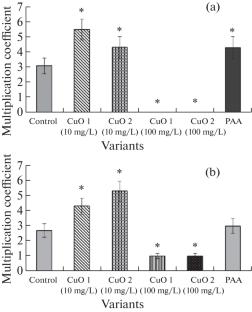
We studied the effect of copper oxide nanoparticles (CuO NPs) of elliptical shape, 80–100 nm in size (CuO 1) and flake-shaped, 100–500 nm in cross-sectional size and 10–20 nm in thickness (CuO 2), on sugar beet (Beta vulgaris L.) micro-sprouts of male-sterile (MS forms) and Owen-type sterility fixers (O-type) under tissue culture conditions in vitro. NPs were added to the nutrient growth medium at concentrations of 10 and 100 mg/L. We found a decrease in the growth indices of regenerants under the influence of NPs, regardless of the type of plants and particles. At the same time, the addition of 10 mg/L NPs significantly increased the multiplication coefficient. For MS-form plants, the maximum multiplication rate (+77% to the control) was observed with the introduction of CuO 1, while for O-type plants, an increase in the rate by 96% was noted in the variant with CuO 2. Analysis of copper bioaccumulation showed an increase in the element content in sugar beet microclones, and if a two-fold increase was noted for CuO 1, then in the case of CuO 2, the copper content increased 4 times for MS-form plants and 5 times for O-type plants. Thus, we have shown for the first time the prospects of using CuO NPs to increase the efficiency of the clonal micropropagation procedure of sugar beet plants. However, further studies of the safety of their use are required, which is associated with the identified accumulation of copper in regenerated plants.
期刊介绍:
Nanobiotechnology Reports publishes interdisciplinary research articles on fundamental aspects of the structure and properties of nanoscale objects and nanomaterials, polymeric and bioorganic molecules, and supramolecular and biohybrid complexes, as well as articles that discuss technologies for their preparation and processing, and practical implementation of products, devices, and nature-like systems based on them. The journal publishes original articles and reviews that meet the highest scientific quality standards in the following areas of science and technology studies: self-organizing structures and nanoassemblies; nanostructures, including nanotubes; functional and structural nanomaterials; polymeric, bioorganic, and hybrid nanomaterials; devices and products based on nanomaterials and nanotechnology; nanobiology and genetics, and omics technologies; nanobiomedicine and nanopharmaceutics; nanoelectronics and neuromorphic computing systems; neurocognitive systems and technologies; nanophotonics; natural science methods in a study of cultural heritage items; metrology, standardization, and monitoring in nanotechnology.

 求助内容:
求助内容: 应助结果提醒方式:

 京公网安备 11010802042870号


