Krishnan Shreema, Shanmugam Mathammal, Gopi Somasundaram, Viswanathan Kalaiselvi, Nadir Ayrilmis, B. Blessymol
{"title":"Biosynthesis of zinc oxide and silver/zinc oxide nanocompositesusing Kalanchoe pinnata leaf extracts for antibacterial and anticancer applications","authors":"Krishnan Shreema, Shanmugam Mathammal, Gopi Somasundaram, Viswanathan Kalaiselvi, Nadir Ayrilmis, B. Blessymol","doi":"10.1186/s11671-026-04523-8","DOIUrl":null,"url":null,"abstract":"<div><p>Green synthesis of metal and metal oxide nanoparticles has attracted considerable attention due to its eco-friendly nature and enhanced functional performance. Zinc oxide (ZnO) nanoparticles have been extensively explored; however, their efficiency is often limited by rapid charge recombination and moderate biological activity. The incorporation of silver (Ag) and the use of plant-mediated synthesis offer a promising strategy to overcome these limitations.In the present study, Ag–ZnO nanoparticles were synthesized via a green route using <i>Kalanchoe pinnata</i> leaf extract as a natural reducing and stabilizing agent. The synthesized nanoparticles were characterized by X-ray diffraction (XRD), Fourier transform infrared spectroscopy (FTIR), UV–Visible spectroscopy, scanning electron microscopy (SEM), and energy-dispersive X-ray analysis (EDAX). The biological activities were evaluated using standard antioxidant and antibacterial assays.XRD analysis confirmed the crystalline nature of ZnO with the successful incorporation of Ag, without the formation of secondary impurity phases. The FTIR spectra revealed the presence of phytochemical functional groups responsible for nanoparticle stabilization. SEM images demonstrated nearly spherical and well-dispersed nanoparticles, while EDAX analysis confirmed the elemental composition of Ag and Zn. UV–Visible spectroscopy indicated enhanced optical absorption due to Ag incorporation.The Ag–ZnO nanoparticles exhibited significantly improved antioxidant and antibacterial activities compared to pure ZnO, which can be attributed to the synergistic effect of Ag and bioactive phytochemical capping. This study demonstrates that <i>Kalanchoe pinnata</i>-mediated green synthesis effectively enhances the structural, optical, and biological performance of Ag–ZnO nanoparticles, highlighting their potential for eco-friendly biomedical applications.</p><h3>Graphical abstract</h3><div><figure><div><div><picture><img></picture></div></div></figure></div></div>","PeriodicalId":51136,"journal":{"name":"Nanoscale Research Letters","volume":"21 1","pages":""},"PeriodicalIF":4.1000,"publicationDate":"2026-04-03","publicationTypes":"Journal Article","fieldsOfStudy":null,"isOpenAccess":false,"openAccessPdf":"https://link.springer.com/content/pdf/10.1186/s11671-026-04523-8.pdf","citationCount":"0","resultStr":null,"platform":"Semanticscholar","paperid":null,"PeriodicalName":"Nanoscale Research Letters","FirstCategoryId":"88","ListUrlMain":"https://link.springer.com/article/10.1186/s11671-026-04523-8","RegionNum":3,"RegionCategory":"材料科学","ArticlePicture":[],"TitleCN":null,"AbstractTextCN":null,"PMCID":null,"EPubDate":"","PubModel":"","JCR":"Q2","JCRName":"MATERIALS SCIENCE, MULTIDISCIPLINARY","Score":null,"Total":0}
引用次数: 0
Abstract
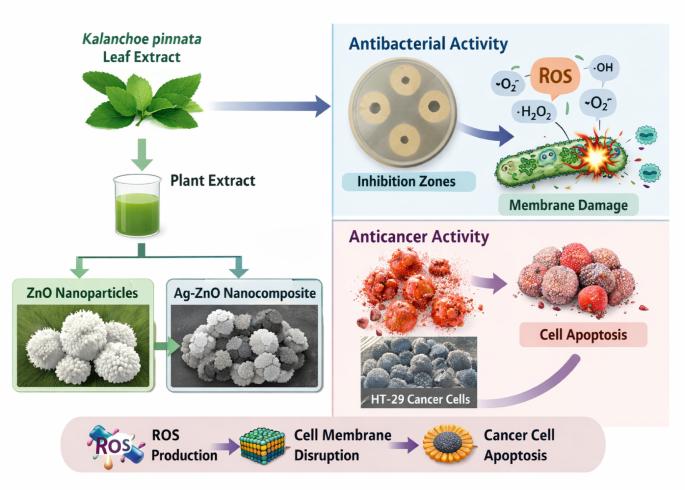
Green synthesis of metal and metal oxide nanoparticles has attracted considerable attention due to its eco-friendly nature and enhanced functional performance. Zinc oxide (ZnO) nanoparticles have been extensively explored; however, their efficiency is often limited by rapid charge recombination and moderate biological activity. The incorporation of silver (Ag) and the use of plant-mediated synthesis offer a promising strategy to overcome these limitations.In the present study, Ag–ZnO nanoparticles were synthesized via a green route using Kalanchoe pinnata leaf extract as a natural reducing and stabilizing agent. The synthesized nanoparticles were characterized by X-ray diffraction (XRD), Fourier transform infrared spectroscopy (FTIR), UV–Visible spectroscopy, scanning electron microscopy (SEM), and energy-dispersive X-ray analysis (EDAX). The biological activities were evaluated using standard antioxidant and antibacterial assays.XRD analysis confirmed the crystalline nature of ZnO with the successful incorporation of Ag, without the formation of secondary impurity phases. The FTIR spectra revealed the presence of phytochemical functional groups responsible for nanoparticle stabilization. SEM images demonstrated nearly spherical and well-dispersed nanoparticles, while EDAX analysis confirmed the elemental composition of Ag and Zn. UV–Visible spectroscopy indicated enhanced optical absorption due to Ag incorporation.The Ag–ZnO nanoparticles exhibited significantly improved antioxidant and antibacterial activities compared to pure ZnO, which can be attributed to the synergistic effect of Ag and bioactive phytochemical capping. This study demonstrates that Kalanchoe pinnata-mediated green synthesis effectively enhances the structural, optical, and biological performance of Ag–ZnO nanoparticles, highlighting their potential for eco-friendly biomedical applications.
期刊介绍:
Nanoscale Research Letters (NRL) provides an interdisciplinary forum for communication of scientific and technological advances in the creation and use of objects at the nanometer scale. NRL is the first nanotechnology journal from a major publisher to be published with Open Access.


 求助内容:
求助内容: 应助结果提醒方式:

 京公网安备 11010802042870号


