E. R. Umerov, A. P. Amosov, E. I. Latukhin, A. D. Kachura, I. A. Rastegaev, M. A. Afanasiev
{"title":"The Influence of Aluminum Alloying on the Structure and Properties of TiC–Graphite–Al SHS Composites","authors":"E. R. Umerov, A. P. Amosov, E. I. Latukhin, A. D. Kachura, I. A. Rastegaev, M. A. Afanasiev","doi":"10.1134/S1067821225601224","DOIUrl":null,"url":null,"abstract":"<p>The study investigates the possibility of using self-propagating high-temperature synthesis (SHS) in open air to produce porous titanium carbide skeletons containing free graphite, designed for spontaneous infiltration with Al–5% Cu and Al–5% Si melts prepared in a furnace at 900°C. Hybrid composites TiC–C(graphite)–(Al–5% Cu) and TiC–C(graphite)–(Al–5% Si) were obtained with relatively homogeneous structures and average densities of 3.06 and 2.94 g/cm<sup>3</sup>. The microstructure, phase composition, physical–mechanical and tribological characteristics were studied using scanning electron microscopy (SEM) with energy-dispersive spectrometry (EDS), X-ray diffraction (XRD), hydrostatic density measurement, compressive strength tests, and pin-on-disk tribometry. Secondary phases in the composites include Al<sub>4</sub>C<sub>3</sub>, Al<sub>2</sub>O<sub>3</sub>, and TiAl<sub>3</sub>. Reduced interfacial chemical activity was observed in TiC–C(graphite)–(Al–5% Cu). Tribological tests revealed enhanced wear resistance with predominantly abrasive wear mechanisms. Compared to pure Al, TiC–C composites infiltrated with Al–5% Si and Al–5% Cu exhibited significantly better tribological performance: the addition of 5% Si and 5% Cu reduced the friction coefficient by 17 and 34%, counter body wear by 21 and 71%, and composite wear by 1.8 and 3.5 times, respectively. The best tribological results were achieved for TiC–C–(Al–5% Cu). The conventional yield strength was: Al–5% Si (92.8 ± 13.1 MPa), Al–5% Cu (128.7 ± 17.2 MPa), TiC–C–(Al–5% Si) (191.0 ± 29.7 MPa), TiC–C–(Al–5% Cu) (208.3 ± 58.1 MPa). Thus, the addition of a TiC–C skeleton increased the yield strength of Al alloys by 1.6–2 times.</p>","PeriodicalId":765,"journal":{"name":"Russian Journal of Non-Ferrous Metals","volume":"67 1","pages":"100 - 110"},"PeriodicalIF":0.9000,"publicationDate":"2026-04-02","publicationTypes":"Journal Article","fieldsOfStudy":null,"isOpenAccess":false,"openAccessPdf":"","citationCount":"0","resultStr":null,"platform":"Semanticscholar","paperid":null,"PeriodicalName":"Russian Journal of Non-Ferrous Metals","FirstCategoryId":"88","ListUrlMain":"https://link.springer.com/article/10.1134/S1067821225601224","RegionNum":4,"RegionCategory":"材料科学","ArticlePicture":[],"TitleCN":null,"AbstractTextCN":null,"PMCID":null,"EPubDate":"","PubModel":"","JCR":"Q4","JCRName":"METALLURGY & METALLURGICAL ENGINEERING","Score":null,"Total":0}
引用次数: 0
Abstract
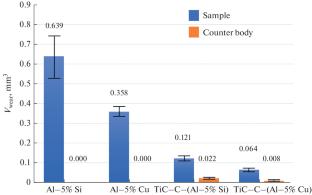
The study investigates the possibility of using self-propagating high-temperature synthesis (SHS) in open air to produce porous titanium carbide skeletons containing free graphite, designed for spontaneous infiltration with Al–5% Cu and Al–5% Si melts prepared in a furnace at 900°C. Hybrid composites TiC–C(graphite)–(Al–5% Cu) and TiC–C(graphite)–(Al–5% Si) were obtained with relatively homogeneous structures and average densities of 3.06 and 2.94 g/cm3. The microstructure, phase composition, physical–mechanical and tribological characteristics were studied using scanning electron microscopy (SEM) with energy-dispersive spectrometry (EDS), X-ray diffraction (XRD), hydrostatic density measurement, compressive strength tests, and pin-on-disk tribometry. Secondary phases in the composites include Al4C3, Al2O3, and TiAl3. Reduced interfacial chemical activity was observed in TiC–C(graphite)–(Al–5% Cu). Tribological tests revealed enhanced wear resistance with predominantly abrasive wear mechanisms. Compared to pure Al, TiC–C composites infiltrated with Al–5% Si and Al–5% Cu exhibited significantly better tribological performance: the addition of 5% Si and 5% Cu reduced the friction coefficient by 17 and 34%, counter body wear by 21 and 71%, and composite wear by 1.8 and 3.5 times, respectively. The best tribological results were achieved for TiC–C–(Al–5% Cu). The conventional yield strength was: Al–5% Si (92.8 ± 13.1 MPa), Al–5% Cu (128.7 ± 17.2 MPa), TiC–C–(Al–5% Si) (191.0 ± 29.7 MPa), TiC–C–(Al–5% Cu) (208.3 ± 58.1 MPa). Thus, the addition of a TiC–C skeleton increased the yield strength of Al alloys by 1.6–2 times.
期刊介绍:
Russian Journal of Non-Ferrous Metals is a journal the main goal of which is to achieve new knowledge in the following topics: extraction metallurgy, hydro- and pirometallurgy, casting, plastic deformation, metallography and heat treatment, powder metallurgy and composites, self-propagating high-temperature synthesis, surface engineering and advanced protected coatings, environments, and energy capacity in non-ferrous metallurgy.

 求助内容:
求助内容: 应助结果提醒方式:

 京公网安备 11010802042870号


