{"title":"Experimental and Statistical Optimization of Thinning Ratio in Deep Drawing of SUS 304 Stainless Steel","authors":"Lai Dang Giang, Tran Duc Hoan","doi":"10.1134/S0036029525600464","DOIUrl":null,"url":null,"abstract":"<p>This study investigates the thinning behavior in the deep drawing of SUS 304 stainless steel cylindrical cups by combining controlled experiments with statistical analysis and metaheuristic optimization. A Box–Behnken Design (BBD) was employed to systematically evaluate the effects of die radius, blank holder force (BHF), and friction coefficient, the latter determined through tribological tests under three lubrication conditions. Wall thickness measurements at eight predefined positions along the cup profile revealed that the most severe thinning consistently occurred at the wall–bottom transition. A quadratic regression model was developed and validated by analysis of variance (ANOVA), demonstrating high statistical adequacy, with BHF identified as the dominant factor, followed by friction coefficient and die radius. Significant effects were also observed for the die radius–friction interaction and the nonlinear influence of BHF. Numerical optimization was then performed using the Particle Swarm Optimization (PSO) algorithm, which identified the optimum forming condition at a die radius of 6 mm, BHF of 41.1 kN, and a friction coefficient of 0.024, corresponding to a minimum thinning ratio of 5.42%. Experimental verification confirmed the prediction with a deviation of only 4.31%. The findings establish a statistically validated framework for minimizing thinning in stainless steel deep drawing and provide benchmark data for FEM calibration together with practical guidelines for die design and lubrication strategies in industrial applications.</p>","PeriodicalId":769,"journal":{"name":"Russian Metallurgy (Metally)","volume":"2025 12","pages":"2106 - 2116"},"PeriodicalIF":0.3000,"publicationDate":"2026-04-03","publicationTypes":"Journal Article","fieldsOfStudy":null,"isOpenAccess":false,"openAccessPdf":"","citationCount":"0","resultStr":null,"platform":"Semanticscholar","paperid":null,"PeriodicalName":"Russian Metallurgy (Metally)","FirstCategoryId":"5","ListUrlMain":"https://link.springer.com/article/10.1134/S0036029525600464","RegionNum":0,"RegionCategory":null,"ArticlePicture":[],"TitleCN":null,"AbstractTextCN":null,"PMCID":null,"EPubDate":"","PubModel":"","JCR":"Q4","JCRName":"METALLURGY & METALLURGICAL ENGINEERING","Score":null,"Total":0}
引用次数: 0
Abstract
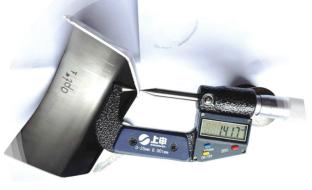
This study investigates the thinning behavior in the deep drawing of SUS 304 stainless steel cylindrical cups by combining controlled experiments with statistical analysis and metaheuristic optimization. A Box–Behnken Design (BBD) was employed to systematically evaluate the effects of die radius, blank holder force (BHF), and friction coefficient, the latter determined through tribological tests under three lubrication conditions. Wall thickness measurements at eight predefined positions along the cup profile revealed that the most severe thinning consistently occurred at the wall–bottom transition. A quadratic regression model was developed and validated by analysis of variance (ANOVA), demonstrating high statistical adequacy, with BHF identified as the dominant factor, followed by friction coefficient and die radius. Significant effects were also observed for the die radius–friction interaction and the nonlinear influence of BHF. Numerical optimization was then performed using the Particle Swarm Optimization (PSO) algorithm, which identified the optimum forming condition at a die radius of 6 mm, BHF of 41.1 kN, and a friction coefficient of 0.024, corresponding to a minimum thinning ratio of 5.42%. Experimental verification confirmed the prediction with a deviation of only 4.31%. The findings establish a statistically validated framework for minimizing thinning in stainless steel deep drawing and provide benchmark data for FEM calibration together with practical guidelines for die design and lubrication strategies in industrial applications.
期刊介绍:
Russian Metallurgy (Metally) publishes results of original experimental and theoretical research in the form of reviews and regular articles devoted to topical problems of metallurgy, physical metallurgy, and treatment of ferrous, nonferrous, rare, and other metals and alloys, intermetallic compounds, and metallic composite materials. The journal focuses on physicochemical properties of metallurgical materials (ores, slags, matters, and melts of metals and alloys); physicochemical processes (thermodynamics and kinetics of pyrometallurgical, hydrometallurgical, electrochemical, and other processes); theoretical metallurgy; metal forming; thermoplastic and thermochemical treatment; computation and experimental determination of phase diagrams and thermokinetic diagrams; mechanisms and kinetics of phase transitions in metallic materials; relations between the chemical composition, phase and structural states of materials and their physicochemical and service properties; interaction between metallic materials and external media; and effects of radiation on these materials.

 求助内容:
求助内容: 应助结果提醒方式:

 京公网安备 11010802042870号


