{"title":"Phase Transformation and Process Optimization for High-Temperature Calcification Dissolution of Gibbsitic Bauxite","authors":"Zhiguo Li, Wang Song, Tingan Zhang, Lv Guozhi, Xin He, Zhuangzhuang Yun","doi":"10.1134/S0036029525600336","DOIUrl":null,"url":null,"abstract":"<p>As the main method of alumina production in the world, Bayer process emits a large amount of high alkaline red mud, which poses a very serious threat to the ecological environment. In this study, the high-temperature calcification transformation method based on source blocking was used to treat the Guinea gibbsite from the perspective of mineral phase reconstruction. A new type of structural red mud with almost no alkali was obtained while achieving efficient dissolution of alumina at high temperature. Single-factor tests (180–280°C, C/S = 1.25–2.5, 60 min, 240 g L<sup>–1</sup> Na<sub>2</sub>O) showed that temperature and CaO/SiO<sub>2</sub> ratio jointly control extraction yield and Na<sub>2</sub>O content of the residue. Characterization revealed that rising temperature converts boehmite to well-crystallized hydrogarnet while suppressing sodium aluminosilicate. Al<sub>2</sub>O<sub>3</sub> dissolution increases from ~76% at 180°C to ~88% at 260–280°C; excess CaO drops yield. Na<sub>2</sub>O in slag falls continuously with higher C/S, reaching 0.41 wt % at 280°C and C/S = 2.5. The optimum compromise among yield, energy and equipment pressure is 240°C, C/S = 2.0, 60 min, giving 85% Al<sub>2</sub>O<sub>3</sub> extraction and <0.8 wt % Na<sub>2</sub>O in residue.</p>","PeriodicalId":769,"journal":{"name":"Russian Metallurgy (Metally)","volume":"2025 12","pages":"2089 - 2097"},"PeriodicalIF":0.3000,"publicationDate":"2026-04-03","publicationTypes":"Journal Article","fieldsOfStudy":null,"isOpenAccess":false,"openAccessPdf":"","citationCount":"0","resultStr":null,"platform":"Semanticscholar","paperid":null,"PeriodicalName":"Russian Metallurgy (Metally)","FirstCategoryId":"5","ListUrlMain":"https://link.springer.com/article/10.1134/S0036029525600336","RegionNum":0,"RegionCategory":null,"ArticlePicture":[],"TitleCN":null,"AbstractTextCN":null,"PMCID":null,"EPubDate":"","PubModel":"","JCR":"Q4","JCRName":"METALLURGY & METALLURGICAL ENGINEERING","Score":null,"Total":0}
引用次数: 0
Abstract
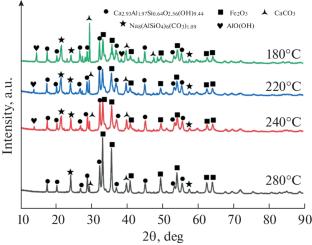
As the main method of alumina production in the world, Bayer process emits a large amount of high alkaline red mud, which poses a very serious threat to the ecological environment. In this study, the high-temperature calcification transformation method based on source blocking was used to treat the Guinea gibbsite from the perspective of mineral phase reconstruction. A new type of structural red mud with almost no alkali was obtained while achieving efficient dissolution of alumina at high temperature. Single-factor tests (180–280°C, C/S = 1.25–2.5, 60 min, 240 g L–1 Na2O) showed that temperature and CaO/SiO2 ratio jointly control extraction yield and Na2O content of the residue. Characterization revealed that rising temperature converts boehmite to well-crystallized hydrogarnet while suppressing sodium aluminosilicate. Al2O3 dissolution increases from ~76% at 180°C to ~88% at 260–280°C; excess CaO drops yield. Na2O in slag falls continuously with higher C/S, reaching 0.41 wt % at 280°C and C/S = 2.5. The optimum compromise among yield, energy and equipment pressure is 240°C, C/S = 2.0, 60 min, giving 85% Al2O3 extraction and <0.8 wt % Na2O in residue.
期刊介绍:
Russian Metallurgy (Metally) publishes results of original experimental and theoretical research in the form of reviews and regular articles devoted to topical problems of metallurgy, physical metallurgy, and treatment of ferrous, nonferrous, rare, and other metals and alloys, intermetallic compounds, and metallic composite materials. The journal focuses on physicochemical properties of metallurgical materials (ores, slags, matters, and melts of metals and alloys); physicochemical processes (thermodynamics and kinetics of pyrometallurgical, hydrometallurgical, electrochemical, and other processes); theoretical metallurgy; metal forming; thermoplastic and thermochemical treatment; computation and experimental determination of phase diagrams and thermokinetic diagrams; mechanisms and kinetics of phase transitions in metallic materials; relations between the chemical composition, phase and structural states of materials and their physicochemical and service properties; interaction between metallic materials and external media; and effects of radiation on these materials.

 求助内容:
求助内容: 应助结果提醒方式:

 京公网安备 11010802042870号


