Development and Mechanical Properties of Ceramic-Reinforced Hypoeutectic Al Alloy Functionally Graded Materials Produced by Centrifugal Casting: A Machine Learning-Enhanced Constitutive Modeling Approach
IF 0.9 4区 材料科学Q4 METALLURGY & METALLURGICAL ENGINEERING
Chahinez Medjane, Abdelhakim Benslimane, Oussama Djema, Liamine Kaba, Hind Mansour, Ridha Badi, Nadir Mesrati
{"title":"Development and Mechanical Properties of Ceramic-Reinforced Hypoeutectic Al Alloy Functionally Graded Materials Produced by Centrifugal Casting: A Machine Learning-Enhanced Constitutive Modeling Approach","authors":"Chahinez Medjane, Abdelhakim Benslimane, Oussama Djema, Liamine Kaba, Hind Mansour, Ridha Badi, Nadir Mesrati","doi":"10.1134/S1067821225601170","DOIUrl":null,"url":null,"abstract":"<p>This study presents a systematic investigation of ceramic-reinforced AlSi10 functionally graded materials through optimized centrifugal casting combined with machine learning-enhanced constitutive modeling. Processing parameters were systematically optimized using twelve experimental specimens with rotation speeds of 600, 1200 and 1800 rpm, with 1200 rpm yielding consistent compositional gradients within the investigated rotational range. Characterization focused on Al<sub>2</sub>O<sub>3</sub>, graphite, and SiC reinforcements at 1.26 wt % loading under controlled conditions (400°C mold temperature, 850°C casting temperature). Spatial hardness mapping confirmed the formation of functionally graded microstructure with maximum gradients of 1.34 HV/mm, demonstrating effective density-driven particle segregation. Graphite reinforcement achieved optimal performance with 177.4 MPa ultimate tensile strength and 24.9% elongation, representing 14.8 and 13.1% improvements over the matrix. Machine learning algorithms were employed for constitutive parameter identification, with the Hockett–Sherby formulation providing close fits to experimental flow curves (<i>R</i><sup>2</sup> = 0.998). This approach provides baseline data for FGM process-property relationships for aluminum-silicon based functionally graded components.</p>","PeriodicalId":765,"journal":{"name":"Russian Journal of Non-Ferrous Metals","volume":"67 1","pages":"13 - 30"},"PeriodicalIF":0.9000,"publicationDate":"2026-04-02","publicationTypes":"Journal Article","fieldsOfStudy":null,"isOpenAccess":false,"openAccessPdf":"","citationCount":"0","resultStr":null,"platform":"Semanticscholar","paperid":null,"PeriodicalName":"Russian Journal of Non-Ferrous Metals","FirstCategoryId":"88","ListUrlMain":"https://link.springer.com/article/10.1134/S1067821225601170","RegionNum":4,"RegionCategory":"材料科学","ArticlePicture":[],"TitleCN":null,"AbstractTextCN":null,"PMCID":null,"EPubDate":"","PubModel":"","JCR":"Q4","JCRName":"METALLURGY & METALLURGICAL ENGINEERING","Score":null,"Total":0}
引用次数: 0
Abstract
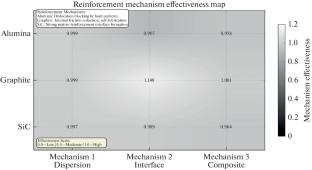
This study presents a systematic investigation of ceramic-reinforced AlSi10 functionally graded materials through optimized centrifugal casting combined with machine learning-enhanced constitutive modeling. Processing parameters were systematically optimized using twelve experimental specimens with rotation speeds of 600, 1200 and 1800 rpm, with 1200 rpm yielding consistent compositional gradients within the investigated rotational range. Characterization focused on Al2O3, graphite, and SiC reinforcements at 1.26 wt % loading under controlled conditions (400°C mold temperature, 850°C casting temperature). Spatial hardness mapping confirmed the formation of functionally graded microstructure with maximum gradients of 1.34 HV/mm, demonstrating effective density-driven particle segregation. Graphite reinforcement achieved optimal performance with 177.4 MPa ultimate tensile strength and 24.9% elongation, representing 14.8 and 13.1% improvements over the matrix. Machine learning algorithms were employed for constitutive parameter identification, with the Hockett–Sherby formulation providing close fits to experimental flow curves (R2 = 0.998). This approach provides baseline data for FGM process-property relationships for aluminum-silicon based functionally graded components.
期刊介绍:
Russian Journal of Non-Ferrous Metals is a journal the main goal of which is to achieve new knowledge in the following topics: extraction metallurgy, hydro- and pirometallurgy, casting, plastic deformation, metallography and heat treatment, powder metallurgy and composites, self-propagating high-temperature synthesis, surface engineering and advanced protected coatings, environments, and energy capacity in non-ferrous metallurgy.

 求助内容:
求助内容: 应助结果提醒方式:

 京公网安备 11010802042870号


