Effect of Texture and Distribution of Second-Phase Particles on the Corrosion Anisotropy of Extruded ZX10 Magnesium Alloy Assessed with the Aid of Confocal Laser Scanning Microscopy
IF 0.9 4区 材料科学Q4 METALLURGY & METALLURGICAL ENGINEERING
E. D. Merson, V. A. Poluyanov, P. N. Myagkikh, V. A. Danilov, A. V. Danyuk, A. I. Brilevskiy, D. L. Merson
{"title":"Effect of Texture and Distribution of Second-Phase Particles on the Corrosion Anisotropy of Extruded ZX10 Magnesium Alloy Assessed with the Aid of Confocal Laser Scanning Microscopy","authors":"E. D. Merson, V. A. Poluyanov, P. N. Myagkikh, V. A. Danilov, A. V. Danyuk, A. I. Brilevskiy, D. L. Merson","doi":"10.1134/S1067821225601492","DOIUrl":null,"url":null,"abstract":"<p>The work investigated the anisotropy of corrosion properties of extruded low-alloy magnesium alloy ZX10 in two orthogonal sections (longitudinal TD and transverse ED). Using the EBSD and SEM methods, it was established that the TD section is characterized by the dominance of grains with a basal orientation and a stringer-like distribution of second-phase particles (relative area ~0.1%) oriented along the extrusion direction. In the ED section, the prismatic-pyramidal texture predominates, the particles are distributed more evenly, and their relative area is smaller than in the longitudinal section (~0.065%). Corrosion tests in 0.9% NaCl at 37°C for 168 h showed that the integral corrosion rates (determined by mass and volume loss) for both sections are similar, despite the different texture. However, detailed quantitative analysis of damage morphology using confocal laser scanning microscopy (CLSM) revealed significant differences in the nature of pitting corrosion. In the TD section, a larger relative area of pits was observed (14% versus 6% in ED), but their average depth was smaller (90 versus 186 µm) and their axial growth rate was two times lower. It has been shown that the initiation and growth of pits correlate with the location of second-phase particles. It is suggested that the slight differences in the integral corrosion rate of the two sections of the extruded rod are likely explained by the opposite influence of two factors: a favorable basal texture but a high density of string-distributed particles in the TD section and, conversely, an unfavorable texture but a uniform distribution of particles in the ED section. The paper demonstrates the effectiveness of CLSM for quantitatively separating the contribution of different types of corrosion.</p>","PeriodicalId":765,"journal":{"name":"Russian Journal of Non-Ferrous Metals","volume":"67 1","pages":"79 - 90"},"PeriodicalIF":0.9000,"publicationDate":"2026-04-02","publicationTypes":"Journal Article","fieldsOfStudy":null,"isOpenAccess":false,"openAccessPdf":"","citationCount":"0","resultStr":null,"platform":"Semanticscholar","paperid":null,"PeriodicalName":"Russian Journal of Non-Ferrous Metals","FirstCategoryId":"88","ListUrlMain":"https://link.springer.com/article/10.1134/S1067821225601492","RegionNum":4,"RegionCategory":"材料科学","ArticlePicture":[],"TitleCN":null,"AbstractTextCN":null,"PMCID":null,"EPubDate":"","PubModel":"","JCR":"Q4","JCRName":"METALLURGY & METALLURGICAL ENGINEERING","Score":null,"Total":0}
引用次数: 0
Abstract
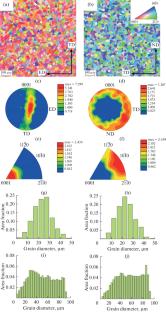
The work investigated the anisotropy of corrosion properties of extruded low-alloy magnesium alloy ZX10 in two orthogonal sections (longitudinal TD and transverse ED). Using the EBSD and SEM methods, it was established that the TD section is characterized by the dominance of grains with a basal orientation and a stringer-like distribution of second-phase particles (relative area ~0.1%) oriented along the extrusion direction. In the ED section, the prismatic-pyramidal texture predominates, the particles are distributed more evenly, and their relative area is smaller than in the longitudinal section (~0.065%). Corrosion tests in 0.9% NaCl at 37°C for 168 h showed that the integral corrosion rates (determined by mass and volume loss) for both sections are similar, despite the different texture. However, detailed quantitative analysis of damage morphology using confocal laser scanning microscopy (CLSM) revealed significant differences in the nature of pitting corrosion. In the TD section, a larger relative area of pits was observed (14% versus 6% in ED), but their average depth was smaller (90 versus 186 µm) and their axial growth rate was two times lower. It has been shown that the initiation and growth of pits correlate with the location of second-phase particles. It is suggested that the slight differences in the integral corrosion rate of the two sections of the extruded rod are likely explained by the opposite influence of two factors: a favorable basal texture but a high density of string-distributed particles in the TD section and, conversely, an unfavorable texture but a uniform distribution of particles in the ED section. The paper demonstrates the effectiveness of CLSM for quantitatively separating the contribution of different types of corrosion.
期刊介绍:
Russian Journal of Non-Ferrous Metals is a journal the main goal of which is to achieve new knowledge in the following topics: extraction metallurgy, hydro- and pirometallurgy, casting, plastic deformation, metallography and heat treatment, powder metallurgy and composites, self-propagating high-temperature synthesis, surface engineering and advanced protected coatings, environments, and energy capacity in non-ferrous metallurgy.


 求助内容:
求助内容: 应助结果提醒方式:

 京公网安备 11010802042870号


