
Dissecting the compatible mechanisms of pharmacological and toxicological effects of cinnabar in Guilingji by gut microbiome and metabolomics
IF 1.3
4区 化学
Q4 CHEMISTRY, ANALYTICAL
Chinese Journal of Analytical Chemistry
Pub Date : 2026-04-01
Epub Date: 2025-10-23
DOI:10.1016/j.cjac.2025.100662
引用次数: 0
Abstract
Guilingji (GLJ) is a well-known prescription in China, and has great advantages in the treatment of frailty syndrome, accompanied by good safety profile and outcomes. Cinnabar is one of the traditional Chinese medicines in GLJ, and has been used in China for more than 2000 years in many Chinese medicine prescription. Controversially, cinnabar is reported to have many potential side effects, including brain damage, hepatotoxicity and nephrotoxicity. This study investigated the therapeutical efficacy and toxicity of cinnabar in the case that GLJ treated aging rats to explore the rationality of the application of cinnabar in GLJ. GLJ displayed the therapeutical efficacy of improving brain aging, bone aging and muscle aging, in which cinnabar contributed to the anti-aging efficacy of GLJ against muscle by increasing the levels of intestinal androgens. Meanwhile, cinnabar in a dose, equivalent to its therapeutic dose in GLJ, individually showed a certain toxicity to the liver, kidney and brain of aging rats after long exposure, whereas GLJ didn’t not. Mechanistically, cinnabar free GLJ reversed the effect that cinnabar increased the abundance of mercury methylating microbiota and reduced the abundance of mercury demethylating microbiota in gut. Furthermore, cinnabar free GLJ significantly changed the gut microbiota composition of aging rats, while GLJ reprogrammed gut microbiota composition of aging rats into that of health rats via depending on cinnabar. This research provides an efficient way to understand the compatibility of pharmacological and toxicological effects of cinnabar in traditional Chinese medicine (TCM) prescriptions.
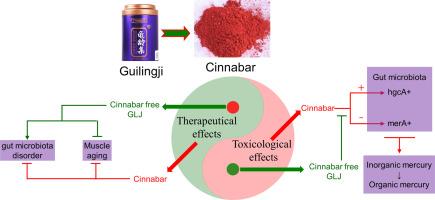
从肠道微生物组学和代谢组学角度探讨桂陵鸡朱砂药理和毒理作用的相容机制
龟灵鸡(GLJ)是国内知名的方剂,在治疗虚弱综合征方面具有很大优势,且安全性和疗效良好。朱砂是GLJ中的传统中药之一,在中国的许多中药处方中已有2000多年的历史。有争议的是,据报道朱砂有许多潜在的副作用,包括脑损伤、肝毒性和肾毒性。本研究通过观察朱砂对衰老大鼠GLJ的治疗效果及毒性,探讨朱砂在GLJ中应用的合理性。GLJ表现出改善脑衰老、骨衰老和肌肉衰老的治疗效果,其中朱砂通过提高肠道雄激素水平来促进GLJ对肌肉的抗衰老作用。同时,与GLJ治疗剂量相当剂量的朱砂单独长期暴露对衰老大鼠的肝、肾、脑均有一定的毒性作用,而GLJ则没有。在机制上,不含朱砂的GLJ逆转了朱砂增加肠道中汞甲基化微生物群丰度和减少汞去甲基化微生物群丰度的作用。此外,不含朱砂的GLJ显著改变了衰老大鼠的肠道菌群组成,而GLJ通过依赖朱砂将衰老大鼠的肠道菌群组成重新编程为健康大鼠的肠道菌群组成。本研究为了解朱砂在中药处方中的药理和毒理学配伍作用提供了有效途径。
本文章由计算机程序翻译,如有差异,请以英文原文为准。
求助全文
约1分钟内获得全文
求助全文
来源期刊
CiteScore
3.60
自引率
25.00%
发文量
17223
审稿时长
35 days
期刊介绍:
Chinese Journal of Analytical Chemistry(CJAC) is an academic journal of analytical chemistry established in 1972 and sponsored by the Chinese Chemical Society and Changchun Institute of Applied Chemistry, Chinese Academy of Sciences. Its objectives are to report the original scientific research achievements and review the recent development of analytical chemistry in all areas. The journal sets up 5 columns including Research Papers, Research Notes, Experimental Technique and Instrument, Review and Progress and Summary Accounts. The journal published monthly in Chinese language. A detailed abstract, keywords and the titles of figures and tables are provided in English, except column of Summary Accounts. Prof. Wang Erkang, an outstanding analytical chemist, academician of Chinese Academy of Sciences & Third World Academy of Sciences, holds the post of the Editor-in-chief.
 求助内容:
求助内容: 应助结果提醒方式:

 京公网安备 11010802042870号


