L. G. Lavrenova, V. G. Makotchenko, E. V. Korotaev, E. Yu. Gerasimov, A. I. Bulavchenko, O. G. Shakirova
{"title":"Spin Crossover–Few-Layer Graphene Nanocomposites: Synthesis and Magnetic Properties of Fe(NH2trz)3A2@FLG (A = Cl–, Br–)","authors":"L. G. Lavrenova, V. G. Makotchenko, E. V. Korotaev, E. Yu. Gerasimov, A. I. Bulavchenko, O. G. Shakirova","doi":"10.1134/S1070328425601244","DOIUrl":null,"url":null,"abstract":"<p>Stable nanoparticles capable of experiencing spin crossover with hysteresis on curves of the µ<sub>eff</sub>(<i>T</i>) dependence near ambient temperature have been synthesized. The earlier synthesized complexes [Fe(NH<sub>2</sub>trz)<sub>3</sub>]Cl<sub>2</sub>·H<sub>2</sub>O and [Fe(NH<sub>2</sub>trz)<sub>3</sub>]Br<sub>2</sub>·H<sub>2</sub>O exhibiting sharp spin crossover with hysteresis are used for the preparation of the nanocomposites. Few-layer graphene (FLG) formed by the microwave heating of the intercalated polydicarbonfluoride compound with acetone served as the basis. Nanoparticles Fe(NH<sub>2</sub>trz)<sub>3</sub>Cl<sub>2</sub>@FLG (SCO1-<i>n</i>) and Fe(NH<sub>2</sub>trz)<sub>3</sub>Br<sub>2</sub>@FLG (SCO2-<i>n</i>) (<i>n</i> = 1–3) have been prepared (<i>n</i> indicates time (h) of the treatment of the initial particles with ultrasound). The effective hydrodynamic diameter of particles of the complexes in ethanol is determined by photon correlation spectroscopy. The structures and microstructures of the samples are studied by high resolution transmission electron microscopy. The study of the µ<sub>eff</sub>(<i>T</i>) dependence shows that all synthesized composites exhibit crossover with hysteresis on the µ<sub>eff</sub>(<i>T</i>) curves. The temperature and character of the transition depend substantially on the particle size. The variation of the ultrasonication time during the preparation of the composites makes it possible to purposefully modify their magnetic properties.</p>","PeriodicalId":759,"journal":{"name":"Russian Journal of Coordination Chemistry","volume":"51 12","pages":"1172 - 1186"},"PeriodicalIF":1.1000,"publicationDate":"2026-04-01","publicationTypes":"Journal Article","fieldsOfStudy":null,"isOpenAccess":false,"openAccessPdf":"","citationCount":"0","resultStr":null,"platform":"Semanticscholar","paperid":null,"PeriodicalName":"Russian Journal of Coordination Chemistry","FirstCategoryId":"92","ListUrlMain":"https://link.springer.com/article/10.1134/S1070328425601244","RegionNum":3,"RegionCategory":"化学","ArticlePicture":[],"TitleCN":null,"AbstractTextCN":null,"PMCID":null,"EPubDate":"","PubModel":"","JCR":"Q4","JCRName":"CHEMISTRY, INORGANIC & NUCLEAR","Score":null,"Total":0}
引用次数: 0
Abstract
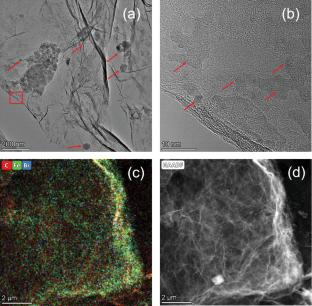
Stable nanoparticles capable of experiencing spin crossover with hysteresis on curves of the µeff(T) dependence near ambient temperature have been synthesized. The earlier synthesized complexes [Fe(NH2trz)3]Cl2·H2O and [Fe(NH2trz)3]Br2·H2O exhibiting sharp spin crossover with hysteresis are used for the preparation of the nanocomposites. Few-layer graphene (FLG) formed by the microwave heating of the intercalated polydicarbonfluoride compound with acetone served as the basis. Nanoparticles Fe(NH2trz)3Cl2@FLG (SCO1-n) and Fe(NH2trz)3Br2@FLG (SCO2-n) (n = 1–3) have been prepared (n indicates time (h) of the treatment of the initial particles with ultrasound). The effective hydrodynamic diameter of particles of the complexes in ethanol is determined by photon correlation spectroscopy. The structures and microstructures of the samples are studied by high resolution transmission electron microscopy. The study of the µeff(T) dependence shows that all synthesized composites exhibit crossover with hysteresis on the µeff(T) curves. The temperature and character of the transition depend substantially on the particle size. The variation of the ultrasonication time during the preparation of the composites makes it possible to purposefully modify their magnetic properties.
期刊介绍:
Russian Journal of Coordination Chemistry is a journal that publishes reviews, original papers, and short communications on all aspects of theoretical and experimental coordination chemistry. Modern coordination chemistry is an interdisciplinary science that makes a bridge between inorganic, organic, physical, analytical, and biological chemistry.


 求助内容:
求助内容: 应助结果提醒方式:

 京公网安备 11010802042870号


