Xu Jianxin, Wu Wensong, Fang Dengpan, Wang Yiwei, Chen Fangmin
{"title":"Sarcopenia-related traits and erectile dysfunction: a bi-directional Mendelian randomization study.","authors":"Xu Jianxin, Wu Wensong, Fang Dengpan, Wang Yiwei, Chen Fangmin","doi":"10.1093/sexmed/qfag010","DOIUrl":null,"url":null,"abstract":"<p><strong>Background: </strong>Erectile dysfunction (ED) and sarcopenia share many risk factors, but the causal direction of their association remains unclear.</p><p><strong>Aim: </strong>To investigate the potential causal relationship between sarcopenia-related traits and ED using genetic data.</p><p><strong>Methods: </strong>We conducted a bi-directional 2-sample Mendelian randomization (MR) analysis to evaluate the potential causal relationship between sarcopenia-related traits (hand grip strength, appendicular lean mass, and walking pace) and ED. We selected the inverse variance weighted (IVW) method as the main method to assess the causal effect, and we use Cochrane's Q tests derived from the IVW and MR-Egger method to evaluate the heterogeneity. To investigate horizontal pleiotropy, the study employed MR-Egger and MR-PRESSO methods. Leave-one-out analysis was conducted to assess the influence of individual genetic loci on the outcomes.</p><p><strong>Outcomes: </strong>Specific sarcopenia-related functional traits might increase the risk of ED, while reverse causality was not observed.</p><p><strong>Results: </strong>When considering sarcopenia-related characteristics as exposure factors, we found a positive causal relationship between appendicular lean mass and ED (OR = 1.097, CI = 1.009-1.194, <i>P</i> = .029) and a negative causal relationship between walking pace and ED (OR = 0.325, CI = 0.172-0.613, <i>P</i> = .00052). Hand grip strength showed no causal relationship with ED. Reverse MR results indicated that ED as an exposure factor did not have a causal relationship with sarcopenia-related characteristics. The MR-Egger intercept indicated no evidence of horizontal pleiotropy (<i>P</i> > .05). Cochran's Q test showed no significant heterogeneity (<i>P</i> > .05). Leave-one-out analysis revealed that excluding any single SNP did not significantly change the overall error lines, confirming the reliability of our conclusions.</p><p><strong>Clinical implications: </strong>Interventions aimed at improving overall physical function and fitness, particularly addressing a slow walking pace, may help reduce the risk of ED.</p><p><strong>Strengths and limitations: </strong>Key strengths include the MR design minimizing confounding and reverse causation, and comprehensive sensitivity analyses. The main limitation is that our study only contains samples of European descent.</p><p><strong>Conclusion: </strong>Specific sarcopenia-related functional traits, particularly a slower walking pace, may play a causal role in ED. These findings highlight the importance of overall physical function and fitness in ED risk, although further studies are needed to clarify the specific role of muscle mass.</p>","PeriodicalId":21782,"journal":{"name":"Sexual Medicine","volume":"14 2","pages":"qfag010"},"PeriodicalIF":2.0000,"publicationDate":"2026-03-27","publicationTypes":"Journal Article","fieldsOfStudy":null,"isOpenAccess":false,"openAccessPdf":"https://www.ncbi.nlm.nih.gov/pmc/articles/PMC13025071/pdf/","citationCount":"0","resultStr":null,"platform":"Semanticscholar","paperid":null,"PeriodicalName":"Sexual Medicine","FirstCategoryId":"3","ListUrlMain":"https://doi.org/10.1093/sexmed/qfag010","RegionNum":3,"RegionCategory":"医学","ArticlePicture":[],"TitleCN":null,"AbstractTextCN":null,"PMCID":null,"EPubDate":"2026/4/1 0:00:00","PubModel":"eCollection","JCR":"Q1","JCRName":"MEDICINE, GENERAL & INTERNAL","Score":null,"Total":0}
引用次数: 0
Abstract
Background: Erectile dysfunction (ED) and sarcopenia share many risk factors, but the causal direction of their association remains unclear.
Aim: To investigate the potential causal relationship between sarcopenia-related traits and ED using genetic data.
Methods: We conducted a bi-directional 2-sample Mendelian randomization (MR) analysis to evaluate the potential causal relationship between sarcopenia-related traits (hand grip strength, appendicular lean mass, and walking pace) and ED. We selected the inverse variance weighted (IVW) method as the main method to assess the causal effect, and we use Cochrane's Q tests derived from the IVW and MR-Egger method to evaluate the heterogeneity. To investigate horizontal pleiotropy, the study employed MR-Egger and MR-PRESSO methods. Leave-one-out analysis was conducted to assess the influence of individual genetic loci on the outcomes.
Outcomes: Specific sarcopenia-related functional traits might increase the risk of ED, while reverse causality was not observed.
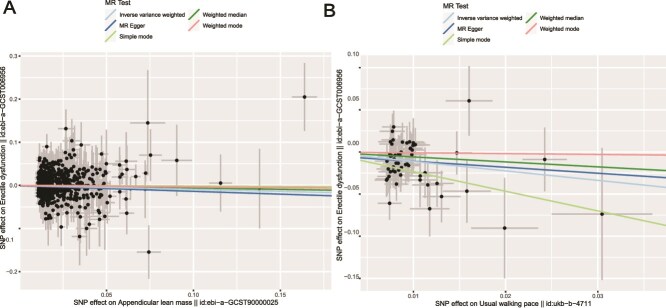
Results: When considering sarcopenia-related characteristics as exposure factors, we found a positive causal relationship between appendicular lean mass and ED (OR = 1.097, CI = 1.009-1.194, P = .029) and a negative causal relationship between walking pace and ED (OR = 0.325, CI = 0.172-0.613, P = .00052). Hand grip strength showed no causal relationship with ED. Reverse MR results indicated that ED as an exposure factor did not have a causal relationship with sarcopenia-related characteristics. The MR-Egger intercept indicated no evidence of horizontal pleiotropy (P > .05). Cochran's Q test showed no significant heterogeneity (P > .05). Leave-one-out analysis revealed that excluding any single SNP did not significantly change the overall error lines, confirming the reliability of our conclusions.
Clinical implications: Interventions aimed at improving overall physical function and fitness, particularly addressing a slow walking pace, may help reduce the risk of ED.
Strengths and limitations: Key strengths include the MR design minimizing confounding and reverse causation, and comprehensive sensitivity analyses. The main limitation is that our study only contains samples of European descent.
Conclusion: Specific sarcopenia-related functional traits, particularly a slower walking pace, may play a causal role in ED. These findings highlight the importance of overall physical function and fitness in ED risk, although further studies are needed to clarify the specific role of muscle mass.
期刊介绍:
Sexual Medicine is an official publication of the International Society for Sexual Medicine, and serves the field as the peer-reviewed, open access journal for rapid dissemination of multidisciplinary clinical and basic research in all areas of global sexual medicine, and particularly acts as a venue for topics of regional or sub-specialty interest. The journal is focused on issues in clinical medicine and epidemiology but also publishes basic science papers with particular relevance to specific populations. Sexual Medicine offers clinicians and researchers a rapid route to publication and the opportunity to publish in a broadly distributed and highly visible global forum. The journal publishes high quality articles from all over the world and actively seeks submissions from countries with expanding sexual medicine communities. Sexual Medicine relies on the same expert panel of editors and reviewers as The Journal of Sexual Medicine and Sexual Medicine Reviews.


 求助内容:
求助内容: 应助结果提醒方式:

 京公网安备 11010802042870号


