{"title":"Dentinogenic ghost cell tumor: Two case reports and review of the literature.","authors":"Neda Kargahi, Parvin Mahzoni, Abbass Haghighat, Faezeh Khozeimeh, Arash Esmaeili, Nedasadat Mirmohammadsadeghi, Mahya Rahmani","doi":"10.4103/drj.drj_212_25","DOIUrl":null,"url":null,"abstract":"<p><p>Dentinogenic ghost cell tumor (DGCT) is a rare odontogenic neoplasm, representing a solid variant of the calcifying odontogenic cyst (COC), accounting for 2%-14% of all COCs and <0.5% of odontogenic tumors. Its unique histological and clinical characteristics, coupled with its potential for local invasiveness, underscore the necessity for accurate diagnosis and management. This article reports two cases of DGCT Case 1involves a 13-year-old boy presented with the absence of permanent teeth 4 and 5. Radiographic examinations revealed a mixed radiolucent-radiopaque lesion in the left mandible associated with the impacted permanent teeth. The lesion exhibited well-defined borders and significant calcifications. Microscopic analysis revealed islands of odontogenic epithelium with features resembling ameloblasts, numerous ghost cells, and areas of dystrophic calcification, confirming the diagnosis of DGCT. Case 2 involves A 67-year-old male presented with an exophytic lesion on the left side of the mandibular alveolar mucosa. On pathologic examination, the sample revealed features that led to the diagnosis of a peripheral DGCT. In the first case, given the lesion's size and location, a surgical excision was performed using an intraoral approach under general anesthesia, including a margin of healthy tissue. Short-term follow-ups were conducted every 3 months, and no recurrence was noted after 6 months. In the second case, an excision biopsy and short-term follow-up were conducted. This case highlights the clinical presentation, radiographic features, and histopathological characteristics of two cases of DGCT, emphasizing the importance of surgical intervention and regular follow-up in managing this rare neoplasm. Enhanced awareness and understanding of DGCT are essential for timely diagnosis and effective treatment, particularly in pediatric patients presenting with dental abnormalities.</p>","PeriodicalId":11016,"journal":{"name":"Dental Research Journal","volume":"23 ","pages":"9"},"PeriodicalIF":0.0000,"publicationDate":"2026-02-26","publicationTypes":"Journal Article","fieldsOfStudy":null,"isOpenAccess":false,"openAccessPdf":"https://www.ncbi.nlm.nih.gov/pmc/articles/PMC13021160/pdf/","citationCount":"0","resultStr":null,"platform":"Semanticscholar","paperid":null,"PeriodicalName":"Dental Research Journal","FirstCategoryId":"1085","ListUrlMain":"https://doi.org/10.4103/drj.drj_212_25","RegionNum":0,"RegionCategory":null,"ArticlePicture":[],"TitleCN":null,"AbstractTextCN":null,"PMCID":null,"EPubDate":"2026/1/1 0:00:00","PubModel":"eCollection","JCR":"Q2","JCRName":"Dentistry","Score":null,"Total":0}
引用次数: 0
Abstract
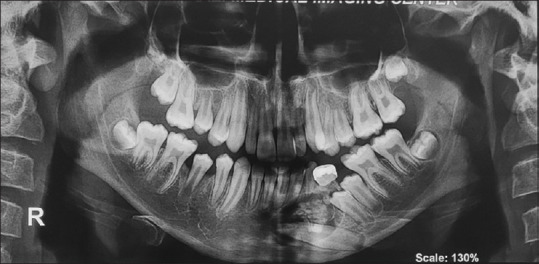
Dentinogenic ghost cell tumor (DGCT) is a rare odontogenic neoplasm, representing a solid variant of the calcifying odontogenic cyst (COC), accounting for 2%-14% of all COCs and <0.5% of odontogenic tumors. Its unique histological and clinical characteristics, coupled with its potential for local invasiveness, underscore the necessity for accurate diagnosis and management. This article reports two cases of DGCT Case 1involves a 13-year-old boy presented with the absence of permanent teeth 4 and 5. Radiographic examinations revealed a mixed radiolucent-radiopaque lesion in the left mandible associated with the impacted permanent teeth. The lesion exhibited well-defined borders and significant calcifications. Microscopic analysis revealed islands of odontogenic epithelium with features resembling ameloblasts, numerous ghost cells, and areas of dystrophic calcification, confirming the diagnosis of DGCT. Case 2 involves A 67-year-old male presented with an exophytic lesion on the left side of the mandibular alveolar mucosa. On pathologic examination, the sample revealed features that led to the diagnosis of a peripheral DGCT. In the first case, given the lesion's size and location, a surgical excision was performed using an intraoral approach under general anesthesia, including a margin of healthy tissue. Short-term follow-ups were conducted every 3 months, and no recurrence was noted after 6 months. In the second case, an excision biopsy and short-term follow-up were conducted. This case highlights the clinical presentation, radiographic features, and histopathological characteristics of two cases of DGCT, emphasizing the importance of surgical intervention and regular follow-up in managing this rare neoplasm. Enhanced awareness and understanding of DGCT are essential for timely diagnosis and effective treatment, particularly in pediatric patients presenting with dental abnormalities.
期刊介绍:
Dental Research Journal, a publication of Isfahan University of Medical Sciences, is a peer-reviewed online journal with Bimonthly print on demand compilation of issues published. The journal’s full text is available online at http://www.drjjournal.net. The journal allows free access (Open Access) to its contents and permits authors to self-archive final accepted version of the articles on any OAI-compliant institutional / subject-based repository. The journal will cover technical and clinical studies related to health, ethical and social issues in field of Dentistry. Articles with clinical interest and implications will be given preference.




 求助内容:
求助内容: 应助结果提醒方式:

 京公网安备 11010802042870号


