R. Cortés-Rodríguez, F. Paz-Zavala, V. H. López-Morelos, M. Salazar-Martínez, F. F. Curiel-López, A. Ruiz
{"title":"The Influence of the Application of Electromagnetic Fields of Low Intensity during Gas Metal Arc Welding of AL6XN-Inconel 600 Dissimilar Welds","authors":"R. Cortés-Rodríguez, F. Paz-Zavala, V. H. López-Morelos, M. Salazar-Martínez, F. F. Curiel-López, A. Ruiz","doi":"10.1007/s11665-025-12621-4","DOIUrl":null,"url":null,"abstract":"<div><p>The effects of the application of electromagnetic fields (EMF) of low intensity (3 mT) during welding AL6XN-Inconel 600 (IN600) plates were investigated in terms of the microstructure and mechanical properties. The plates, 6.35 mm in thickness, were gas metal arc welded (GMAW) in a single pass using ERNiCrMo-3 and ER310 filler wires. The welding parameters were adjusted to heat inputs of ~ 1.2 kJ/mm. The application of the EMFs had no significant effect on the dilution of the base materials, but the microstructural characterization of the welds revealed a remarkable grain refining effect in the weld metal (WM). The non-mixing zone at the interface between the WM and the AL6XN was significantly reduced for both electrodes applying EMFs. The highest energy absorbed in the Charpy impact tests was for the specimens welded with ER310. A positive effect was seen in this property for welds performed with EMFs. Failure of the welded joints during tension tests occurred at the WM when using ER310 whereas for ERNiCrMo-3 the specimens broke at the HAZ of IN600. The failures zones correlated well with microhardness maps. The dissimilar welds joined with ERNiCrMo-3 in conjunction with the simultaneous application of the EMF exhibited the best mechanical properties.</p></div>","PeriodicalId":644,"journal":{"name":"Journal of Materials Engineering and Performance","volume":"35 :","pages":"12027 - 12039"},"PeriodicalIF":2.0000,"publicationDate":"2026-03-02","publicationTypes":"Journal Article","fieldsOfStudy":null,"isOpenAccess":false,"openAccessPdf":"","citationCount":"0","resultStr":null,"platform":"Semanticscholar","paperid":null,"PeriodicalName":"Journal of Materials Engineering and Performance","FirstCategoryId":"88","ListUrlMain":"https://link.springer.com/article/10.1007/s11665-025-12621-4","RegionNum":4,"RegionCategory":"材料科学","ArticlePicture":[],"TitleCN":null,"AbstractTextCN":null,"PMCID":null,"EPubDate":"","PubModel":"","JCR":"Q3","JCRName":"MATERIALS SCIENCE, MULTIDISCIPLINARY","Score":null,"Total":0}
引用次数: 0
Abstract
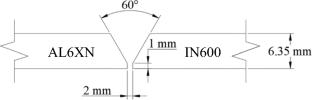
The effects of the application of electromagnetic fields (EMF) of low intensity (3 mT) during welding AL6XN-Inconel 600 (IN600) plates were investigated in terms of the microstructure and mechanical properties. The plates, 6.35 mm in thickness, were gas metal arc welded (GMAW) in a single pass using ERNiCrMo-3 and ER310 filler wires. The welding parameters were adjusted to heat inputs of ~ 1.2 kJ/mm. The application of the EMFs had no significant effect on the dilution of the base materials, but the microstructural characterization of the welds revealed a remarkable grain refining effect in the weld metal (WM). The non-mixing zone at the interface between the WM and the AL6XN was significantly reduced for both electrodes applying EMFs. The highest energy absorbed in the Charpy impact tests was for the specimens welded with ER310. A positive effect was seen in this property for welds performed with EMFs. Failure of the welded joints during tension tests occurred at the WM when using ER310 whereas for ERNiCrMo-3 the specimens broke at the HAZ of IN600. The failures zones correlated well with microhardness maps. The dissimilar welds joined with ERNiCrMo-3 in conjunction with the simultaneous application of the EMF exhibited the best mechanical properties.
期刊介绍:
ASM International''s Journal of Materials Engineering and Performance focuses on solving day-to-day engineering challenges, particularly those involving components for larger systems. The journal presents a clear understanding of relationships between materials selection, processing, applications and performance.
The Journal of Materials Engineering covers all aspects of materials selection, design, processing, characterization and evaluation, including how to improve materials properties through processes and process control of casting, forming, heat treating, surface modification and coating, and fabrication.
Testing and characterization (including mechanical and physical tests, NDE, metallography, failure analysis, corrosion resistance, chemical analysis, surface characterization, and microanalysis of surfaces, features and fractures), and industrial performance measurement are also covered

 求助内容:
求助内容: 应助结果提醒方式:

 京公网安备 11010802042870号


