
Identifying Arkansas Rice Cultivars With Similar Physicochemical Attributes and Milling Performance

IF 2.4 4区 农林科学 Q3 CHEMISTRY, APPLIED
Cereal Chemistry Pub Date : 2026-03-26 Epub Date: 2026-01-07 DOI:10.1002/cche.70040
Alan R. Vazquez, Samuel O. Olaoni, Devisree Chukkapalli, Kaushik Luthra, Griffiths G. Atungulu
{"title":"Identifying Arkansas Rice Cultivars With Similar Physicochemical Attributes and Milling Performance","authors":"Alan R. Vazquez,&nbsp;Samuel O. Olaoni,&nbsp;Devisree Chukkapalli,&nbsp;Kaushik Luthra,&nbsp;Griffiths G. Atungulu","doi":"10.1002/cche.70040","DOIUrl":null,"url":null,"abstract":"<div>\n \n \n <section>\n \n <h3> Background and Objectives</h3>\n \n <p>The objective of this study was to comprehensively evaluate the variation in milling efficiency and physicochemical attributes among Arkansas rice cultivars. To accomplish this, a total of 45 cultivars were analyzed, including 9 long-grain purelines, 32 long-grain hybrids, 2 medium-grain purelines, and 2 medium-grain hybrids collected over three harvest seasons from 2019 to 2022. Hierarchical clustering and principal component analysis (PCA) were employed to identify and classify groups of cultivars with similar characteristics, and to generate components that capture most of the variability across the explored variables, using the 30-s milling and the area under the curve (AUC) of 0–60 s milling summary. The samples were assessed for key quality parameters, including moisture content, field fissuring, total protein content, chalkiness, kernel dimensions, total lipid content, milling yields, color, and pasting properties. By examining this diverse range of cultivars under controlled conditions, the study aims to better understand the genetic and environmental factors influencing variations in rice quality.</p>\n </section>\n \n <section>\n \n <h3> Findings</h3>\n \n <p>Hierarchical clustering based on rice quality parameters after 30 s of milling grouped the cultivars into five clusters, with Groups 1–4 comprising long-grain types and Group 5 consisting entirely of medium grains. This distinction is expected given the differences in milling behavior between medium- and long-grain cultivars due to morphological traits. PCA score plots showed that medium grains were strongly associated with kernel width, milled rice yield (MRY), and peak viscosity, while cultivars such as RTv7303, V3503, RT7801, V3502, and XP784 were correlated to higher setback and final viscosities. Similarly, clustering based on the AUC summary dataset produced four groups, again isolating medium grains. In this analysis, medium grains were correlated with higher width, MRY, head rice yield (HRY), and NIR color <i>b</i>-values.</p>\n </section>\n \n <section>\n \n <h3> Conclusions</h3>\n \n <p>In conclusion, Jupiter, RT302, RT3201, and Titan consistently emerged as a distinct group across the rice quality properties, providing valuable information to millers, breeders, and producers to identify rice cultivars with similar milling behavior and physicochemical properties.</p>\n </section>\n \n <section>\n \n <h3> Significance and Novelty</h3>\n \n <p>The results from this study support the selection of suitable cultivars for product formulation by clearly identifying which cultivars share similar physical, milling, and functional properties. By grouping cultivars with comparable characteristics, the findings help formulators choose rice types that will perform reliably in specific processing or end-use applications. This information also helps in identifying potential substitutes when a preferred cultivar is unavailable and enables better commingling strategies to maintain consistency and improve overall product quality.</p>\n </section>\n </div>","PeriodicalId":9807,"journal":{"name":"Cereal Chemistry","volume":"103 2","pages":"215-225"},"PeriodicalIF":2.4000,"publicationDate":"2026-03-26","publicationTypes":"Journal Article","fieldsOfStudy":null,"isOpenAccess":false,"openAccessPdf":"","citationCount":"0","resultStr":null,"platform":"Semanticscholar","paperid":null,"PeriodicalName":"Cereal Chemistry","FirstCategoryId":"97","ListUrlMain":"https://onlinelibrary.wiley.com/doi/10.1002/cche.70040","RegionNum":4,"RegionCategory":"农林科学","ArticlePicture":[],"TitleCN":null,"AbstractTextCN":null,"PMCID":null,"EPubDate":"2026/1/7 0:00:00","PubModel":"Epub","JCR":"Q3","JCRName":"CHEMISTRY, APPLIED","Score":null,"Total":0}
引用次数: 0

Abstract

Background and Objectives

The objective of this study was to comprehensively evaluate the variation in milling efficiency and physicochemical attributes among Arkansas rice cultivars. To accomplish this, a total of 45 cultivars were analyzed, including 9 long-grain purelines, 32 long-grain hybrids, 2 medium-grain purelines, and 2 medium-grain hybrids collected over three harvest seasons from 2019 to 2022. Hierarchical clustering and principal component analysis (PCA) were employed to identify and classify groups of cultivars with similar characteristics, and to generate components that capture most of the variability across the explored variables, using the 30-s milling and the area under the curve (AUC) of 0–60 s milling summary. The samples were assessed for key quality parameters, including moisture content, field fissuring, total protein content, chalkiness, kernel dimensions, total lipid content, milling yields, color, and pasting properties. By examining this diverse range of cultivars under controlled conditions, the study aims to better understand the genetic and environmental factors influencing variations in rice quality.

Findings

Hierarchical clustering based on rice quality parameters after 30 s of milling grouped the cultivars into five clusters, with Groups 1–4 comprising long-grain types and Group 5 consisting entirely of medium grains. This distinction is expected given the differences in milling behavior between medium- and long-grain cultivars due to morphological traits. PCA score plots showed that medium grains were strongly associated with kernel width, milled rice yield (MRY), and peak viscosity, while cultivars such as RTv7303, V3503, RT7801, V3502, and XP784 were correlated to higher setback and final viscosities. Similarly, clustering based on the AUC summary dataset produced four groups, again isolating medium grains. In this analysis, medium grains were correlated with higher width, MRY, head rice yield (HRY), and NIR color b-values.

Conclusions

In conclusion, Jupiter, RT302, RT3201, and Titan consistently emerged as a distinct group across the rice quality properties, providing valuable information to millers, breeders, and producers to identify rice cultivars with similar milling behavior and physicochemical properties.

Significance and Novelty

The results from this study support the selection of suitable cultivars for product formulation by clearly identifying which cultivars share similar physical, milling, and functional properties. By grouping cultivars with comparable characteristics, the findings help formulators choose rice types that will perform reliably in specific processing or end-use applications. This information also helps in identifying potential substitutes when a preferred cultivar is unavailable and enables better commingling strategies to maintain consistency and improve overall product quality.
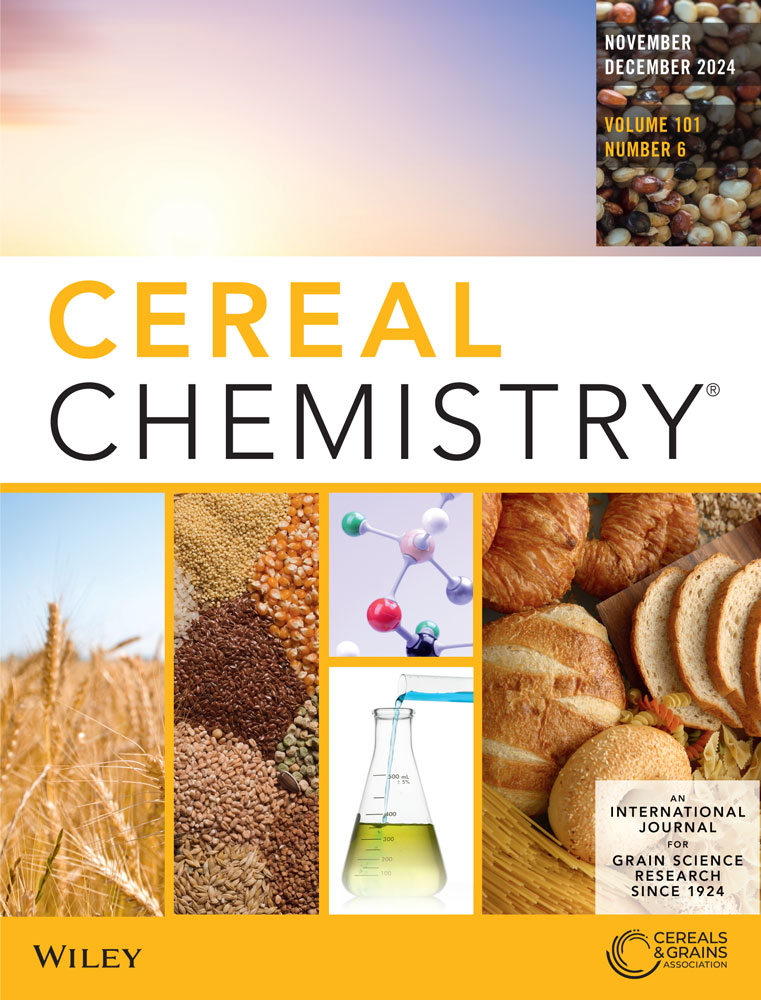

具有相似理化性状和碾磨性能的阿肯色水稻品种的鉴定
背景与目的综合评价阿肯色稻品种碾磨效率和理化性状的差异。为了实现这一目标,共分析了45个品种,包括9个长粒纯系,32个长粒杂交种,2个中粒纯系和2个中粒杂交种,收集于2019年至2022年的三个收获季节。利用30 s碾磨和0 ~ 60 s碾磨曲线下面积(AUC),采用层次聚类和主成分分析(PCA)对具有相似性状的品种群体进行识别和分类,并生成能够捕获所探索变量间大部分变异的成分。对样品的关键质量参数进行了评估,包括水分含量、田间裂缝、总蛋白质含量、白垩度、籽粒尺寸、总脂质含量、磨粒率、颜色和糊化性能。通过在控制条件下考察这些品种的多样性,本研究旨在更好地了解影响水稻品质变化的遗传和环境因素。结果碾磨30 s后稻米品质参数的分层聚类将品种划分为5类,其中1 ~ 4组为长粒型,5组为全中粒型。考虑到中粒和长粒品种由于形态特征而在碾磨行为上的差异,这种区别是预料之中的。PCA评分图显示,中粒与籽粒宽度、精米产量和峰值黏度密切相关,而RTv7303、V3503、RT7801、V3502和XP784等品种与较高的回退黏度和最终黏度相关。同样,基于AUC汇总数据集的聚类产生了四组,再次分离了中等颗粒。在本分析中,中粒与较高的宽度、MRY、稻米单产(HRY)和近红外色值相关。综上所述,木星、RT302、RT3201和泰坦在稻米品质特性上始终是一个独特的群体,为碾磨者、育种者和生产者鉴别具有相似碾磨行为和理化特性的水稻品种提供了有价值的信息。本研究的结果通过清楚地确定哪些品种具有相似的物理、碾磨和功能特性,为产品配方的合适选择提供了支持。通过对具有可比特性的品种进行分组,研究结果有助于配方制定者选择在特定加工或最终用途应用中可靠表现的水稻类型。这些信息还有助于在没有首选品种时确定潜在的替代品,并使更好的混合策略能够保持一致性并提高整体产品质量。
本文章由计算机程序翻译,如有差异,请以英文原文为准。
求助全文
约1分钟内获得全文 求助全文
来源期刊
Cereal Chemistry
Cereal Chemistry 工程技术-食品科技
CiteScore
5.10
自引率
8.30%
发文量
110
审稿时长
3 months
期刊介绍: Cereal Chemistry publishes high-quality papers reporting novel research and significant conceptual advances in genetics, biotechnology, composition, processing, and utili­zation of cereal grains (barley, maize, millet, oats, rice, rye, sorghum, triticale, and wheat), pulses (beans, lentils, peas, etc.), oil­seeds, and specialty crops (amaranth, flax, quinoa, etc.). Papers advancing grain science in relation to health, nutrition, pet and animal food, and safety, along with new methodologies, instrumentation, and analysis relating to these areas are welcome, as are research notes and topical review papers. The journal generally does not accept papers that focus on nongrain ingredients, technology of a commercial or proprietary nature, or that confirm previous research without extending knowledge. Papers that describe product development should include discussion of underlying theoretical principles.
×
引用
GB/T 7714-2015
复制
MLA
复制
APA
复制
导出至
BibTeX EndNote RefMan NoteFirst NoteExpress
×
提示
您的信息不完整,为了账户安全,请先补充。
现在去补充
×
提示
您因"违规操作"
具体请查看互助需知
我知道了
×
提示
确定
请完成安全验证×
copy
已复制链接
快去分享给好友吧!
我知道了
右上角分享
点击右上角分享
0
联系我们:info@booksci.cn Book学术提供免费学术资源搜索服务,方便国内外学者检索中英文文献。致力于提供最便捷和优质的服务体验。 Copyright © 2023 布克学术 All rights reserved.
京ICP备2023020795号-1
ghs 京公网安备 11010802042870号
Book学术文献互助
Book学术文献互助群
群 号:604180095
Book学术官方微信
小红书


