Artem Chystiakov, Osama A. Q. Ziada, Sheikh Ali Ahmed, Janka Kovacikova
{"title":"Experimental Evaluation of Characteristics in Large-Scale 3D-Printed Structures from Wood-Based Polymer Composites","authors":"Artem Chystiakov, Osama A. Q. Ziada, Sheikh Ali Ahmed, Janka Kovacikova","doi":"10.1007/s10443-026-10457-2","DOIUrl":null,"url":null,"abstract":"<div><p>This study investigates the mechanical and physical properties of a wood-based polymer composite DuraSense® 3D S50 Flex K to enhance its potential in large-scale additive manufacturing by studying the influence of printing orientation on the mechanical characteristics of the product. To assess performance, the specimens were produced with different printing layer orientations: at 0°, 30°, 45°, and 90° to the sample length, which corresponds to load application during the tests. Tensile strength, flexural strength, modulus of elasticity, hardness, water absorption, thermophysical properties and microstructure were determined for the samples. The 0° specimens exhibited the highest tensile (15.39 MPa) and flexural strength (26.05 MPa), while the 90° orientation specimens showed reductions in strength of 72% and 69%, respectively. The modulus of elasticity also decreased by 71% at 90°, confirming anisotropy. Additional tests revealed a Brinell hardness of 179.9 N/mm<sup>2</sup>, a water absorption of 19.75%, with minimal dimensional change, and a thermal conductivity of 0.1553 W/m·K. Microscopic analysis showed porosity and uneven fibre distribution, indicating the need for composite optimisation. These findings confirm the importance of orientation-aware design in large-scale additive manufacturing and provide the background for future work focusing on the development of printing strategies and computational modelling to enhance print quality, interlayer adhesion, and performance in applications.</p></div>","PeriodicalId":468,"journal":{"name":"Applied Composite Materials","volume":"33 2","pages":""},"PeriodicalIF":3.9000,"publicationDate":"2026-03-28","publicationTypes":"Journal Article","fieldsOfStudy":null,"isOpenAccess":false,"openAccessPdf":"https://link.springer.com/content/pdf/10.1007/s10443-026-10457-2.pdf","citationCount":"0","resultStr":null,"platform":"Semanticscholar","paperid":null,"PeriodicalName":"Applied Composite Materials","FirstCategoryId":"88","ListUrlMain":"https://link.springer.com/article/10.1007/s10443-026-10457-2","RegionNum":4,"RegionCategory":"材料科学","ArticlePicture":[],"TitleCN":null,"AbstractTextCN":null,"PMCID":null,"EPubDate":"","PubModel":"","JCR":"Q3","JCRName":"MATERIALS SCIENCE, COMPOSITES","Score":null,"Total":0}
引用次数: 0
Abstract
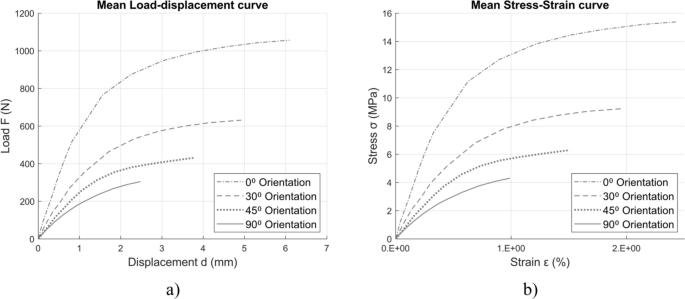
This study investigates the mechanical and physical properties of a wood-based polymer composite DuraSense® 3D S50 Flex K to enhance its potential in large-scale additive manufacturing by studying the influence of printing orientation on the mechanical characteristics of the product. To assess performance, the specimens were produced with different printing layer orientations: at 0°, 30°, 45°, and 90° to the sample length, which corresponds to load application during the tests. Tensile strength, flexural strength, modulus of elasticity, hardness, water absorption, thermophysical properties and microstructure were determined for the samples. The 0° specimens exhibited the highest tensile (15.39 MPa) and flexural strength (26.05 MPa), while the 90° orientation specimens showed reductions in strength of 72% and 69%, respectively. The modulus of elasticity also decreased by 71% at 90°, confirming anisotropy. Additional tests revealed a Brinell hardness of 179.9 N/mm2, a water absorption of 19.75%, with minimal dimensional change, and a thermal conductivity of 0.1553 W/m·K. Microscopic analysis showed porosity and uneven fibre distribution, indicating the need for composite optimisation. These findings confirm the importance of orientation-aware design in large-scale additive manufacturing and provide the background for future work focusing on the development of printing strategies and computational modelling to enhance print quality, interlayer adhesion, and performance in applications.
期刊介绍:
Applied Composite Materials is an international journal dedicated to the publication of original full-length papers, review articles and short communications of the highest quality that advance the development and application of engineering composite materials. Its articles identify problems that limit the performance and reliability of the composite material and composite part; and propose solutions that lead to innovation in design and the successful exploitation and commercialization of composite materials across the widest spectrum of engineering uses. The main focus is on the quantitative descriptions of material systems and processing routes.
Coverage includes management of time-dependent changes in microscopic and macroscopic structure and its exploitation from the material''s conception through to its eventual obsolescence.

 求助内容:
求助内容: 应助结果提醒方式:

 京公网安备 11010802042870号


