O. I. Vishnyakov, P. A. Polivanov, S. O. Morozov, A. A. Sidorenko
{"title":"Development of a Disturbance from a Local Discharge in a Laminar Boundary Layer at M = 1.43","authors":"O. I. Vishnyakov, P. A. Polivanov, S. O. Morozov, A. A. Sidorenko","doi":"10.1134/S1063780X25603803","DOIUrl":null,"url":null,"abstract":"<p>Disturbances generated by a short-period spark discharge in a laminar boundary layer on a plate at a free-stream Mach number of M = 1.43 have been examined. The study consists of experimental and numerical components. In the experiment, a spark discharge has been initiated in the boundary layer lasting less than a microsecond, which is an order of magnitude shorter than the characteristic times of boundary layer disturbances. The numerical simulation has been used to study in more detail the process of receptivity and disturbance development in the boundary layer as a function of the energy input. The numerical simulation showed that the Tollmien–Schlichting wave is unambiguously detected starting at a distance of approximately 50δ from the discharge. It is found numerically that, for a small energy input, the most rapidly growing oblique waves are those of the first mode, which agrees with the estimate according to the linear stability theory. As the energy input increases, a second type of disturbance, reminiscent of a longitudinal structure, starts to be manifested in the mass flow pulsations. In the experiment, with a higher energy supply value than in the calculation, it was possible to record only the second type of disturbances, while the maximum amplitude of mass flow pulsations reaches 30%.</p>","PeriodicalId":735,"journal":{"name":"Plasma Physics Reports","volume":"52 1","pages":"69 - 79"},"PeriodicalIF":1.1000,"publicationDate":"2026-03-25","publicationTypes":"Journal Article","fieldsOfStudy":null,"isOpenAccess":false,"openAccessPdf":"","citationCount":"0","resultStr":null,"platform":"Semanticscholar","paperid":null,"PeriodicalName":"Plasma Physics Reports","FirstCategoryId":"101","ListUrlMain":"https://link.springer.com/article/10.1134/S1063780X25603803","RegionNum":4,"RegionCategory":"物理与天体物理","ArticlePicture":[],"TitleCN":null,"AbstractTextCN":null,"PMCID":null,"EPubDate":"","PubModel":"","JCR":"Q4","JCRName":"PHYSICS, FLUIDS & PLASMAS","Score":null,"Total":0}
引用次数: 0
Abstract
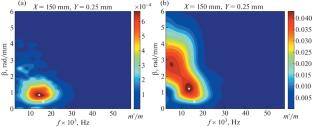
Disturbances generated by a short-period spark discharge in a laminar boundary layer on a plate at a free-stream Mach number of M = 1.43 have been examined. The study consists of experimental and numerical components. In the experiment, a spark discharge has been initiated in the boundary layer lasting less than a microsecond, which is an order of magnitude shorter than the characteristic times of boundary layer disturbances. The numerical simulation has been used to study in more detail the process of receptivity and disturbance development in the boundary layer as a function of the energy input. The numerical simulation showed that the Tollmien–Schlichting wave is unambiguously detected starting at a distance of approximately 50δ from the discharge. It is found numerically that, for a small energy input, the most rapidly growing oblique waves are those of the first mode, which agrees with the estimate according to the linear stability theory. As the energy input increases, a second type of disturbance, reminiscent of a longitudinal structure, starts to be manifested in the mass flow pulsations. In the experiment, with a higher energy supply value than in the calculation, it was possible to record only the second type of disturbances, while the maximum amplitude of mass flow pulsations reaches 30%.
期刊介绍:
Plasma Physics Reports is a peer reviewed journal devoted to plasma physics. The journal covers the following topics: high-temperature plasma physics related to the problem of controlled nuclear fusion based on magnetic and inertial confinement; physics of cosmic plasma, including magnetosphere plasma, sun and stellar plasma, etc.; gas discharge plasma and plasma generated by laser and particle beams. The journal also publishes papers on such related topics as plasma electronics, generation of radiation in plasma, and plasma diagnostics. As well as other original communications, the journal publishes topical reviews and conference proceedings.

 求助内容:
求助内容: 应助结果提醒方式:

 京公网安备 11010802042870号


