Carlos Lazaro-Hdez, Mario Miranda-Pinzon, Maria del Puig Vicente-Vinas, Teodomiro Boronat, Juan Ivorra-Martinez
{"title":"Development and Characterization of Ductile Polylactic Acid Blends with Plasticized Zein for Injection Molding Applications","authors":"Carlos Lazaro-Hdez, Mario Miranda-Pinzon, Maria del Puig Vicente-Vinas, Teodomiro Boronat, Juan Ivorra-Martinez","doi":"10.1007/s10924-026-03813-7","DOIUrl":null,"url":null,"abstract":"<div><p>This study explores the development of polylactic acid (PLA) blends incorporating plasticized zein, a corn-derived protein, and dipropylene glycol (DPG) as a biobased plasticizer to enhance compatibility and processability. Blends were produced via twin-screw extrusion and injection molding, with plasticized zein content ranging from 10 to 50 wt%. Mechanical testing showed a significant increase in ductility, with elongation at break rising from 6.3% (neat PLA) to 56.3% (50 wt% zein), accompanied by reduced tensile strength (58.4 MPa to 22.7 MPa) and impact resistance (42.2 kJ/m<sup>2</sup> to 11.5 kJ/m<sup>2</sup>), due to phase separation and limited compatibility. Shore D hardness slightly declined (from 82.9 to 77.4). Thermal analysis revealed the T<sub>g</sub> decreasing from 59.5 °C to 39.9 °C as zein content increased. Thermogravimetric analysis showed reduced thermal stability with zein addition, dropping the initial degradation temperature from 360.0 °C to 188.2 °C. Morphological analysis indicated greater heterogeneity at higher zein levels due to partial miscibility. Colorimetric data showed visible changes, and FTIR spectra confirmed physical interactions and partial miscibility between PLA and zein.</p></div>","PeriodicalId":659,"journal":{"name":"Journal of Polymers and the Environment","volume":"34 4","pages":""},"PeriodicalIF":5.0000,"publicationDate":"2026-03-27","publicationTypes":"Journal Article","fieldsOfStudy":null,"isOpenAccess":false,"openAccessPdf":"https://link.springer.com/content/pdf/10.1007/s10924-026-03813-7.pdf","citationCount":"0","resultStr":null,"platform":"Semanticscholar","paperid":null,"PeriodicalName":"Journal of Polymers and the Environment","FirstCategoryId":"5","ListUrlMain":"https://link.springer.com/article/10.1007/s10924-026-03813-7","RegionNum":3,"RegionCategory":"工程技术","ArticlePicture":[],"TitleCN":null,"AbstractTextCN":null,"PMCID":null,"EPubDate":"","PubModel":"","JCR":"Q2","JCRName":"ENGINEERING, ENVIRONMENTAL","Score":null,"Total":0}
引用次数: 0
Abstract
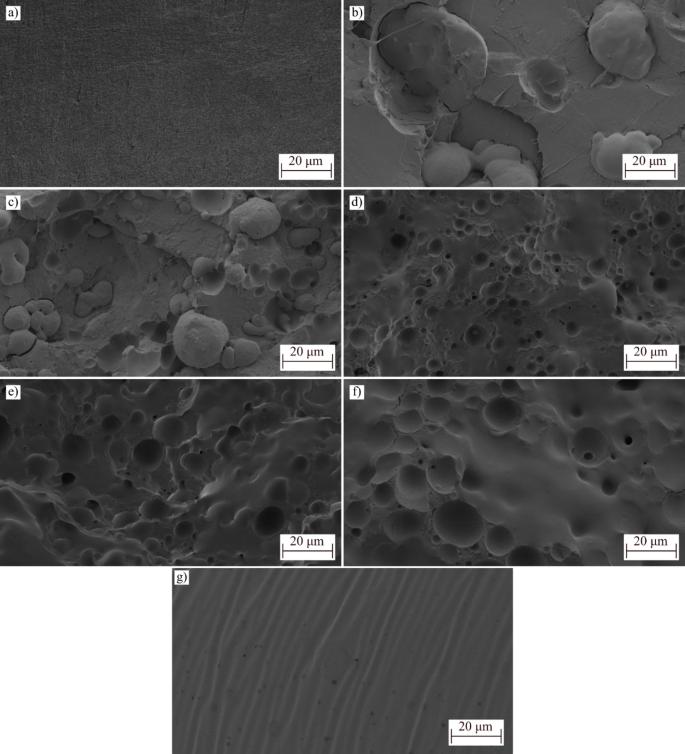
This study explores the development of polylactic acid (PLA) blends incorporating plasticized zein, a corn-derived protein, and dipropylene glycol (DPG) as a biobased plasticizer to enhance compatibility and processability. Blends were produced via twin-screw extrusion and injection molding, with plasticized zein content ranging from 10 to 50 wt%. Mechanical testing showed a significant increase in ductility, with elongation at break rising from 6.3% (neat PLA) to 56.3% (50 wt% zein), accompanied by reduced tensile strength (58.4 MPa to 22.7 MPa) and impact resistance (42.2 kJ/m2 to 11.5 kJ/m2), due to phase separation and limited compatibility. Shore D hardness slightly declined (from 82.9 to 77.4). Thermal analysis revealed the Tg decreasing from 59.5 °C to 39.9 °C as zein content increased. Thermogravimetric analysis showed reduced thermal stability with zein addition, dropping the initial degradation temperature from 360.0 °C to 188.2 °C. Morphological analysis indicated greater heterogeneity at higher zein levels due to partial miscibility. Colorimetric data showed visible changes, and FTIR spectra confirmed physical interactions and partial miscibility between PLA and zein.
期刊介绍:
The Journal of Polymers and the Environment fills the need for an international forum in this diverse and rapidly expanding field. The journal serves a crucial role for the publication of information from a wide range of disciplines and is a central outlet for the publication of high-quality peer-reviewed original papers, review articles and short communications. The journal is intentionally interdisciplinary in regard to contributions and covers the following subjects - polymers, environmentally degradable polymers, and degradation pathways: biological, photochemical, oxidative and hydrolytic; new environmental materials: derived by chemical and biosynthetic routes; environmental blends and composites; developments in processing and reactive processing of environmental polymers; characterization of environmental materials: mechanical, physical, thermal, rheological, morphological, and others; recyclable polymers and plastics recycling environmental testing: in-laboratory simulations, outdoor exposures, and standardization of methodologies; environmental fate: end products and intermediates of biodegradation; microbiology and enzymology of polymer biodegradation; solid-waste management and public legislation specific to environmental polymers; and other related topics.

 求助内容:
求助内容: 应助结果提醒方式:

 京公网安备 11010802042870号


