{"title":"Fabrication and characterization of corn-silk biochar@Fe3O4 composite for the adsorption of malachite green dye","authors":"Akshay Verma, Pooja Dhiman, Chin Wei Lai, Alberto García-Peñas, Gaurav Sharma","doi":"10.1007/s42768-025-00274-x","DOIUrl":null,"url":null,"abstract":"<div><p>The unregulated discharge of toxic dyes and agrochemicals resulting from industrial processes poses serious risks to aquatic and terrestrial ecosystems, highlighting the need for efficient remediation processes. In this work, a new corn silk-derived biochar/iron oxide (Fe<sub>3</sub>O<sub>4</sub>) composite (BCCS@Fe<sub>3</sub>O<sub>4</sub>) was synthesised via an in situ co-precipitation technique to effectively remove malachite green (MG) dye from aqueous solutions. The uniqueness of this study stems from the innovative use of corn silk, an agricultural waste, as a sustainable biochar precursor combined with Fe<sub>3</sub>O<sub>4</sub> nanoparticles to achieve both high adsorption capacity and magnetic recoverability. The prepared composite exhibited a high surface area, well-developed porosity, and strong magnetic properties that enabled efficient separation and reuse. Remarkably, the BCCS@Fe<sub>3</sub>O<sub>4</sub> composite exhibited superior adsorption uptake of 1000 mg/g, substantially surpassing conventional biochar and many previously reported adsorbents. The improved performance was due to electrostatic attraction, hydrogen bonding, and π–π interaction between dye molecules and the composite surface. The adsorption behaviour was well described by the Langmuir isotherm model, suggesting a monolayer adsorption pattern. Furthermore, the kinetic studies align with the pseudo-second-order model, indicating that chemisorption was the dominant mechanism governing the adsorption process. In addition, the material exhibited high recyclability, retaining 88.39% adsorption over four cycles. These findings highlight the promise of BCCS@Fe<sub>3</sub>O<sub>4</sub> composite as a low-cost, eco-friendly, and recyclable adsorbent for wastewater treatment processes.</p><h3>Graphical abstract</h3>\n<div><figure><div><div><picture><source><img></source></picture></div></div></figure></div></div>","PeriodicalId":807,"journal":{"name":"Waste Disposal & Sustainable Energy","volume":"8 1","pages":"159 - 178"},"PeriodicalIF":0.0000,"publicationDate":"2026-01-26","publicationTypes":"Journal Article","fieldsOfStudy":null,"isOpenAccess":false,"openAccessPdf":"https://link.springer.com/content/pdf/10.1007/s42768-025-00274-x.pdf","citationCount":"0","resultStr":null,"platform":"Semanticscholar","paperid":null,"PeriodicalName":"Waste Disposal & Sustainable Energy","FirstCategoryId":"6","ListUrlMain":"https://link.springer.com/article/10.1007/s42768-025-00274-x","RegionNum":0,"RegionCategory":null,"ArticlePicture":[],"TitleCN":null,"AbstractTextCN":null,"PMCID":null,"EPubDate":"","PubModel":"","JCR":"","JCRName":"","Score":null,"Total":0}
引用次数: 0
Abstract
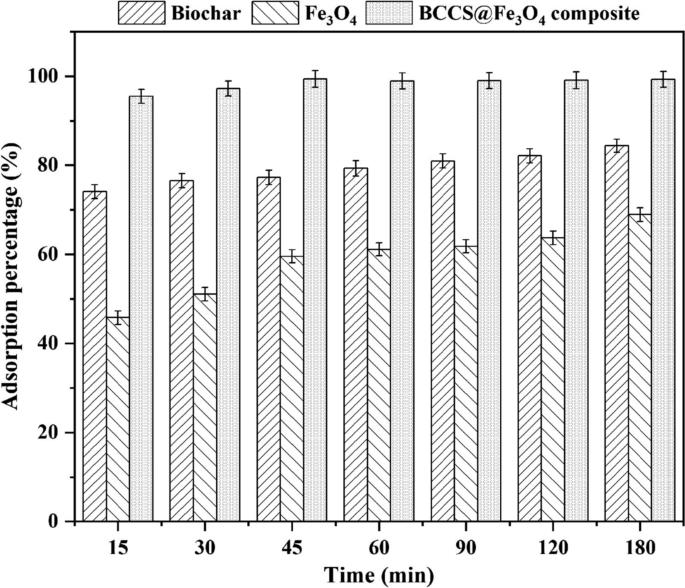
The unregulated discharge of toxic dyes and agrochemicals resulting from industrial processes poses serious risks to aquatic and terrestrial ecosystems, highlighting the need for efficient remediation processes. In this work, a new corn silk-derived biochar/iron oxide (Fe3O4) composite (BCCS@Fe3O4) was synthesised via an in situ co-precipitation technique to effectively remove malachite green (MG) dye from aqueous solutions. The uniqueness of this study stems from the innovative use of corn silk, an agricultural waste, as a sustainable biochar precursor combined with Fe3O4 nanoparticles to achieve both high adsorption capacity and magnetic recoverability. The prepared composite exhibited a high surface area, well-developed porosity, and strong magnetic properties that enabled efficient separation and reuse. Remarkably, the BCCS@Fe3O4 composite exhibited superior adsorption uptake of 1000 mg/g, substantially surpassing conventional biochar and many previously reported adsorbents. The improved performance was due to electrostatic attraction, hydrogen bonding, and π–π interaction between dye molecules and the composite surface. The adsorption behaviour was well described by the Langmuir isotherm model, suggesting a monolayer adsorption pattern. Furthermore, the kinetic studies align with the pseudo-second-order model, indicating that chemisorption was the dominant mechanism governing the adsorption process. In addition, the material exhibited high recyclability, retaining 88.39% adsorption over four cycles. These findings highlight the promise of BCCS@Fe3O4 composite as a low-cost, eco-friendly, and recyclable adsorbent for wastewater treatment processes.

 求助内容:
求助内容: 应助结果提醒方式:

 京公网安备 11010802042870号


