ZnO nanoparticles as a reusable catalyst for multicomponent one pot synthesis of 1H-Indeno[1,2-d]pyrimidine-2,5-dione and bis-3,4-dihydropyrimidin-2(1H)-ones
{"title":"ZnO nanoparticles as a reusable catalyst for multicomponent one pot synthesis of 1H-Indeno[1,2-d]pyrimidine-2,5-dione and bis-3,4-dihydropyrimidin-2(1H)-ones","authors":"Ananda Mane, Sonatai Patil, Siddharth Kamat, Tanaji Bhosale, Savita Dhongade-Desai","doi":"10.1007/s13738-026-03401-5","DOIUrl":null,"url":null,"abstract":"<div><p>This study explores the catalytic role of zinc oxide nanoparticles (ZnO NPs) in the synthesis of 1<i>H</i>-indeno[1,2-<i>d</i>]pyrimidine-2,5-diones and bis-3,4-dihydropyrimidin-2(1<i>H</i>)-ones through multicomponent reactions. ZnO NPs were characterized by FT-IR, XRD, FESEM and EDS. FT-IR analysis revealed a Zn-O stretching peak at 515 cm<sup>−1</sup>, confirming the formation of ZnO NPs. XRD pattern indicated a hexagonal wurtzite structure with an average crystallite size of 25.86 nm, while FESEM images showed nanoflakes with dimensions around 120 nm. EDS analysis confirmed the presence of zinc and oxygen in the nanoparticles with atomic percentages of 46.04% and 53.96% respectively. Optimization of the reaction conditions for synthesizing 4-phenyl-3,4-dihydro-1<i>H</i>-indeno[1,2-<i>d</i>]pyrimidine-2,5-dione was performed and the best yield (90%) was obtained using 10 mol% ZnO NPs in ethanol under reflux conditions. The effect of different solvents, temperatures and catalyst concentrations was studied. The catalyst showed broad applicability producing various substituted derivatives with good to excellent yields. The recyclability of ZnO NPs was demonstrated for up to five cycles, with a slight decrease in yield due to nanoparticle aggregation. A proposed mechanism involves ZnO NPs coordinating to enhance the electrophilic character of the aldehyde carbonyl, facilitating product formation. The study highlights the potential of ZnO NPs as an efficient, sustainable catalyst for multicomponent reactions. </p><h3>Graphical abstract</h3><div><figure><div><div><picture><source><img></source></picture></div></div></figure></div></div>","PeriodicalId":676,"journal":{"name":"Journal of the Iranian Chemical Society","volume":"23 4","pages":""},"PeriodicalIF":2.3000,"publicationDate":"2026-03-25","publicationTypes":"Journal Article","fieldsOfStudy":null,"isOpenAccess":false,"openAccessPdf":"","citationCount":"0","resultStr":null,"platform":"Semanticscholar","paperid":null,"PeriodicalName":"Journal of the Iranian Chemical Society","FirstCategoryId":"92","ListUrlMain":"https://link.springer.com/article/10.1007/s13738-026-03401-5","RegionNum":4,"RegionCategory":"化学","ArticlePicture":[],"TitleCN":null,"AbstractTextCN":null,"PMCID":null,"EPubDate":"","PubModel":"","JCR":"Q3","JCRName":"CHEMISTRY, MULTIDISCIPLINARY","Score":null,"Total":0}
引用次数: 0
Abstract
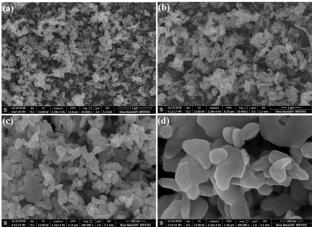
This study explores the catalytic role of zinc oxide nanoparticles (ZnO NPs) in the synthesis of 1H-indeno[1,2-d]pyrimidine-2,5-diones and bis-3,4-dihydropyrimidin-2(1H)-ones through multicomponent reactions. ZnO NPs were characterized by FT-IR, XRD, FESEM and EDS. FT-IR analysis revealed a Zn-O stretching peak at 515 cm−1, confirming the formation of ZnO NPs. XRD pattern indicated a hexagonal wurtzite structure with an average crystallite size of 25.86 nm, while FESEM images showed nanoflakes with dimensions around 120 nm. EDS analysis confirmed the presence of zinc and oxygen in the nanoparticles with atomic percentages of 46.04% and 53.96% respectively. Optimization of the reaction conditions for synthesizing 4-phenyl-3,4-dihydro-1H-indeno[1,2-d]pyrimidine-2,5-dione was performed and the best yield (90%) was obtained using 10 mol% ZnO NPs in ethanol under reflux conditions. The effect of different solvents, temperatures and catalyst concentrations was studied. The catalyst showed broad applicability producing various substituted derivatives with good to excellent yields. The recyclability of ZnO NPs was demonstrated for up to five cycles, with a slight decrease in yield due to nanoparticle aggregation. A proposed mechanism involves ZnO NPs coordinating to enhance the electrophilic character of the aldehyde carbonyl, facilitating product formation. The study highlights the potential of ZnO NPs as an efficient, sustainable catalyst for multicomponent reactions.
期刊介绍:
JICS is an international journal covering general fields of chemistry. JICS welcomes high quality original papers in English dealing with experimental, theoretical and applied research related to all branches of chemistry. These include the fields of analytical, inorganic, organic and physical chemistry as well as the chemical biology area. Review articles discussing specific areas of chemistry of current chemical or biological importance are also published. JICS ensures visibility of your research results to a worldwide audience in science. You are kindly invited to submit your manuscript to the Editor-in-Chief or Regional Editor. All contributions in the form of original papers or short communications will be peer reviewed and published free of charge after acceptance.

 求助内容:
求助内容: 应助结果提醒方式:

 京公网安备 11010802042870号


