M. Carmen Borrallo-Aniceto, Beatriz Fuerte-Díez, Laura González-Aguilera, M. Luisa Ferrer, M. Pilar Lillo, Andreas Mavrandonakis, Urbano Díaz, Eva M. Maya and Marta Iglesias
{"title":"Impact of π-conjugation and fluorination on the sensing performance of 1,6-pyrene covalent triazine frameworks","authors":"M. Carmen Borrallo-Aniceto, Beatriz Fuerte-Díez, Laura González-Aguilera, M. Luisa Ferrer, M. Pilar Lillo, Andreas Mavrandonakis, Urbano Díaz, Eva M. Maya and Marta Iglesias","doi":"10.1039/D5LP00381D","DOIUrl":null,"url":null,"abstract":"<p >In this work, we describe the synthesis of a series covalent triazine frameworks (CTFs) based on 1,6-substituted-pyrene-derivatives, in which triazine units (electron acceptor groups) are either directly bonded to the pyrene core (1,6-Pyr-CTF) or connected <em>via</em> aryl or fluoroaryl-π-linkers (1,6-DPhPyr-CTF and 1,6-2FDPhPyr-CTF). These CTFs were readily synthesized through cyclotrimerization of the corresponding dinitriles, yielding thermally stable products with favorable photophysical properties and fluorescence emission maxima at 401 nm (1,6-Pyr-CTF), 428 nm (1,6-DPhPyr-CTF) and 433 nm (1,6-2FDPhPyr-CTF). These characteristics make them promising candidates for fluorescent sensing of nitroaromatic compounds. Among the synthesized frameworks, the fluorinated diphenylpyrene-triazine (1,6-2FDPhPyr-CTF) exhibits the highest selectivity and sensitivity toward nitro compounds, in EtOH/H<small><sub>2</sub></small>O dispersions, with <em>K</em><small><sub>SV</sub></small> = 4.35 × 10<small><sup>4</sup></small> M<small><sup>−1</sup></small> (LOD = 0.15 ppm) for picric acid (TNP) or 3.39 × 10<small><sup>4</sup></small> M<small><sup>−1</sup></small> (LOD = 0.11 ppm) for (<em>p</em>-nitroaniline, 4-NA). These results demonstrate the beneficial effect of extended π-conjugation and fluorine incorporation on the sensing performance of CTFs.</p>","PeriodicalId":101139,"journal":{"name":"RSC Applied Polymers","volume":" 2","pages":" 839-850"},"PeriodicalIF":0.0000,"publicationDate":"2026-02-25","publicationTypes":"Journal Article","fieldsOfStudy":null,"isOpenAccess":false,"openAccessPdf":"https://pubs.rsc.org/en/content/articlepdf/2026/lp/d5lp00381d?page=search","citationCount":"0","resultStr":null,"platform":"Semanticscholar","paperid":null,"PeriodicalName":"RSC Applied Polymers","FirstCategoryId":"1085","ListUrlMain":"https://pubs.rsc.org/en/content/articlelanding/2026/lp/d5lp00381d","RegionNum":0,"RegionCategory":null,"ArticlePicture":[],"TitleCN":null,"AbstractTextCN":null,"PMCID":null,"EPubDate":"","PubModel":"","JCR":"","JCRName":"","Score":null,"Total":0}
引用次数: 0
Abstract
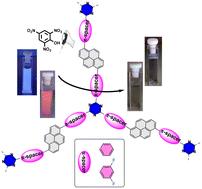
In this work, we describe the synthesis of a series covalent triazine frameworks (CTFs) based on 1,6-substituted-pyrene-derivatives, in which triazine units (electron acceptor groups) are either directly bonded to the pyrene core (1,6-Pyr-CTF) or connected via aryl or fluoroaryl-π-linkers (1,6-DPhPyr-CTF and 1,6-2FDPhPyr-CTF). These CTFs were readily synthesized through cyclotrimerization of the corresponding dinitriles, yielding thermally stable products with favorable photophysical properties and fluorescence emission maxima at 401 nm (1,6-Pyr-CTF), 428 nm (1,6-DPhPyr-CTF) and 433 nm (1,6-2FDPhPyr-CTF). These characteristics make them promising candidates for fluorescent sensing of nitroaromatic compounds. Among the synthesized frameworks, the fluorinated diphenylpyrene-triazine (1,6-2FDPhPyr-CTF) exhibits the highest selectivity and sensitivity toward nitro compounds, in EtOH/H2O dispersions, with KSV = 4.35 × 10⁴ M−1 (LOD = 0.15 ppm) for picric acid (TNP) or 3.39 × 10⁴ M−1 (LOD = 0.11 ppm) for (p-nitroaniline, 4-NA). These results demonstrate the beneficial effect of extended π-conjugation and fluorine incorporation on the sensing performance of CTFs.


 求助内容:
求助内容: 应助结果提醒方式:

 京公网安备 11010802042870号


