Christian Gonzalez, Arijit Ghorai and Hoyong Chung
{"title":"Sustainable synthesis methods of lignin-based copolymers: recyclable non-carbodiimide catalytic systems in aqueous solvent","authors":"Christian Gonzalez, Arijit Ghorai and Hoyong Chung","doi":"10.1039/D5LP00387C","DOIUrl":null,"url":null,"abstract":"<p >Lignin is a valuable biopolymer that serves as a raw material for producing functional polymers due to its abundance, low price, sustainability, and high aromatic content. However, conventional lignin modification methods often rely on environmentally harmful reagents, solvents, and catalysts, primarily because these are common in traditional organic and polymer chemistry. Therefore, utilizing more sustainable solvents, reagents, and catalysts for synthesizing biomass-based, biodegradable polymers is crucial for developing more sustainable production methods. In this work, a lignin-containing copolymer, lignin-<em>graft</em>-polycaprolactone (lignin-<em>graft</em>-PCL), was synthesized using more environmentally friendly solvents, reagents, and catalysts. The first innovation focuses on natural lignin modification. While conventional methods use <em>N</em>,<em>N</em>′-dicyclohexylcarbodiimide (DCC) and 4-dimethylaminopyridine (DMAP) to introduce carboxylic acid functionality into lignin, this study employs 2-chloro-1-methylpyridinium iodide (Mukaiyama reagent), which eliminates the formation of harmful byproducts such as <em>N</em>,<em>N</em>′-dicyclohexylurea (DCU) while maintaining high efficiency. Additionally, a tetrahydrofuran (THF)/water cosolvent system was used for lignin modification, replacing the traditionally used dimethylformamide (DMF). The second key innovation is the use of a recyclable catalyst system for lignin-based graft copolymer synthesis, which requires separate synthesis of PCL prior to graft onto lignin through covalent linkage. Unlike conventional approaches, this study presents a new recyclable polymer bound catalyst, 1,3,4,6,7,8-Hexahydro-2<em>H</em>-pyrimido[1,2-<em>a</em>] pyrimidine, polymer-bound (PS-TBD), for a ε-caprolactone polymerization. The PS-TBD catalyst was successfully recycled and demonstrated sustained performance over four consecutive cycles, showing only a gradual reduction in efficiency. Comprehensive spectroscopic analyses confirmed the chemical structures of all synthesized products obtained from the esterification in lignin modification, ring-opening polymerization, and copolymerization, demonstrating high efficiency.</p>","PeriodicalId":101139,"journal":{"name":"RSC Applied Polymers","volume":" 2","pages":" 823-838"},"PeriodicalIF":0.0000,"publicationDate":"2026-02-09","publicationTypes":"Journal Article","fieldsOfStudy":null,"isOpenAccess":false,"openAccessPdf":"https://pubs.rsc.org/en/content/articlepdf/2026/lp/d5lp00387c?page=search","citationCount":"0","resultStr":null,"platform":"Semanticscholar","paperid":null,"PeriodicalName":"RSC Applied Polymers","FirstCategoryId":"1085","ListUrlMain":"https://pubs.rsc.org/en/content/articlelanding/2026/lp/d5lp00387c","RegionNum":0,"RegionCategory":null,"ArticlePicture":[],"TitleCN":null,"AbstractTextCN":null,"PMCID":null,"EPubDate":"","PubModel":"","JCR":"","JCRName":"","Score":null,"Total":0}
引用次数: 0
Abstract
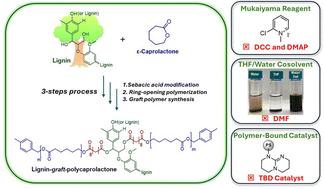
Lignin is a valuable biopolymer that serves as a raw material for producing functional polymers due to its abundance, low price, sustainability, and high aromatic content. However, conventional lignin modification methods often rely on environmentally harmful reagents, solvents, and catalysts, primarily because these are common in traditional organic and polymer chemistry. Therefore, utilizing more sustainable solvents, reagents, and catalysts for synthesizing biomass-based, biodegradable polymers is crucial for developing more sustainable production methods. In this work, a lignin-containing copolymer, lignin-graft-polycaprolactone (lignin-graft-PCL), was synthesized using more environmentally friendly solvents, reagents, and catalysts. The first innovation focuses on natural lignin modification. While conventional methods use N,N′-dicyclohexylcarbodiimide (DCC) and 4-dimethylaminopyridine (DMAP) to introduce carboxylic acid functionality into lignin, this study employs 2-chloro-1-methylpyridinium iodide (Mukaiyama reagent), which eliminates the formation of harmful byproducts such as N,N′-dicyclohexylurea (DCU) while maintaining high efficiency. Additionally, a tetrahydrofuran (THF)/water cosolvent system was used for lignin modification, replacing the traditionally used dimethylformamide (DMF). The second key innovation is the use of a recyclable catalyst system for lignin-based graft copolymer synthesis, which requires separate synthesis of PCL prior to graft onto lignin through covalent linkage. Unlike conventional approaches, this study presents a new recyclable polymer bound catalyst, 1,3,4,6,7,8-Hexahydro-2H-pyrimido[1,2-a] pyrimidine, polymer-bound (PS-TBD), for a ε-caprolactone polymerization. The PS-TBD catalyst was successfully recycled and demonstrated sustained performance over four consecutive cycles, showing only a gradual reduction in efficiency. Comprehensive spectroscopic analyses confirmed the chemical structures of all synthesized products obtained from the esterification in lignin modification, ring-opening polymerization, and copolymerization, demonstrating high efficiency.


 求助内容:
求助内容: 应助结果提醒方式:

 京公网安备 11010802042870号


