{"title":"Harnessing 1,8-Naphthalimide based amide capped with Pluronic F127 micelles for the detection of chlorpyrifos methyl and erythrosine B","authors":"Nisha Jain and Navneet Kaur","doi":"10.1039/D5LP00287G","DOIUrl":null,"url":null,"abstract":"<p >Considering the detrimental effects of chlorpyrifos methyl (CPS methyl) and erythrosine B on living organisms, it is crucial to detect their presence even at trace levels. For this, a binary ensemble, <strong>NPOH@PF127</strong>, was developed by encapsulating the 1,8-naphthalimide-based amide <strong>NPOH</strong> in the hydrophobic core of micelles of the block copolymer Pluronic F127. Structural and chemical properties of this binary ensemble were scrupulously investigated using various analytical techniques such as DLS, HRTEM, EDX, elemental mapping, SAED, PXRD, FT-IR spectroscopy, TGA, DSC, DTG, XPS and optical spectroscopy. The sensor exhibited significant enhancement and quenching of fluorescence intensity upon interaction with CPS methyl (LOD = 1.28 µM) and erythrosine B (LOD = 0.18 µM), respectively, with corresponding linear detection ranges of 4.22–1500 µM and 0.59–138 µM. Moreover, <strong>NPOH@PF127</strong> accurately detected CPS methyl and erythrosine B in grape juice and watermelon juice, with excellent recoveries in the range of 96% to 110%. Given the high stability, quick response, high sensitivity and selectivity of <strong>NPOH@PF127</strong>, it can be utilized for making portable test kits and thus contribute to refined environmental and food safety monitoring.</p>","PeriodicalId":101139,"journal":{"name":"RSC Applied Polymers","volume":" 2","pages":" 689-703"},"PeriodicalIF":0.0000,"publicationDate":"2026-01-21","publicationTypes":"Journal Article","fieldsOfStudy":null,"isOpenAccess":false,"openAccessPdf":"https://pubs.rsc.org/en/content/articlepdf/2026/lp/d5lp00287g?page=search","citationCount":"0","resultStr":null,"platform":"Semanticscholar","paperid":null,"PeriodicalName":"RSC Applied Polymers","FirstCategoryId":"1085","ListUrlMain":"https://pubs.rsc.org/en/content/articlelanding/2026/lp/d5lp00287g","RegionNum":0,"RegionCategory":null,"ArticlePicture":[],"TitleCN":null,"AbstractTextCN":null,"PMCID":null,"EPubDate":"","PubModel":"","JCR":"","JCRName":"","Score":null,"Total":0}
引用次数: 0
Abstract
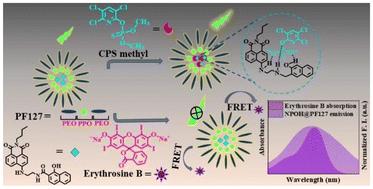
Considering the detrimental effects of chlorpyrifos methyl (CPS methyl) and erythrosine B on living organisms, it is crucial to detect their presence even at trace levels. For this, a binary ensemble, NPOH@PF127, was developed by encapsulating the 1,8-naphthalimide-based amide NPOH in the hydrophobic core of micelles of the block copolymer Pluronic F127. Structural and chemical properties of this binary ensemble were scrupulously investigated using various analytical techniques such as DLS, HRTEM, EDX, elemental mapping, SAED, PXRD, FT-IR spectroscopy, TGA, DSC, DTG, XPS and optical spectroscopy. The sensor exhibited significant enhancement and quenching of fluorescence intensity upon interaction with CPS methyl (LOD = 1.28 µM) and erythrosine B (LOD = 0.18 µM), respectively, with corresponding linear detection ranges of 4.22–1500 µM and 0.59–138 µM. Moreover, NPOH@PF127 accurately detected CPS methyl and erythrosine B in grape juice and watermelon juice, with excellent recoveries in the range of 96% to 110%. Given the high stability, quick response, high sensitivity and selectivity of NPOH@PF127, it can be utilized for making portable test kits and thus contribute to refined environmental and food safety monitoring.


 求助内容:
求助内容: 应助结果提醒方式:

 京公网安备 11010802042870号


