Oscar Kayanja, Emre Kantar, Svein M. Hellesø, Julia Glaum, Sverre Hvidsten and Mari-Ann Einarsrud
{"title":"Accelerated ageing of silicone rubber and XLPE used in HV cable accessories: a thermomechanical analysis","authors":"Oscar Kayanja, Emre Kantar, Svein M. Hellesø, Julia Glaum, Sverre Hvidsten and Mari-Ann Einarsrud","doi":"10.1039/D5LP00369E","DOIUrl":null,"url":null,"abstract":"<p >Medium and high-voltage cable accessories, such as terminations and connectors, operate under harsh mechanical and thermal stresses, influencing long-term reliability. These stresses may lead to deterioration in the mechanical properties of the materials, thereby reducing radial pressure. Hence, the number and size of microcavities at the solid–solid interfaces will increase, being detrimental to the electrical breakdown strength. To mitigate this, applying external compressive pressure after installation is proposed to address challenges with the microcavities. However, the long-term effect of the external compressive pressure on the mechanical properties of the materials remains unclear. This study investigates the combined effect of mechanical compression and thermal cycling on two types of insulating silicone rubber (SiR) and semiconductive SiR used in HV cable accessories, comparing them with cross-linked polyethylene (XLPE). The materials were subjected to 25% compressive strain and thermal cycling between −20 and 110 °C in air, while another set underwent only thermal cycling. Ageing under compression increased the compression set by ∼1% in hard SiR and ∼3% in soft and semiconductive SiR compared to unaged materials. Surface hardness increased significantly in soft and semiconductive SiR (∼3.7%) but slightly in hard SiR (∼0.3%). Surface roughness increased by 0.7–0.9 µm across all materials. After ageing, the stress-relaxation response decreased for both hard and soft SiR, whereas semiconductive SiR showed a slight increase. The material response to cyclic loading after accelerated ageing is presented, along with the suitability of these materials for future cable termination designs.</p>","PeriodicalId":101139,"journal":{"name":"RSC Applied Polymers","volume":" 2","pages":" 785-795"},"PeriodicalIF":0.0000,"publicationDate":"2026-02-05","publicationTypes":"Journal Article","fieldsOfStudy":null,"isOpenAccess":false,"openAccessPdf":"https://pubs.rsc.org/en/content/articlepdf/2026/lp/d5lp00369e?page=search","citationCount":"0","resultStr":null,"platform":"Semanticscholar","paperid":null,"PeriodicalName":"RSC Applied Polymers","FirstCategoryId":"1085","ListUrlMain":"https://pubs.rsc.org/en/content/articlelanding/2026/lp/d5lp00369e","RegionNum":0,"RegionCategory":null,"ArticlePicture":[],"TitleCN":null,"AbstractTextCN":null,"PMCID":null,"EPubDate":"","PubModel":"","JCR":"","JCRName":"","Score":null,"Total":0}
引用次数: 0
Abstract
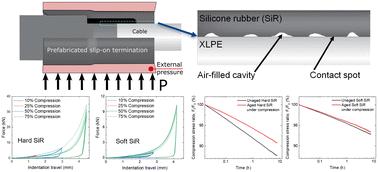
Medium and high-voltage cable accessories, such as terminations and connectors, operate under harsh mechanical and thermal stresses, influencing long-term reliability. These stresses may lead to deterioration in the mechanical properties of the materials, thereby reducing radial pressure. Hence, the number and size of microcavities at the solid–solid interfaces will increase, being detrimental to the electrical breakdown strength. To mitigate this, applying external compressive pressure after installation is proposed to address challenges with the microcavities. However, the long-term effect of the external compressive pressure on the mechanical properties of the materials remains unclear. This study investigates the combined effect of mechanical compression and thermal cycling on two types of insulating silicone rubber (SiR) and semiconductive SiR used in HV cable accessories, comparing them with cross-linked polyethylene (XLPE). The materials were subjected to 25% compressive strain and thermal cycling between −20 and 110 °C in air, while another set underwent only thermal cycling. Ageing under compression increased the compression set by ∼1% in hard SiR and ∼3% in soft and semiconductive SiR compared to unaged materials. Surface hardness increased significantly in soft and semiconductive SiR (∼3.7%) but slightly in hard SiR (∼0.3%). Surface roughness increased by 0.7–0.9 µm across all materials. After ageing, the stress-relaxation response decreased for both hard and soft SiR, whereas semiconductive SiR showed a slight increase. The material response to cyclic loading after accelerated ageing is presented, along with the suitability of these materials for future cable termination designs.


 求助内容:
求助内容: 应助结果提醒方式:

 京公网安备 11010802042870号


