Swapnil S. Bamane, Prathamesh P. Deshpande, Folarin Erogbogbo and Ozgur Keles
{"title":"Enhancing the mechanical properties of epoxy with graphene quantum dots: a molecular dynamics study","authors":"Swapnil S. Bamane, Prathamesh P. Deshpande, Folarin Erogbogbo and Ozgur Keles","doi":"10.1039/D5LP00373C","DOIUrl":null,"url":null,"abstract":"<p >Polymers are the key to the next generation of high-performance materials for their applications in aerospace, defense, and energy. Thermoset polymers like epoxy are widely used as a matrix material in composites due to their ease of processability and compatibility with reinforcement materials. There have been significant efforts in the development of polymer materials properties using nanofillers such as graphene, carbon nanotubes, rubber, and metal oxides. However, graphene quantum dots (GQD), a zero-dimensional nano-scale filler material, have not been extensively explored towards improvement of the mechanical properties of polymers. The objective of this study is to understand the effects of GQDs on the mechanical properties of the epoxy. The impact of various functional GQDs is evaluated on mechanical properties such as Young's Modulus, yield strength, and Poisson's ratio. The predicted materials properties using a fixed-bond interface forcefield (IFF) are compared with a reactive forcefield, ReaxFF. The results of this study demonstrate that the amine-functionalized GQDs improve the Young's modulus of the epoxy by 14% and the yield strength by 47%. Furthermore, MD simulations offer nanoscale insights into the energy distributions, free volume, and increase of free volume pockets in the material. The results and observations of this study provide valuable nano-scale insights into accurate and efficient modeling of GQD nanocomposite materials for high-performance applications in aerospace, defense, and energy.</p>","PeriodicalId":101139,"journal":{"name":"RSC Applied Polymers","volume":" 2","pages":" 753-766"},"PeriodicalIF":0.0000,"publicationDate":"2026-01-26","publicationTypes":"Journal Article","fieldsOfStudy":null,"isOpenAccess":false,"openAccessPdf":"https://pubs.rsc.org/en/content/articlepdf/2026/lp/d5lp00373c?page=search","citationCount":"0","resultStr":null,"platform":"Semanticscholar","paperid":null,"PeriodicalName":"RSC Applied Polymers","FirstCategoryId":"1085","ListUrlMain":"https://pubs.rsc.org/en/content/articlelanding/2026/lp/d5lp00373c","RegionNum":0,"RegionCategory":null,"ArticlePicture":[],"TitleCN":null,"AbstractTextCN":null,"PMCID":null,"EPubDate":"","PubModel":"","JCR":"","JCRName":"","Score":null,"Total":0}
引用次数: 0
Abstract
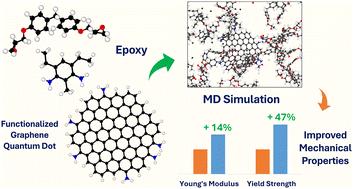
Polymers are the key to the next generation of high-performance materials for their applications in aerospace, defense, and energy. Thermoset polymers like epoxy are widely used as a matrix material in composites due to their ease of processability and compatibility with reinforcement materials. There have been significant efforts in the development of polymer materials properties using nanofillers such as graphene, carbon nanotubes, rubber, and metal oxides. However, graphene quantum dots (GQD), a zero-dimensional nano-scale filler material, have not been extensively explored towards improvement of the mechanical properties of polymers. The objective of this study is to understand the effects of GQDs on the mechanical properties of the epoxy. The impact of various functional GQDs is evaluated on mechanical properties such as Young's Modulus, yield strength, and Poisson's ratio. The predicted materials properties using a fixed-bond interface forcefield (IFF) are compared with a reactive forcefield, ReaxFF. The results of this study demonstrate that the amine-functionalized GQDs improve the Young's modulus of the epoxy by 14% and the yield strength by 47%. Furthermore, MD simulations offer nanoscale insights into the energy distributions, free volume, and increase of free volume pockets in the material. The results and observations of this study provide valuable nano-scale insights into accurate and efficient modeling of GQD nanocomposite materials for high-performance applications in aerospace, defense, and energy.


 求助内容:
求助内容: 应助结果提醒方式:

 京公网安备 11010802042870号


