Study of uniaxially stretched single-layer and multi-layer blown films based on poly(butylene adipate-co-terephthalate) and inorganic fillers for food and agriculture applications
Debarshi Nath, Matias Menossi, Ehsan Pesaranhajiabbas, Michael R. Snowdon, Amar K. Mohanty and Manjusri Misra
{"title":"Study of uniaxially stretched single-layer and multi-layer blown films based on poly(butylene adipate-co-terephthalate) and inorganic fillers for food and agriculture applications","authors":"Debarshi Nath, Matias Menossi, Ehsan Pesaranhajiabbas, Michael R. Snowdon, Amar K. Mohanty and Manjusri Misra","doi":"10.1039/D5LP00306G","DOIUrl":null,"url":null,"abstract":"<p >This study develops a biodegradable flexible packaging material using poly(butylene adipate-<em>co</em>-terephthalate) (PBAT) with talc or CaCO<small><sub>3</sub></small> (at 25 wt%) using the blown film extrusion method for flexible packaging applications. The films were produced in single-layer (SL) and tri-layer (TL) configurations. The maximum stretch ratio (SR) obtained for the TL-PBAT/talc25%, TL-PBAT/CaCO<small><sub>3</sub></small>25%, and SL-PBAT/CaCO<small><sub>3</sub></small>25% were 4, 5.5, and 6, respectively. The mechanical properties of the PBAT/talc films were better than the PBAT/CaCO<small><sub>3</sub></small> films for both stretched and unstretched films. With uniaxial orientation in the machine direction, the tensile strength, impact strength, and modulus increased for all films while the elongation at break decreased. The maximum improvement was shown for tensile strength, where this property increased by 250%, 400%, and 300% for TL-PBAT/talc25%, SL-PBAT/CaCO<small><sub>3</sub></small>25%, and TL-PBAT/CaCO<small><sub>3</sub></small>25%, respectively, after stretching to the maximum SR. This is attributed to strain-induced crystallization and strong alignment of polymer chains in the machine direction. This is evident from the improvement of barrier performance of the films upon stretching, also attributed to the increase in crystallinity of the films. The measurement of percentage crystallinity was conducted using DSC and XRD techniques, where the crystallinity of the samples increased with an increase in SR. Although other factors also influence the improvement of stretched film performance, an increase in crystallinity is considered one of the most important factors. Morphological analysis of the samples shows better talc dispersion than CaCO<small><sub>3</sub></small> and a strong orientation of the matrix in the stretching direction.</p>","PeriodicalId":101139,"journal":{"name":"RSC Applied Polymers","volume":" 2","pages":" 674-688"},"PeriodicalIF":0.0000,"publicationDate":"2026-01-21","publicationTypes":"Journal Article","fieldsOfStudy":null,"isOpenAccess":false,"openAccessPdf":"https://pubs.rsc.org/en/content/articlepdf/2026/lp/d5lp00306g?page=search","citationCount":"0","resultStr":null,"platform":"Semanticscholar","paperid":null,"PeriodicalName":"RSC Applied Polymers","FirstCategoryId":"1085","ListUrlMain":"https://pubs.rsc.org/en/content/articlelanding/2026/lp/d5lp00306g","RegionNum":0,"RegionCategory":null,"ArticlePicture":[],"TitleCN":null,"AbstractTextCN":null,"PMCID":null,"EPubDate":"","PubModel":"","JCR":"","JCRName":"","Score":null,"Total":0}
引用次数: 0
Abstract
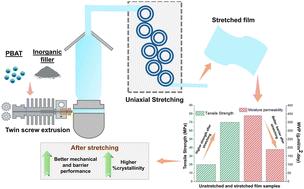
This study develops a biodegradable flexible packaging material using poly(butylene adipate-co-terephthalate) (PBAT) with talc or CaCO3 (at 25 wt%) using the blown film extrusion method for flexible packaging applications. The films were produced in single-layer (SL) and tri-layer (TL) configurations. The maximum stretch ratio (SR) obtained for the TL-PBAT/talc25%, TL-PBAT/CaCO325%, and SL-PBAT/CaCO325% were 4, 5.5, and 6, respectively. The mechanical properties of the PBAT/talc films were better than the PBAT/CaCO3 films for both stretched and unstretched films. With uniaxial orientation in the machine direction, the tensile strength, impact strength, and modulus increased for all films while the elongation at break decreased. The maximum improvement was shown for tensile strength, where this property increased by 250%, 400%, and 300% for TL-PBAT/talc25%, SL-PBAT/CaCO325%, and TL-PBAT/CaCO325%, respectively, after stretching to the maximum SR. This is attributed to strain-induced crystallization and strong alignment of polymer chains in the machine direction. This is evident from the improvement of barrier performance of the films upon stretching, also attributed to the increase in crystallinity of the films. The measurement of percentage crystallinity was conducted using DSC and XRD techniques, where the crystallinity of the samples increased with an increase in SR. Although other factors also influence the improvement of stretched film performance, an increase in crystallinity is considered one of the most important factors. Morphological analysis of the samples shows better talc dispersion than CaCO3 and a strong orientation of the matrix in the stretching direction.


 求助内容:
求助内容: 应助结果提醒方式:

 京公网安备 11010802042870号


