
Bacterial 2′,3′-cGAMP activates a SAVED effector to form membrane-disrupting filaments and restrict phage replication
IF 18.7
1区 医学
Q1 MICROBIOLOGY
引用次数: 0
Abstract
Mammalian cells initiate antiviral signaling when cyclic GMP-AMP synthase (cGAS) detects cytoplasmic DNA and synthesizes 2′,3′-cyclic GMP-AMP (2′,3′-cGAMP), which activates stimulator of interferon genes (STING). Similarly, bacteria use cyclic oligonucleotide-based antiphage signaling systems (CBASS) to detect phage using ancestral cGAS/DncV-like nucleotidyltransferases (CD-NTases), but they are not known to use 2′,3′-cGAMP. Here, we discover a bacterial CD-NTase that produces 2′,3′-cGAMP to activate a Saf-2TM-SMODS-associated fused to various effector domains (SAVED) effector (CD-NTase-associated protein 14 [Cap14]), which initiates membrane disruption to restrict phage replication. Cryo-electron microscopy (cryo-EM) reveals that Cap14 binds 2′,3′-cGAMP to form a filament, while electrophysiology suggests that cGAMP activates membrane disruption. Swapping the Cap14 transmembrane domain with a nuclease domain yields a functional chimera that exclusively responds to 2′,3′-cGAMP. We hypothesize that other predicted transmembrane effectors in CBASS operons disrupt membranes, and we confirm this by showing that bacterial STING homologs with transmembrane domains restrict phage through membrane disruption. These findings expand our understanding of cGAS-STING-like pathways in bacterial immunity.
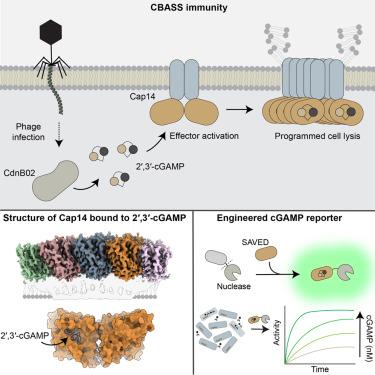
细菌的2 ',3 ' -cGAMP激活一个SAVED效应体形成膜破坏细丝并限制噬菌体复制
哺乳动物细胞通过环GMP-AMP合成酶(cGAS)检测细胞质DNA,合成2 ',3 ' -环GMP-AMP (2 ',3 ' -cGAMP),激活干扰素刺激因子(STING),从而启动抗病毒信号。类似地,细菌使用基于环寡核苷酸的噬菌体信号系统(CBASS)检测噬菌体,使用祖先的cGAS/ dncv样核苷酸转移酶(cd - nases),但已知它们不使用2 ',3 ' -cGAMP。在这里,我们发现了一种细菌CD-NTase,它产生2 ',3 ' -cGAMP来激活saf - 2tm - smods相关的融合到各种效应域(SAVED)效应(CD-NTase相关蛋白14 [Cap14]),从而启动膜破坏以限制噬菌体复制。低温电子显微镜(cro - em)显示Cap14结合2 ',3 ' -cGAMP形成丝,而电生理学表明cGAMP激活膜破坏。将Cap14跨膜结构域与核酸酶结构域交换可以产生只响应2 ',3 ' -cGAMP的功能性嵌合体。我们假设CBASS操纵子中的其他预测的跨膜效应物会破坏膜,我们通过显示具有跨膜结构域的细菌STING同源物通过膜破坏来限制噬菌体来证实这一点。这些发现扩大了我们对细菌免疫中cgas - sting样途径的理解。
本文章由计算机程序翻译,如有差异,请以英文原文为准。
求助全文
约1分钟内获得全文
求助全文
来源期刊
Cell host & microbe
生物-微生物学
CiteScore
45.10
自引率
1.70%
发文量
201
审稿时长
4-8 weeks
期刊介绍:
Cell Host & Microbe is a scientific journal that was launched in March 2007. The journal aims to provide a platform for scientists to exchange ideas and concepts related to the study of microbes and their interaction with host organisms at a molecular, cellular, and immune level. It publishes novel findings on a wide range of microorganisms including bacteria, fungi, parasites, and viruses. The journal focuses on the interface between the microbe and its host, whether the host is a vertebrate, invertebrate, or plant, and whether the microbe is pathogenic, non-pathogenic, or commensal. The integrated study of microbes and their interactions with each other, their host, and the cellular environment they inhabit is a unifying theme of the journal. The published work in Cell Host & Microbe is expected to be of exceptional significance within its field and also of interest to researchers in other areas. In addition to primary research articles, the journal features expert analysis, commentary, and reviews on current topics of interest in the field.
 求助内容:
求助内容: 应助结果提醒方式:

 京公网安备 11010802042870号


