
Vaginal microbiota impacts of a Lactobacillus crispatus live biotherapeutic and predictors of colonization in randomized controlled trial
IF 18.7
1区 医学
Q1 MICROBIOLOGY
引用次数: 0
Abstract
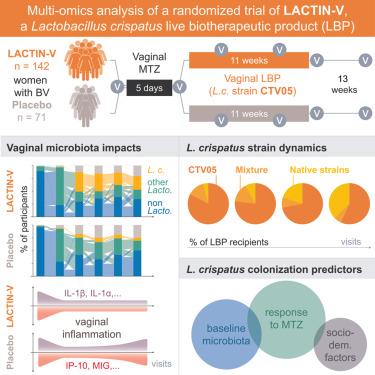
Bacterial vaginosis (BV) affects >25% of women worldwide and often recurs after standard-of-care metronidazole (MTZ) treatment. LACTIN-V, a live biotherapeutic product (LBP) containing Lactobacillus crispatus strain CTV-05, significantly reduced recurrent BV in a phase 2b clinical trial, but efficacy was incomplete. Here, we characterize microbiota and immune effects using multi-omics and define correlates of treatment success. By week 12, an L. crispatus-dominant microbiota was achieved in 30% of LBP recipients compared with 9% of placebo recipients (benefit ratio: 3.31; p < 0.005). This is primarily due to CTV-05, but native L. crispatus strains are also present and increase over time. Inflammatory cytokines decrease in both arms after MTZ but return to baseline in placebo recipients. Successful L. crispatus colonization is associated with pre-MTZ microbiota, baseline inflammatory profiles, post-MTZ bacterial load, and clinical and behavioral variables. These findings elucidate LBP microbiota effects and identify predictors of treatment success, informing improved intervention strategies to advance women’s health.
在随机对照试验中,一种马铃薯乳杆菌活生物疗法对阴道微生物群的影响和定植的预测因素
细菌性阴道病(BV)影响全球25%的女性,通常在标准护理甲硝唑(MTZ)治疗后复发。LACTIN-V是一种含有crispatus乳酸菌CTV-05的活生物治疗产品(LBP),在2b期临床试验中显著降低复发性BV,但疗效不完全。在这里,我们使用多组学表征微生物群和免疫效应,并定义治疗成功的相关因素。到第12周,30%的LBP接受者获得了以葡萄球菌为主的微生物群,而安慰剂接受者只有9%(获益比:3.31;p < 0.005)。这主要是由于CTV-05,但本地的葡萄球菌菌株也存在,并随着时间的推移而增加。MTZ后,两组的炎症细胞因子均下降,但安慰剂组恢复到基线水平。crispatus的成功定植与mtz前的微生物群、基线炎症谱、mtz后的细菌负荷以及临床和行为变量有关。这些发现阐明了腰痛菌群的影响,确定了治疗成功的预测因素,为改善干预策略提供了信息,以促进妇女的健康。
本文章由计算机程序翻译,如有差异,请以英文原文为准。
求助全文
约1分钟内获得全文
求助全文
来源期刊
Cell host & microbe
生物-微生物学
CiteScore
45.10
自引率
1.70%
发文量
201
审稿时长
4-8 weeks
期刊介绍:
Cell Host & Microbe is a scientific journal that was launched in March 2007. The journal aims to provide a platform for scientists to exchange ideas and concepts related to the study of microbes and their interaction with host organisms at a molecular, cellular, and immune level. It publishes novel findings on a wide range of microorganisms including bacteria, fungi, parasites, and viruses. The journal focuses on the interface between the microbe and its host, whether the host is a vertebrate, invertebrate, or plant, and whether the microbe is pathogenic, non-pathogenic, or commensal. The integrated study of microbes and their interactions with each other, their host, and the cellular environment they inhabit is a unifying theme of the journal. The published work in Cell Host & Microbe is expected to be of exceptional significance within its field and also of interest to researchers in other areas. In addition to primary research articles, the journal features expert analysis, commentary, and reviews on current topics of interest in the field.
 求助内容:
求助内容: 应助结果提醒方式:

 京公网安备 11010802042870号


