Dietary changes in patients with clear aligners compared with fixed orthodontic appliances during the early stages of orthodontic treatment: A systematic review.
Robert Iacobelli, Diana Tucker De Sanctis, Luay Jabr, Dimitris Michelogiannakis, Linda Sangalli
{"title":"Dietary changes in patients with clear aligners compared with fixed orthodontic appliances during the early stages of orthodontic treatment: A systematic review.","authors":"Robert Iacobelli, Diana Tucker De Sanctis, Luay Jabr, Dimitris Michelogiannakis, Linda Sangalli","doi":"10.4041/kjod25.271","DOIUrl":null,"url":null,"abstract":"<p><strong>Objective: </strong>This systematic review evaluated dietary changes during the first 6 months of orthodontic treatment between multibracket fixed appliances and clear aligners.</p><p><strong>Methods: </strong>Five databases (PubMed, Web of Science, Cochrane's Database of Systematic Reviews, EMBASE, Scopus) were searched through January 2025 for longitudinal studies on healthy participants undergoing non-extractive orthodontic treatment with multibracket fixed appliances or clear aligners, assessing dietary changes. Data on diet change were extracted at baseline, 24 hours, 1 week, 2 weeks, 1-2 months, and 3-6 months, and descriptively compared with pain outcomes. Quality assessment was performed using Risk-of-Bias-2.0 and ROBINS-I; overall certainty of evidence was evaluated with GRADE.</p><p><strong>Results: </strong>The search retrieved 180 studies; 56 were screened, and 22 full-text articles were reviewed. Nine studies (671 participants, 58.9% females) were included. Despite no significant baseline differences between groups, 24 hours after appliance placement, all studies indicated significantly greater diet-related limitations in the multibracket group than in the aligner group, with differences of 0.1-0.9 points on a 0-10 scale. Trends persisted at 1 week (differences 0.7-1.8 points), 2 weeks (0.8-1.9 points), 1-2 months (0.1-2.0 points), and 3-6 months (0.8-3.0 points). Across timepoints, comparisons of pain intensity and dietary changes did not reveal consistent patterns.</p><p><strong>Conclusions: </strong>During the first 6 months, multibracket appliances may affect diet more negatively than clear aligners and this pattern does not seem to be explained by differences in pain. Given the low-to-moderate certainty of evidence and indirect diet assessment using items from broader oral health-related quality of life instruments, these results should be interpreted with caution.</p>","PeriodicalId":51260,"journal":{"name":"Korean Journal of Orthodontics","volume":"56 2","pages":"142-166"},"PeriodicalIF":2.8000,"publicationDate":"2026-03-25","publicationTypes":"Journal Article","fieldsOfStudy":null,"isOpenAccess":false,"openAccessPdf":"https://www.ncbi.nlm.nih.gov/pmc/articles/PMC13021319/pdf/","citationCount":"0","resultStr":null,"platform":"Semanticscholar","paperid":null,"PeriodicalName":"Korean Journal of Orthodontics","FirstCategoryId":"3","ListUrlMain":"https://doi.org/10.4041/kjod25.271","RegionNum":3,"RegionCategory":"医学","ArticlePicture":[],"TitleCN":null,"AbstractTextCN":null,"PMCID":null,"EPubDate":"2025/12/24 0:00:00","PubModel":"Epub","JCR":"Q1","JCRName":"DENTISTRY, ORAL SURGERY & MEDICINE","Score":null,"Total":0}
引用次数: 0
Abstract
Objective: This systematic review evaluated dietary changes during the first 6 months of orthodontic treatment between multibracket fixed appliances and clear aligners.
Methods: Five databases (PubMed, Web of Science, Cochrane's Database of Systematic Reviews, EMBASE, Scopus) were searched through January 2025 for longitudinal studies on healthy participants undergoing non-extractive orthodontic treatment with multibracket fixed appliances or clear aligners, assessing dietary changes. Data on diet change were extracted at baseline, 24 hours, 1 week, 2 weeks, 1-2 months, and 3-6 months, and descriptively compared with pain outcomes. Quality assessment was performed using Risk-of-Bias-2.0 and ROBINS-I; overall certainty of evidence was evaluated with GRADE.
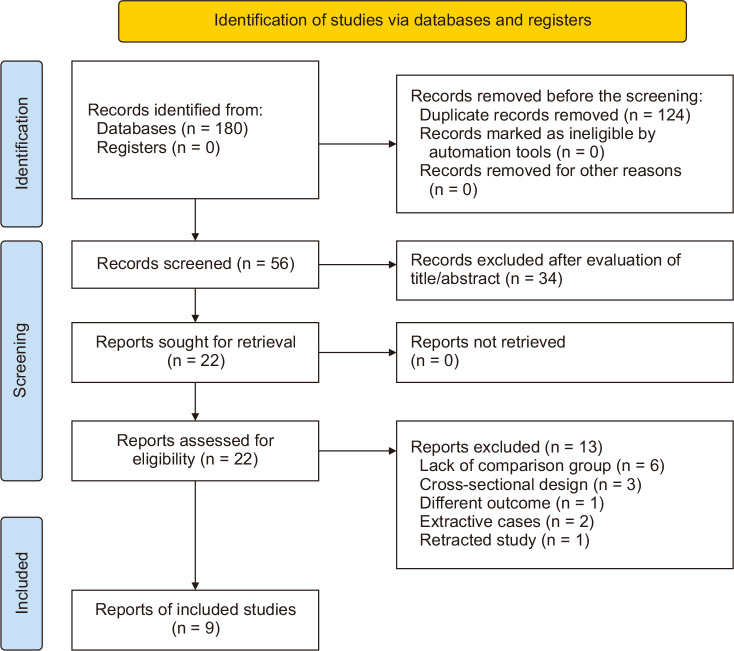
Results: The search retrieved 180 studies; 56 were screened, and 22 full-text articles were reviewed. Nine studies (671 participants, 58.9% females) were included. Despite no significant baseline differences between groups, 24 hours after appliance placement, all studies indicated significantly greater diet-related limitations in the multibracket group than in the aligner group, with differences of 0.1-0.9 points on a 0-10 scale. Trends persisted at 1 week (differences 0.7-1.8 points), 2 weeks (0.8-1.9 points), 1-2 months (0.1-2.0 points), and 3-6 months (0.8-3.0 points). Across timepoints, comparisons of pain intensity and dietary changes did not reveal consistent patterns.
Conclusions: During the first 6 months, multibracket appliances may affect diet more negatively than clear aligners and this pattern does not seem to be explained by differences in pain. Given the low-to-moderate certainty of evidence and indirect diet assessment using items from broader oral health-related quality of life instruments, these results should be interpreted with caution.
期刊介绍:
The Korean Journal of Orthodontics (KJO) is an international, open access, peer reviewed journal published in January, March, May, July, September, and November each year. It was first launched in 1970 and, as the official scientific publication of Korean Association of Orthodontists, KJO aims to publish high quality clinical and scientific original research papers in all areas related to orthodontics and dentofacial orthopedics. Specifically, its interest focuses on evidence-based investigations of contemporary diagnostic procedures and treatment techniques, expanding to significant clinical reports of diverse treatment approaches.
The scope of KJO covers all areas of orthodontics and dentofacial orthopedics including successful diagnostic procedures and treatment planning, growth and development of the face and its clinical implications, appliance designs, biomechanics, TMJ disorders and adult treatment. Specifically, its latest interest focuses on skeletal anchorage devices, orthodontic appliance and biomaterials, 3 dimensional imaging techniques utilized for dentofacial diagnosis and treatment planning, and orthognathic surgery to correct skeletal disharmony in association of orthodontic treatment.

 求助内容:
求助内容: 应助结果提醒方式:

 京公网安备 11010802042870号


