Susanne Wehrli, Jana Hochreuter, David Buttelmann, Francesca Lionetti, Michael Pluess, Niamh Oeri, Helen Koechlin
{"title":"The German version of the highly sensitive child scale: Psychometric properties and identification of sensitivity groups.","authors":"Susanne Wehrli, Jana Hochreuter, David Buttelmann, Francesca Lionetti, Michael Pluess, Niamh Oeri, Helen Koechlin","doi":"10.1007/s12144-026-09244-w","DOIUrl":null,"url":null,"abstract":"<p><p>Individuals differ in their sensitivity to external stimuli. The Highly Sensitive Child (HSC) scale can be used to measure sensitivity in children and adolescents. However, the German version has yet to be validated. We examined the psychometric properties of the German self- and the parent report version of the HSC. Measurement invariance (MI) across age groups was tested for the parent report version and latent profile analysis (LPA) was used to identify sensitivity groups. Pooled data from German-speaking countries (<i>N</i>= 250 self-reports; <i>N</i>= 3657 parent reports) was included. The factor structure was evaluated using confirmatory factor analysis (CFA), reliability was quantified by Cronbach's alpha (α) and MI was assessed by multigroup CFA using the optimal model. An exploratory analysis was carried out across age groups. CFA indicated the bifactorial model as the best fit for the HSC. Reliability of the total score across age groups was acceptable, but the MI was not. In the LPA, we found two sensitivity classes for early, middle childhood, and adolescent parent-reports, and four groups for self-report. The German version of the HSC seems to be a valid measurement of sensitivity. However, future research should examine age differences across childhood more closely.</p><p><strong>Supplementary information: </strong>The online version contains supplementary material available at 10.1007/s12144-026-09244-w.</p>","PeriodicalId":48075,"journal":{"name":"Current Psychology","volume":"45 7","pages":"738"},"PeriodicalIF":2.6000,"publicationDate":"2026-01-01","publicationTypes":"Journal Article","fieldsOfStudy":null,"isOpenAccess":false,"openAccessPdf":"https://www.ncbi.nlm.nih.gov/pmc/articles/PMC13009142/pdf/","citationCount":"0","resultStr":null,"platform":"Semanticscholar","paperid":null,"PeriodicalName":"Current Psychology","FirstCategoryId":"102","ListUrlMain":"https://doi.org/10.1007/s12144-026-09244-w","RegionNum":3,"RegionCategory":"心理学","ArticlePicture":[],"TitleCN":null,"AbstractTextCN":null,"PMCID":null,"EPubDate":"2026/3/23 0:00:00","PubModel":"Epub","JCR":"Q2","JCRName":"PSYCHOLOGY, MULTIDISCIPLINARY","Score":null,"Total":0}
引用次数: 0
Abstract
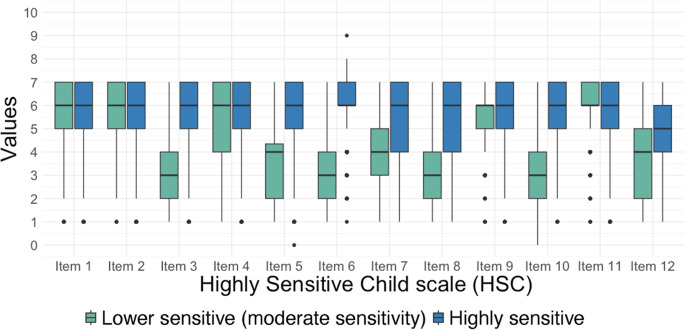
Individuals differ in their sensitivity to external stimuli. The Highly Sensitive Child (HSC) scale can be used to measure sensitivity in children and adolescents. However, the German version has yet to be validated. We examined the psychometric properties of the German self- and the parent report version of the HSC. Measurement invariance (MI) across age groups was tested for the parent report version and latent profile analysis (LPA) was used to identify sensitivity groups. Pooled data from German-speaking countries (N= 250 self-reports; N= 3657 parent reports) was included. The factor structure was evaluated using confirmatory factor analysis (CFA), reliability was quantified by Cronbach's alpha (α) and MI was assessed by multigroup CFA using the optimal model. An exploratory analysis was carried out across age groups. CFA indicated the bifactorial model as the best fit for the HSC. Reliability of the total score across age groups was acceptable, but the MI was not. In the LPA, we found two sensitivity classes for early, middle childhood, and adolescent parent-reports, and four groups for self-report. The German version of the HSC seems to be a valid measurement of sensitivity. However, future research should examine age differences across childhood more closely.
Supplementary information: The online version contains supplementary material available at 10.1007/s12144-026-09244-w.
期刊介绍:
Current Psychology is an international forum for rapid dissemination of peer-reviewed research at the cutting edge of psychology. It welcomes significant and rigorous empirical and theoretical contributions from all the major areas of psychology, including but not limited to: cognitive psychology and cognition, social, clinical, health, developmental, methodological, and personality psychology, neuropsychology, psychometrics, human factors, and educational psychology.



 求助内容:
求助内容: 应助结果提醒方式:

 京公网安备 11010802042870号


