Mengting Shen, Luyao He, Pei Chen, Lei Zhang, Duan Zeng, Yan Li, Huafang Li
{"title":"Selective serotonin reuptake inhibitor and serotonin-norepinephrine reuptake inhibitor use and sexual dysfunction: a pharmacovigilance analysis.","authors":"Mengting Shen, Luyao He, Pei Chen, Lei Zhang, Duan Zeng, Yan Li, Huafang Li","doi":"10.1093/sexmed/qfag008","DOIUrl":null,"url":null,"abstract":"<p><strong>Background: </strong>In clinical practice, selective serotonin reuptake inhibitors (SSRIs) and serotonin-norepinephrine reuptake inhibitors (SNRIs) remain commonly used owing to their proven antidepressant efficacy, however, they are also associated with a considerable risk of sexual adverse effects.</p><p><strong>Aim: </strong>To examine the relationship between individual SSRIs/SNRIs and distinct sexual dysfunction symptoms.</p><p><strong>Methods: </strong>Using the Food and Drug Administration's Adverse Event Reporting System (FAERS) database, we performed a pharmacovigilance analysis of adverse drug events. Disproportionality signals were detected using reporting odds ratios (RORs) and information components (ICs), with Bayesian shrinkage transformation applied to mitigate random variability.</p><p><strong>Outcomes: </strong>The primary outcome indicators are RORs and ICs, which were employed to evaluate the association between SSRIs and SNRIs and the development of sexual dysfunction.</p><p><strong>Results: </strong>Comparative analysis of antidepressant-related adverse events in the FAERS database showed that while sexual dysfunction was associated with all studied SSRIs/SNRIs (sertraline, citalopram/escitalopram, paroxetine, fluoxetine, venlafaxine, and duloxetine), symptom profiles varied markedly. Sertraline presented the most diverse array of sexual dysfunction manifestations, contrasting with duloxetine's relatively restricted adverse effect profile.</p><p><strong>Clinical implications: </strong>This study provides valuable real-world evidence to assist clinicians in optimizing antidepressant selection, proactively identifying high-risk populations for sexual dysfunction, and improving patient compliance and quality of life during antidepressant treatment.</p><p><strong>Strengths and limitations: </strong>The use of FAERS offers large-scale real-world data on antidepressant-related sexual dysfunction to enhance generalizability. But the limitation is FAERS' passive surveillance nature, which may involve underreporting or insufficient clinical context, restricting causal inference.</p><p><strong>Conclusion: </strong>While previous studies have not fully elucidated antidepressant-related sexual dysfunction, our findings delineate distinct sexual adverse effect profiles between SSRIs and SNRIs, contributing valuable evidence for personalized treatment approaches.</p>","PeriodicalId":21782,"journal":{"name":"Sexual Medicine","volume":"14 2","pages":"qfag008"},"PeriodicalIF":2.0000,"publicationDate":"2026-03-23","publicationTypes":"Journal Article","fieldsOfStudy":null,"isOpenAccess":false,"openAccessPdf":"https://www.ncbi.nlm.nih.gov/pmc/articles/PMC13006967/pdf/","citationCount":"0","resultStr":null,"platform":"Semanticscholar","paperid":null,"PeriodicalName":"Sexual Medicine","FirstCategoryId":"3","ListUrlMain":"https://doi.org/10.1093/sexmed/qfag008","RegionNum":3,"RegionCategory":"医学","ArticlePicture":[],"TitleCN":null,"AbstractTextCN":null,"PMCID":null,"EPubDate":"2026/4/1 0:00:00","PubModel":"eCollection","JCR":"Q1","JCRName":"MEDICINE, GENERAL & INTERNAL","Score":null,"Total":0}
引用次数: 0
Abstract
Background: In clinical practice, selective serotonin reuptake inhibitors (SSRIs) and serotonin-norepinephrine reuptake inhibitors (SNRIs) remain commonly used owing to their proven antidepressant efficacy, however, they are also associated with a considerable risk of sexual adverse effects.
Aim: To examine the relationship between individual SSRIs/SNRIs and distinct sexual dysfunction symptoms.
Methods: Using the Food and Drug Administration's Adverse Event Reporting System (FAERS) database, we performed a pharmacovigilance analysis of adverse drug events. Disproportionality signals were detected using reporting odds ratios (RORs) and information components (ICs), with Bayesian shrinkage transformation applied to mitigate random variability.
Outcomes: The primary outcome indicators are RORs and ICs, which were employed to evaluate the association between SSRIs and SNRIs and the development of sexual dysfunction.
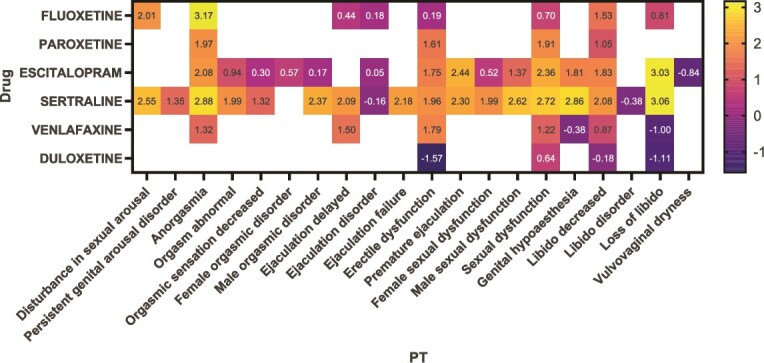
Results: Comparative analysis of antidepressant-related adverse events in the FAERS database showed that while sexual dysfunction was associated with all studied SSRIs/SNRIs (sertraline, citalopram/escitalopram, paroxetine, fluoxetine, venlafaxine, and duloxetine), symptom profiles varied markedly. Sertraline presented the most diverse array of sexual dysfunction manifestations, contrasting with duloxetine's relatively restricted adverse effect profile.
Clinical implications: This study provides valuable real-world evidence to assist clinicians in optimizing antidepressant selection, proactively identifying high-risk populations for sexual dysfunction, and improving patient compliance and quality of life during antidepressant treatment.
Strengths and limitations: The use of FAERS offers large-scale real-world data on antidepressant-related sexual dysfunction to enhance generalizability. But the limitation is FAERS' passive surveillance nature, which may involve underreporting or insufficient clinical context, restricting causal inference.
Conclusion: While previous studies have not fully elucidated antidepressant-related sexual dysfunction, our findings delineate distinct sexual adverse effect profiles between SSRIs and SNRIs, contributing valuable evidence for personalized treatment approaches.
期刊介绍:
Sexual Medicine is an official publication of the International Society for Sexual Medicine, and serves the field as the peer-reviewed, open access journal for rapid dissemination of multidisciplinary clinical and basic research in all areas of global sexual medicine, and particularly acts as a venue for topics of regional or sub-specialty interest. The journal is focused on issues in clinical medicine and epidemiology but also publishes basic science papers with particular relevance to specific populations. Sexual Medicine offers clinicians and researchers a rapid route to publication and the opportunity to publish in a broadly distributed and highly visible global forum. The journal publishes high quality articles from all over the world and actively seeks submissions from countries with expanding sexual medicine communities. Sexual Medicine relies on the same expert panel of editors and reviewers as The Journal of Sexual Medicine and Sexual Medicine Reviews.

 求助内容:
求助内容: 应助结果提醒方式:

 京公网安备 11010802042870号


