{"title":"Dose Prediction Deep Learning-Based Model for VMAT of Prostate Cancer Applying Magnetic Resonance Image (MRI) in Versa HD Linear Accelerator.","authors":"Hossein Taheri, Mohammadbagher Tavakoli, Khadijeh Mousavi, Hamed Taheri, Sheyda Lafz Lenjani, Maryam Farghadani","doi":"10.4103/abr.abr_180_25","DOIUrl":null,"url":null,"abstract":"<p><strong>Background: </strong>Prostate cancer patients are commonly undergoing Radiotherapy (RT) and treatment planning system have a prominent role for dose calculation, while this would seem that dose distribution uncertainties of treatment planning system (TPS) may effect on RT results. Therefore, this study aimed to design a Dose prediction deep learning-based model for prostate cancer volumetric arc therapy (VMAT) applying MRI in Versa HD linear accelerator (linac).</p><p><strong>Materials and methods: </strong>In this work, MRI of 45 patients who underwent VMAT was acquired, and cycle-consistent GAN (CycleGAN) (that allow image-to-image translation) and U-net deep learning (DL) framework for prostate were employed. The synthetic CT (sCT) images were generated from MR images. The predicted dose among CycleGAN, U-net and Monaco TPS (that calculate dose distribution based on CT simulation images) was compared to each other.</p><p><strong>Results: </strong>The sCT that was generated employing CycleGAN illustrated more obvious boundaries than the sCT of U-net (sCTU-net). The gamma passing rate of cycleGAN and U-net was exceeded 97% and 90%, respectively, in all areas.</p><p><strong>Conclusion: </strong>The results of this study illustrates that deep learning models including CycleGAN and U-net are good alternative for dose prediction of VMAT in Versa HD linac, while it seems that CycleGAN may be more accurate compared to U-net.</p>","PeriodicalId":94292,"journal":{"name":"Advanced biomedical research","volume":"15 ","pages":"14"},"PeriodicalIF":1.0000,"publicationDate":"2026-02-27","publicationTypes":"Journal Article","fieldsOfStudy":null,"isOpenAccess":false,"openAccessPdf":"https://www.ncbi.nlm.nih.gov/pmc/articles/PMC13004309/pdf/","citationCount":"0","resultStr":null,"platform":"Semanticscholar","paperid":null,"PeriodicalName":"Advanced biomedical research","FirstCategoryId":"1085","ListUrlMain":"https://doi.org/10.4103/abr.abr_180_25","RegionNum":0,"RegionCategory":null,"ArticlePicture":[],"TitleCN":null,"AbstractTextCN":null,"PMCID":null,"EPubDate":"2026/1/1 0:00:00","PubModel":"eCollection","JCR":"Q4","JCRName":"MEDICINE, RESEARCH & EXPERIMENTAL","Score":null,"Total":0}
引用次数: 0
Abstract
Background: Prostate cancer patients are commonly undergoing Radiotherapy (RT) and treatment planning system have a prominent role for dose calculation, while this would seem that dose distribution uncertainties of treatment planning system (TPS) may effect on RT results. Therefore, this study aimed to design a Dose prediction deep learning-based model for prostate cancer volumetric arc therapy (VMAT) applying MRI in Versa HD linear accelerator (linac).
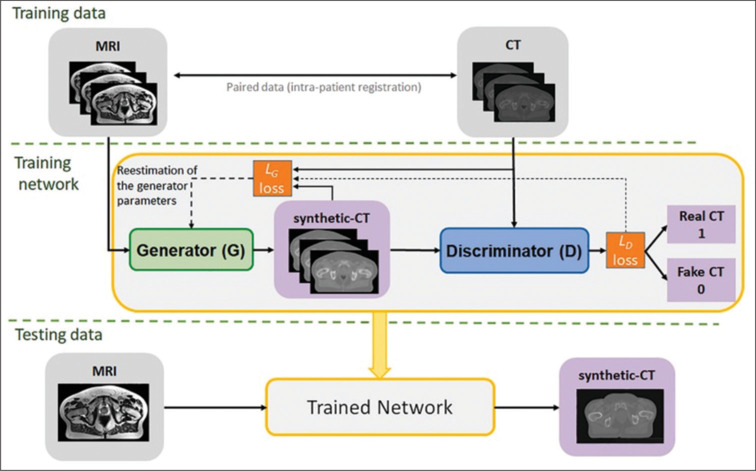
Materials and methods: In this work, MRI of 45 patients who underwent VMAT was acquired, and cycle-consistent GAN (CycleGAN) (that allow image-to-image translation) and U-net deep learning (DL) framework for prostate were employed. The synthetic CT (sCT) images were generated from MR images. The predicted dose among CycleGAN, U-net and Monaco TPS (that calculate dose distribution based on CT simulation images) was compared to each other.
Results: The sCT that was generated employing CycleGAN illustrated more obvious boundaries than the sCT of U-net (sCTU-net). The gamma passing rate of cycleGAN and U-net was exceeded 97% and 90%, respectively, in all areas.
Conclusion: The results of this study illustrates that deep learning models including CycleGAN and U-net are good alternative for dose prediction of VMAT in Versa HD linac, while it seems that CycleGAN may be more accurate compared to U-net.


 求助内容:
求助内容: 应助结果提醒方式:

 京公网安备 11010802042870号


